Do not confuse Imbolc with Candlemas. Candlemas is February 1st. Imbolc means in the belly, or quickening. This festival is the beginning of the wheel of the year in this tradition. It is the time of the stirring of life within the Mother Goddess. The Goddess Brigit is associated with this time of year. Brigit's bed is a tradition of this time of year. A corn dollie is dressed in cloth and made to look like a woman. A bed is made for the corn dollie. The bed and the corn dollie are then placed on the fireplace at Imbolc. Women would then call to Brigit. This is a welcoming to the Goddess Brigit. Some say that a phallic symbol was placed by the bed. If there was an imprint of a phallic symbol in the ashes of the fireplace, then it would be a good year. If the Christmas tree was still green at this time it was also said to be a good or fruitful year. Spring cleaning, or the taking out of the old was done at this time. Omens are taken at this time of year, especially on Candlemas for example, (Groundhog's Day February 1st.) The festival of Lupercalia, or Valentine's Day (February 14th), came in the middle of February. It is known as the love chase. It is a time when hope and love are renewed.
As the days' lengthening becomes perceptible, many candles are lit to hasten the warming of the earth and emphasize the reviving of life. "Imbolc" is from Old Irish, and may mean "in the belly", and Oimelc, "ewe's milk", as this is the lambing time. It is the holiday of the Celtic Fire Goddess Brigid, whose threefold nature rules smithcraft, poetry/inspiration, and healing. Brigid's fire is a symbolic transformation offering healing, visions, and tempering. Februum is a Latin word meaning purification -- naming the month of cleansing. The thaw releases waters (Brigid is also a goddess of holy wells) -- all that was hindered is let flow at this season.
Eostar (Spring Equinox) March 21-23
This time of year is also the time of the Christian Easter, ( the first Sunday after the first full moon after Spring Equinox.) Spring Equinox is a celebration of life, of rebirth, a return of life to the earth, and the return of the dead king. Eostara is the Spring Goddess associated with this festival. The egg and the hare (rabbit) are sacred to her. The egg, the white, is a symbol of the Goddess, and of the God within her womb (the yolk) The gathering of eggs comes from the time when people would harvest the eggs of wild birds, which are pastel in color. The people would also use the nests as a basket to carry the eggs in. The Easter bunny and the hiding of colored eggs both come from this festival. Spring is the time when the animals come out of hibernation. It is also the time when new life in nature is born, and conceived. The saying, Madder than a March hare, comes from rabbits, which come into heat in early Spring.
Day and night are equal as Spring begins to enliven the environment with new growth and more newborn animals. Many people feel "reborn" after the long nights and coldness of winter. The Germanic Goddess Ostara or Eostre (Goddess of the Dawn), after whom Easter is named, is the tutelary deity of this holiday. It is she, as herald of the sun, who announces the triumphal return of life to the earth. Witches in the Greek tradition celebrate the return from Hades of Demeter's daughter Persephone; Witches in the Celtic tradition see in the blossoms the passing of Olwen, in whose footprints flowers bloom. The enigmatic egg, laid by the regenerating snake or the heavenly bird, is a powerful symbol of the emergence of life out of apparent death or absence of life.
Beltane May 1st
This is the time of the May King and Queen. The May King was elected for seven years. After this time he was sacrificed. The May King represented the God of Life. This time of year is also the time of the sacred marriage between the God and the Goddess. Because of this, it is said to be unlucky for mortals to get married in May. The weaving of the May pole is a symbol of the sexual union between the God and the Goddess, and the pole itself is a phallic symbol. The interweaving of the colors is both intercourse, and the weaving of life. The legend of the Goddess Sybil is also associated with the May pole. The red streamers are the blood of the God, and the white streamers are the shroud in which the Goddess Sybil wrapped him. Beltane is the blending of the Maiden aspect into the Mother aspect. Because of the Maiden going full into the Mother, this is a strong fertility time.
Recipe for Maywine: 1 Gallon White Wine
1 Pint Strawberry Wine or Liqueur
1/2 oz Woodruff
As the weather heats up and the plant world burgeons, an exuberant mood prevails. Folk dance around the Maypole, emblem of fertility (the name "May" comes from a Norse word meaning "to shoot out new growth"). May 1st was the midpoint of a five-day Roman festival to Flora, Goddess of Flowers. The name "Beltaine" means "Bel's Fires"; in Celtic lands, cattle were driven between bonfires to bless them, and people leaped the fires for luck. The association in Germany of May Eve with Witches' gatherings is a memory of pre-Christian tradition. "Wild" water (dew, flowing streams or ocean water) is collected as a basis for healing drinks and potions for the year to come.
Midsummer (Litha or Summer Solstice)
This is the greatest time for the God in the wheel of the year. At this time, he is at his peak. The Goddess is in full bloom at this time of year. She is full of strength, sexuality, and she is with child. This is also the time of year for the ritual battle between the Holly King and the Oak King. This time, the Holly King conquers the Oak King. This is the longest day, and the shortest night. The days grow shorter from this time on until Yule. It is thought that if a woman walked naked through the fields during Midsummer, a good harvest will be ensured. Any deity associated with fire is appropriate for this festival. Also, the colors of red, yellow and gold are appropriate at this festival.
On this day, the noon of the year and the longest day, light and life are abundant. We focus outward, experiencing the joys of plenty, tasting the first fruits of the season. In some traditions the sacred marriage of the Goddess and God is celebrated (in others, this is attributed to the springtime holidays). Rhea, the Mountain Mother of Crete, has breathed out all creation. It is also the festival of the Chinese Goddess of Light, Li.
Lammas August 1st
Lammas means Loaf Mass. It is the time of the first harvest. It is also the Mass of the Corn Harvest. This is the time of the killing of the Corn King-John Barleycorn. This festival is also called Lughnasadh in honor of the God Lugh. The sickle and the scythe represent the Goddess because they are in the shape of the Lunar crescent. The pitch fork represents the Horned Lord. The combination of the pitchfork and the sickle/scythe bring about the harvest. If all of the grain was harvested, a corn dollie was made to house the spirit of the grain in order to honor and preserve it.
This festival has two aspects. First, it is one of the Celtic fire festivals, honoring the Celtic culture-bringer and Solar God Lugh (Lleu to the Welsh, Lugus to the Gauls). In Ireland, races and games were held in his name and that of his mother, Tailtiu (these may have been funeral games). The second aspect is Lammas, the Saxon Feast of Bread, at which the first of the grain harvest is consumed in riutal loaves. These aspects are not too dissimilar, as the shamanic death and transformation of Lleu can be compared to that of the Barley God, known from the folksong "John Barleycorn". This time is also sacred to the Greek Goddess of the Moon and the Hunt, Artemis.
Mabon (Autumn Equinox) September 21-23
This festival is named after the Queen of the Fairy folk, Mabe. The name is also attributed to the Goddess Mave. This is the festival of the middle, and biggest, harvest. It also honors the waning power of the Sun. This time of year is the rest after the harvest. It is also the time of the Eleusian mysteries. These are the mysteries of Demeter and Persephone; the mysteries of life, death, and rebirth.
This day sees light and dark in balance again, before the descent to the dark times. A harvest festival is held, thanking the Goddess for giving us enough sustenance to feed us through the winter. Harvest festivals of many types still occur today in farming country, and Thanksgiving is an echo of these.
In this way the Wheel turns, bringing us back to Samhain where we began our cycle. Many of the festival days coincide with holidays of the Jewish and Christian calendars. This is no accident; these points in the year were important community celebrations, and were kept largely intact although they were rededicated to the Christian God or a saint. The names may have changed, but the old Pagan practices still show through.
Samhain October 31st
This festival is the time of the Crone and the Sage. The Crone is the guarantee of life after death. On this night, the veil between the worlds is at its thinnest. This is the only night in which it is safe to walk within the fairy realm. On this night, the fairies can walk into our realm, and we can walk into theirs in safety. All veils to all realms are open at this time. For this reason, the dead are able to walk among the living on this night. It is traditional to leave a candle burning in the window to guide the dead back to their home. This time of year is also the sacred mating of the Dagda and the Morrigan. In Ireland, this day is the Day of the Banshee. In Scandinavia, the Rites of Hel are celebrated. The man in black is played by the High Priest. He is robed and hooded. He was never seen, and his identity was kept secret. All crops must be gathered by this night. All that is left is a gift to the Pooka, who appears as an ugly black horse. The Pooka is a shape shifting hobgoblin who likes to torment humans.
The night lengthens and we work with the positive aspects of darkness in the increasing star- and moonlight. Many Craft traditions, following the ancient Celts, consider this the eve of the New Year (as day begins with sundown, so the year begins with the first day of Winter). It is one night when the barriers between the worlds of life and death are uncertain, allowing the ancestors to walk among the living, welcomed and feasted by their kin, bestowing the Otherworld's blessings. We may focus within ourselves to look "through the glass darkly", developing our divination and psychic skills.
Yule December 21-23
Yule means wheel. Yule is the solar festival that tells of the Sun's rebirth, and is also the last time of the
Crone. It is the end of our year in this tradition. Christians took the ideas of Yule and changed it for their religion into Christmas. Yule is the time of the conquering of the Holly King (God of the waning year) by the Oak King (God of the waxing year.) At this time of year the Goddess, in her Crone aspect, is known as The Queen of Cold Darkness, The White Lady, and The Snow Queen. Most Christmas traditions are Pagan customs. The Christmas tree for example, is a sign of bringing life into the home. In fact, the early church forbade people to bring trees into their homes at Christmas because of its pagan connections. Pine and fir trees are symbolic of life after death and of resurrection. Decorating the home was also another way to bring life inside during the cold death of winter. The giving of gifts to family and friends, another pagan tradition, honors the god of death, Saturn. The three wise men can be attributed to the God in his sage aspect. The tradition of the Yule log, usually Oak, brings the bonfire within the home. They are decorated with light and greenery. The ashes, or part of the log itself is kept until the next year. The Yule log was to be burn all night long in order to burn away the old year. Even Santa Claus has pagan origins. He is sometimes associated with the Sun riding across the sky, and the eight reindeer represent the eight Sabbats of the year. The tradition of kissing under the mistletoe comes from the orgies that were held at Yule in groves under the mistletoe. The mistletoe berry, which is white, is seen as the semen of the God. Similarly, the holly berry, which is red, is seen as the menstrual blood of the Goddess. Wreaths are attributed to the Goddess, because anything round is a symbol of the Goddess and of completion.
The sun is at its nadir, the year's longest night. We internalize and synthesize the outward-directed activities of the previous summer months. Some covens hold a Festival of Light to commemorate the Goddess as Mother giving birth to the Sun God. Others celebrate the victory of the Lord of Light over the Lord of Darkness as the turning point from which the days will lengthen. The name "Yule" derives from the Norse word for "wheel", and many of our customs (like those of the Christian holiday) derive from Norse and Celtic Pagan practices (the Yule log, the tree, the custom of Wassailing, et al).
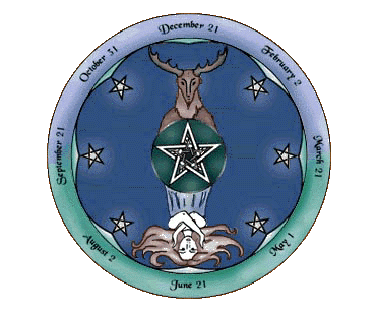
To the ancients, the Heavens appeared to wheel overhead, turning on an axis which points to the north polar stars. At the crown of the axis, a circle of stars revolved about a fixed point, the Celestial Pole, which was believed to be the location of Heaven. At the base of the axis was the Omphalos, the circular altar of the Goddess' temple. The universe of stars turning on this axis formed a spiral path, or stairway, on which souls ascended to Heaven.
This Sun-wise, clockwise, or deosil (Gaelic), motion of the spirals represented the Summer Sun. The continuous spirals with seemingly no beginning or end signified that as one cycle ended another began - eternal life. The spiral's never-ending, always expanding, motion also symbolized the ever- increasing nature of information and knowledge. Many of these symbols often also appeared in triplicate, a sign of the divine.
In addition, the seasons of the year were thought to be part of this cycle. In Gaelic, the names of the four seasons date back to pre-Christian times: 1) Earrach for "Spring," 2) Samhradh for "Summer," 3) Foghara for "Harvest" which refers to Autumn, and 4) Geamhradh for "Winter." (Ross)
The Celtic Wheel has two main fire festivals for purification and good fortune: Samhain and Beltane the beginning of Winter and the beginning of Summer. To the Celts, and most pastoral cultures, the year actually had two seasons instead of four. Subtler divisions of the year concerned crop-raisers rather than cattle-raisers. The Druidic tradition also celebrates two other fire festivals: Imbolc, and Lammas. Five additional sabbats have since been adopted from the Wiccan tradition (listed here by their Druidic names where possible): Alban Arthuan (Winter Solstice), Alban Eiler (Vernal Equinox), Ostara, Alban Heruin (Summer Solstice), and Alban Elued (Autumnal Equinox). Many Pagans, Druid and Wiccan alike, celebrate all nine festivals on the wheel.
Samhain
(pronounced Souw-wee, or in Scots-Gaelic, Sha- vin) After the last apples are picked the year begins again with its dark winter half when the Earth rests and fertility is renewed. Also called Samhiunn or Hallowe'en, this festival is sometimes called Trinoux Samonia or "Three Nights of the End of Summer." Originally a Druidic festival, it is celebrated on the eve of November 1 (October 31). Technically, either date is appropriate as the Celts measured the day from sunset to sunset. In the Celtic tale The Wasting Sickness of Cuchulainn, it is celebrated for a total of seven days - three days before, the day of, and three days after.
Samhain is a time when spirits can mix freely with humans, when the veil of the Otherworld, or the Siacutedh, is thin. The Siacutedh, also called Faerie Hills, are the special dwelling places of the Otherworld spirits, such as the mound at Brugh na in Newgrange, Ireland. This suspension of Time extends to the laws of society, so that all kinds of boisterous behavior can be indulged in. At the end of the festival, several beasts are sacrificed who life-energy goes to replenish the dormant soil. In origin, Samhain was a pastoral festival, held to assist the tribe's fertility, to placate the dead and evil forces, to please the gods (and later the Saints who replaced them) and as a clear distinction between the joys of Harvest and the hardships of the approaching Winter.
The assemblies of the five Irish provinces at Tara Hill, the seat of the Irish king, took place at Samhain, marked by horse races, fairs, markets, pastoral assembly rites, political discussions and ritual mourning for the passage of Summer. In the Christian tradition, these two dates are celebrated as All Souls' Day and All Saints Day.
Rituals
In the Scottish Highlands, many crofts had their own bonfire, or samhnag, but one house was usually a popular gathering place. In early Celtic tradition, Samhain was closely associated with burial mounds, or cairns, which were believed to be entrances to the Otherworld. Ross cites an example in Fortingall (in Perthshire), a samhnag was built on a mound known as Carn nam Marbh, "The Mound of the Dead." Local lore has it that the mound contained the bodies of plague victims and is, in fact, a Bronze Age tumulus. A stone, known as the Clach a' Phaigh, the Plague Stone, crowned the mound. Once the bonfire was lit, the participants would join hands and dance around it, both Sun-wise and anti-Sun-wise. As the blaze waned, the younger attendants would take part in leaping games over the flame. No guises appeared in this particular tradition, the bonfire was the sole center of attention. In the Highlands, after Sunset many of the youth carried a blazing torch and circuited the boundaries of their farms in order to protect the family from the Faeries and malevolent forces. New fire, kindled from the sacred communal blaze, was then brought into each house. Like the Beltain fire, the Samhain bonfire was most likely made from tein-eigin, fire made from the friction of two pieces of wood.
Winter Solstice
The Winter Solstice, or Alban Arthuan (The Light of Arthur), also is referred to as Yule, Mabon, Jul, Saturnalia, or even Christmas. This feast takes place on or about December 21 and marks the longest, darkest night of the year. This is a festival of peace and a celebration of waxing solar light. Many honor the forthcoming Sun child by burning an oaken Yule log, and honor the Goddess in her many Mother aspects. The Father God also can be honored as Santa Claus in his Old Sky God, Father Time, and Holly King forms. Winter symbolizes the time in the womb a deep rejuvinative sleep, rather than nature's death. It also points to how the ancients looked upon human death as a necessary pathway to rebirth.
Because the exact date of the birth for Jesus Christ is unknown, some believe the Church assigned it to this time, a date already sacred to the Ancients. Christians celebrate His birth on December 25.
Imbolc
Celebrated on or around February 1, Imbolc is also known as Oimelc, Brigid, Candlemas, or even in America as Groundhog Day. This mid-Winter feast day symbolizes the first stirring of the Earth from its icy sleep and was the time for caring of the sheep in ancient Britain. In the Mother- Goddess tradition, this day is the festival of the goddess Brigid or Brigantia, patroness of poetry, healing and metalsmithing, rekindles the fire in the Earth, preparing it for new life. During this time Brigid personifies the bride, virgin or Maiden. Brigid also is the protectress of women in childbirth. In the Christian tradition, this day is celebrated, as St. Brigid's Day.
This stirring of new life is manifested by the first milk of the ewes, a few weeks before the lambing season. As the foundation for the American Groundhog Day, Brigid's snake comes of its mound in which it hibernates and its behavior is said to determine the length of the remaining Winter. The Brythonic Celts came to associate Brigantia with the Virgin Mary, leading to such names for the feast as Gwyl Mair Dechrau'r, "The Feast of Mary of the Beginning of Spring".
An ancient Irish story tells of how on the eve of this day, the Cailleach, or White Lady, drinks from the ancient Well of Youth at dawn. In that instant, she is transformed into her Maiden aspect, the young goddess called Brigid. Wells were considered to be sacred because they arose from oimbelc (literally in the belly) or womb of Mother Earth. Vernal Equinox.
Also called Alban Eiler, which means "Light of the Earth, the Vernal, or Spring, Equinox takes place on or about March 21. An equinox refers to the time of the year when the sun crosses the plane of the Earth's Equator, making night and day equal length all over the planet. Crops were typically sown at this time, a time of transition. This rare balance in nature represented a powerful time of magick to the ancients.
Ostara
Also known as Lady Day or Eostre, Ostara takes place on the first full moon after the Vernal Equinox and marks the fullness of the Earth and the triumph of the Sun over Winter. In the Celtic tradition, it signified the period when the Sun and the Earth mate to produce crops. It is thought that the Church's feast of Easter, when Jesus Christ rose from the dead, is named after this feast. Prior to Easter, the Church prepares with the Lenten season, a time of meditation and sacrifice.
Beltane
(pronounced Bee-YAWL-tinnuh)
Beltane, one of two Celtic fire festivals, is a celebration of the return of life and fertility to the world which takes place on April 30. It is sometimes referred to as Cetsamhain which means opposite Samhain. In the Celtic countries the festival was known by other names, such as Beltaine in Ireland (which means in Irish Gaelic May), Bealtunn (which means in Scots-Gaelic May Day) in Scotland, Shenn do Boaldyn on the Isle of Man and Galan Mae in Wales. The Saxons called this day Walpurgisnacht, the night of Walpurga, goddess of May. Like Brigid, the Church changed this goddess into St. Walpurga and attached a similar legend to her origin. Also known as May Eve (likewise May 1 is referred to as May Day), this festival marks the beginning of Summer the growing season.
The word Beltaine literally means bright or brilliant fire, and refers to the bonfire lit by a presiding Druid in honor of the proto-Celtic god variously known as Bel, Beli, Balar, Balor or Belenus. Bel, the god of light, fire and healing, had Sun-like qualities, but was not purely a Sun god as the Celts were not specifically Sun worshippers.
It has been suggested that Bel is the Brythonic Celt equivalent to the Goidelic Celt god Cernunnos. Both Bel and Cernunnos represent the belief that the Great Father impregnates the Great Mother. Some also believe that the mythological king in the story of Lludd and Llefelys in The Mabinogion, Beli Mawr is a folk memory of this god.
At Beltane, the Horned One, the God, dies or is taken by the Goddess, only to be reborn as her son. He then reclaims his role as consort and impregnates the Goddess, sparking his own rebirth. It is important to remember the mindset of the ancients: nothing can live without death; the ancients understood and accepted the taking powers in life in order to obtain the benefit of the giving powers. Through this rite, the Goddess also is transformed from the taking Crone to the virginal Maiden or Sister, and again to Mother, a giving goddess.
Other beliefs tell of the Summer God being released from captivity, or the Summer Maiden wooed away from her Earth-giant father. The Hawthorne tree represents the giant and sometimes this wood is used for the Maypole (see below).
In Irish mythology, the great undertakings of the Tuatha Danann and the Milesians the original supernatural inhabitants of Eiru and their human conquerors, respectively - began at Beltane. The Milesians were led by Amairgen, son of Mil, in folklore reputed to be the first Druid.
Rituals
Two bonfires were kindled by a presiding Druid most likely from tein-eigin, fire made from the friction of two pieces of sacred wood, most likely an Oak-plank. This fire originally symbolized the sacrifice of the Oak-god. Oak is the tree of the God of the Waxing Year and Hawthorne is the tree of the White Goddess.
In ancient Ireland, no one could light a Bel-fire until the Ard Ri, High King, had lit the first on Tara Hill. In 433 A.D., St. Patrick showed his deep understanding of this festival's symbolism when he lit a fire on Slane Hill, ten miles from Tara, before the High King Laoghaire lit his. He could not have made a stronger usurpation of the people's faith. St. David made a similar gesture in Wales in the following century.
The Druids, the powerful Pagan Celtic priests, would drive the cattle between these two fires to protect them from disease ensuring a high milk yield, and the powers of darkness.
Sometimes, a procession was made around the fields with a burning torch of wood in order to obtain a blessing on the corn.
On this day, all hearth-fires were extinguished to be rekindled from this sacred fire.
A May Pole fertility dance also took place. A pole, a phallic symbol for the God, was made usually from a Yule tree, its branches stripped and then planted into the Earth. Red and white ribbons were attached to its top. In the Goddess tradition, the white ribbons stood for the Goddess, red for the God. Men and women danced around the pole, holding onto the ribbons and interweaving them as they went round.
The King Queen of May were also elected stand-ins for the God and Goddess and led the festival. One telling explains that the Queen would ride in on a white horse and the King on a black one. The Goddess on a white horse has a powerful association in Celtic mythology. When Niamh of the Golden Hair came to take Oissin away to the Land of Promise, it is upon a white steed that she rode. Rhian Gabhra, or Rhiannon of the Gaels, rides a white mare in the Otherworldly realms. In both Welsh and Irish traditions the white mare is representative of the Goddess in the Otherworld.
The ancients would also then go and make love on the ground considered a form of magic, prompting the crops to be fertile.
Another, similar rite that took place at Beltane is called the bringing in the May. The youth would go out into the fields and collect flowers. They would often spend the night in the wood, which resulted in many greenwood marriages, handfastings. In the village, they would stop at each home and exchange the flowers for food and drink. Thus, they became the harbingers of the renewal of the Earth. This rite also represented the need of the tribe to share their belongings, sustaining the entire population as a result.
On May Eve people would tear branches from a Hawthorn tree and decorate the outside of their homes. The Hawthorn, or Whitethorn, is the tree of hope, pleasure and protection. The strong taboo on breaking Hawthorne branches or bringing them into the home was traditionally lifted on May Eve.
Another custom would be to jump over the fire. Young people jumped the fire for luck in finding a spouse, sojourners jumped the fire to ensure a safe journey, and pregnant women jumped the fire to assure an easy delivery.
On May 1, the entire tribe, village or clan would lead the cattle to the Summer buailte (pronounced booa-ltuh) or pastures until Samhain.
Alban Heruin, or The Light of the Shore, also is referred to as Litha or Midsummer's Day. This feast takes place on June 21 and marks the shortest, brightest night of the year. The Summer Solstice marks the Earth's full-flowering. Midsummer's Day was traditionally celebrated out in the forest and involved masquerades, picnics, games, and, at night, a bonfire to cut the chill.
Lammas
Traditionally called Lammas from the Saxon word Hlaf-mass, the Feast of Bread, this festival is also known as Lughnasadh, Lughnasa (pronounced Loo-nahs-ah), or First Fruits, and is the feast of the god Lugh. Celebrated on August 1, it coincides with the beginning of the harvest and signifies the death of Bel, or the Corn King. The Corn King dies, to be later reborn, so that the tribe may go into the winter months with sustenance plenty. Another myth tells of the greedy Fomorian Earth-spirits that must be persuaded to relinquish the fruits of the soil to humans.
Rituals
Farmers cut down the first stalks of corn with sickles and called these stalks John Barleycorn. This first grain is used to produce the first beer of the season, for consumption at the Autumnal Equinox six weeks later.
In the British Isles, the Horned One was thought to be the consort of the Earth Goddess. (see Beltane explanation) Harvest festivals usually included a Stag Dance in which men wore antlers on their heads.
Autumnal Equinox
Alban Elued, The Light of the Water," also is called Harvesthome. This feast takes place on September 21 and marks the last harvest before Winter claims the Earth. As with the Vernal Equinox, day and night are of equal length across the planet. This balance in nature presents a powerful time for magick.
To the ancients, this was a sacred time. The Irish saw this time of year as the Waning of the Goddess. From the Summer to the Winter Solstice they would hold festivals for the God - who was seen as a dark, threatening being. To the Goidelic Celts, the spring was the time of joy in the rebirth of the Goddess. To Brythonic Celts, however, this was the time of the death of the God (the Sun or the Grain God).