| THE OGHAM The Ogham system of divination (often pronounced Owam or Ohm, as in the mantra) was created in about 600 BC and has been used by many different Celtic peoples from that date up to the fourteenth century. Its use survives in the form of folk poetry and there are many who find it an inspiration and guide today. It is a sure and safe road that never falters. The letters of the Tree alphabet were commonly cut as a series of nicks on the edges of squared-up wooden laths or sticks to form strokes across a straight line. A more advanced version made these sticks into a square frame, where each revolved at a touch and became a type of mantra - very similar to a Tibetan prayer wheel. Ogham was also carved on stones, using the edge of the stone as a stem line, with the letters usually reading from bottom to top. Some 360 such stones have survived in Ireland, Wales, southern England, the Isle of Man and Scotland. In the northeast of Scotland the inscriptions are in un-deciphered Pictish Ogham of the Dalriada, or Kingdom of Argyll. Initiates could secretly communicate with each other in Ogham by using it as a sign language. With Hand Ogham, communication could be effected by indicating the finger joints associated with each letter, or by forming the shapes of the letters by crossing fingers. Similarly, Nose Ogham and Shin Ogham used the five fingers of the hand to form the cross-strokes of the letters against the straight line of the nose or the shin bone. Obviously more complex ideas connected to the meanings behind the letters could be conveyed, rather than it being merely a matter of spelling. One could quite easily, in front of others, have an ordinary conversation with a person and at the same time send signals that were entirely different. In fact, this system of communication gave the Druids so much power that royal edicts were issued to prevent them conversing in Ogham. |
 |
 |
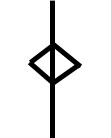
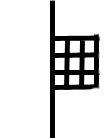
| The final five letters of Ogham, the fifth group, derived from Greek and supplying additional sounds that it had previously lacked. These, too were adapted for hand signing. Two crossed fingers show the sound EA (Koad) fingers and thumbs touching at their tips show the sound OI (Oir) two crossed fingers again represent the sound UI (Uilleand) a crooked finger is the sound IO (Phagos) four fingers of each hand laid across each other represent the sound AE (Mor�) Colin Murray |
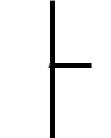
| Beth / Birch The silver birch (Betula pendula Roth) It is one of the first trees to colonize an area after a mature forest is cut; this is probably a large part of its symbolic connection with new beginnings. Birches are members of the Birch family (Betulaceae). Indicates: A new start and beginning, cleansing. Letter: B Color: white |
 |
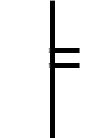
| Luis / Rowan The rowan, or mountain ash (Sorbus aucuparia L.) They grow to 50 feet and are members of the Rose family (Rosaceae). Indicates: Protection against enchantment, control of all the senses. Letter: L Color: gray and red |
 |
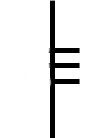
| Fearn / Alder The common alder (Alnus glutinosa (L.) Common along lowland rivers, where it grows with aspens, poplars, and willows. Like willows, alders sprout from stumps. Alders are members of the Birch family (Betulaceae). Indicates: Oracular and protective. Letter: F Color: crimson |
 |
| Saille / Willow Willows are members of the Willow family (Salicaceae). Indicates: Night vision, lunar rhythms, female aspects. Letter: S Color: bright colors |
 |
| Nuin / Ash The common ash (Fraxinus excelsior L.) Ashes are members of the Olive family (Oleaceae). Indicates: Inner and outer worlds linked, macrocosm and microcosm. Letter: N Color: glass green |
 |
| Huathe / Hawthorn All are thorny shrubs in the Rose family (Rosaceae), and most have whitish or pinkish flowers. The common hawthorn (Crataegus monogyna Jacq.) and midland hawthorn (Crataegus laevigata (Poiret) DC.) are both widespread. They are common in abandoned fields and along the edges of forests. Indicates: Cleansing and chastity, protection. Letter: H Color: purple |
 |
 |
|
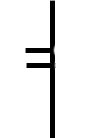
| Duir / Oak The oak of myth and legend is the common oak (Quercus robur L.). Oaks are members of the Beech family (Fagaceae). Indicates: Solid protection, doorway to the mysteries, strength. Letter: D Color: black and dark brown |
 |
| Tinne / Holly The holly (Ilex aquifolium L.) Graves (1966) and others are of the opinion that the original tinne was not the holly, but rather the holm oak, or holly oak (Quercus ilex L.).Like the holly, the holm oak has spiny-edged leaves on young growth. Indicates: Best in the fight. Letter: T Color: dark gray |
 |
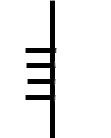
| Coll / Hazel The hazel (Corylus avellana L) Hazelnuts are in the Birch family (Betulaceae). Indicates: Intuition, straight to the source. Letter: C Color: brown |
 |
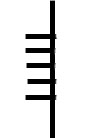
| Quert / Apple Most likely the European crabapple (Malus sylvestris Miller). Apples are in the Rose family (Rosaceae). Indicates: Choice of beauty. Letter: Q Color: green |
 |
|
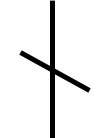
| Muin / Vine The grape (Vitis vinifera L.) Grapes are in the Grape family (Vitaceae). Indicates: Prophecy Letter: M Color: variegated |
 |
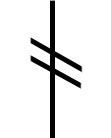
| Gort / Ivy Ivy (Hedera helix L.) A member of the Ginseng family (Araliaceae) Indicates: The spiral of the self, search for self. Letter: G Color: sky blue |
 |
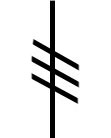
| Ngetal / Reed The common reed (Phragmites australis (Cav.) Trin. ex Steudel). Common reed is in the Grass family (Poaceae, or Gramineae). Indicates: Direct action. Letter: Ng Color: grass green |
 |
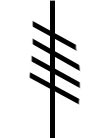
| Straif / Blackthorn The blackthorn (Prunus spinosa L.) They are members of the Rose family (Rosaceae). Indicates: No choice however unpleasant, cleansing. Letter: Ss Color: purple |
 |
| Ruis / Elder The common elder (Sambucus nigra L.) Elders are in the Honeysuckle family (Caprifoliaceae). Indicates: The end in the beginning and the beginning in the end. Letter: R Color: red |
 |
|
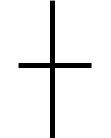
| Ailim / Silver Fir The silver fir (Abies alba Miller) They are members of the Pine family (Pinaceae). Indicates: High views and long sight. Letter: A Color: light blue |
 |
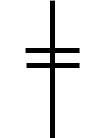
| Ohn / Furze Furze, or gorse (Ulex europaeus L.) A member of the Pea family (Fabaceae, or Leguminosae). Indicates: Good at collecting, a magpie. Letter: O Color: yellow, gold |
 |
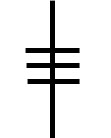
| Ur / Heather Heather (Calluna vulgaris (L.) Hull) A member of the Heath family (Ericaceae). Indicates: Links to inner self, all heal. Letter: U Color: purple |
 |
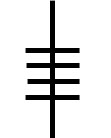
| Eadha / White Poplar The aspen (Populus tremula L.) Poplars are members of the Willow family (Salicaceae). Indicates: Helps rebirth, prevents illness. Letter: E Color: silver white |
 |
| Ioho / Yew The yew (Taxus baccata L.) The Yew family (Taxaceae). Indicates: Rebirth and everlasting. Letter: I Color: dark green |
 |
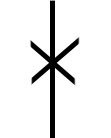
| Koad / Grove Containing various types of trees, among them the Oak, and by a stream. It is here all meetings by the Druids were held. Indicates: All knowledge, past, present and future. Letter: EA with the sound EA Color: many shades of green |
 |
|
| Oir / Spindle The Spindle tree (Euonymus atropurpureus, Euonymus Europoeus) The Celastraceae Family Indicates: Sweetness and delight, sudden intelligence. Letter: TH with the sound OI Color: white |
 |
| Uilleand / Honeysuckle Honeysuckle (Lonicera caprifolium) The Caprifoliaceae family Indicates: Hidden desires, secrets and the path to the search for the self. Letter: PE with the sound UI Color: white yellow |
 |
| Phagos / Beech Beech (Fagus sylvatica) The Corylaceae family Indicates: Old knowledge, old writing. Letter: PH with the sound IO Color: orange brown |
 |
| Mor� / The Sea The Sea (water) represents the lunar and the female, and it is a link between your place of birth and the lands to which you may have to go on your spiritual passage. Indicates: The sea, travel, maternal links. Letter: XI with the sound AE Color: blue green |
 |
| The Celtic Tree Calendar |
|
| Beth (Birch) December 24 to January 20 Luis (Rowan) January 21 to February 17 Nuin (Ash) February 18 to March 17 Fearn (Alder) March 18 to April 14 Saille (Willow) April 15 to May 12 Uath (Hawthorn) May 13 to June 9 Duir (Oak) June 10 to July 7 Tinne (Holly) July 8 to August 4 Coll (Hazel) August 5 to September 1 Muin (Vine) September 2 to September 29 Gort (Ivy) September 30 to October 27 Ngetal (Reed) October 28 to November 24 Ruis (Elder) November 25 to December 22 December 23 is not ruled by any tree for it is the traditional day of the proverbial "Year and a Day" |