| I Ching |
| In both the East and the West, the I Ching has had two distinct uses. The first, as a book of wisdom and second as a book or oracles. One asks a question and is pointed to an answer in one of the hexagrams. There are two methods used to ask the answer to a question. One method is to take three coins and tossing them six times to build a hexagram. Heads (yang) are assigned a value of 2, and tails (yin) are assigned a value of 3. Throwing the coins a total of six times, each throw will yield a total of 6,7,8,or 9. You can thus build a hexagram- always building from the bottom to the top- using 6s and 8s as yin, or broken lines and 7s and 9s as yang, or solid lines. Further, 6s are read as �old yin� lines (yins that are in the process of changing into yangs) and 9s are read as �old yang� lines (yangs that are in the process of changing into yins) |
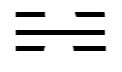
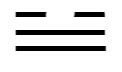
| Coin toss example: throw 1 = three heads, value 6 = old yin throw 2 = two head, one tail, value 7 = yang throw 3 = two tails, one head, value 8 = yin K�an throw 4 = three tails value 9 = old yang throw 5 = two heads, one tail, value 7 = yang throw 6 = two tails one head, value 8 = yin Tui |
 |
 |
 |
 |
 |
 |
|
|
| The graphic representation of the hexagram would look like this. |
| with changing lines included (keeping in mind the �old yin� and �old yang� lines as they allow a deeper reading into the meaning of your hexagram.) and like this to look up the hexagrams |
| changing to changing to |
|
|
|
|
|
|
|
|
|
|
| Tui above K'an above and K�an below and Tui below |
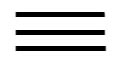
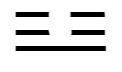
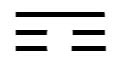
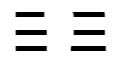
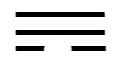
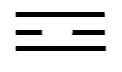
| The other method is a much more complicated traditional method using yarrow stalks. (This is the method I prefer above the coin toss) Starting with fifty yarrow stalks, cut a little longer than the width of your palm. One is put aside and plays no further part. The remaining 49 stalks are first divided into two heaps (at random) Take one stalk from the right-hand pile and put it between the ring finger and the little finger of the left hand. Then the left-hand pile is placed in the left hand, and the right hand takes from it bundles of 4, (placing them in a pile in front of you) until there are 4 or fewer stalks remaining. This remainder is placed between the ring finger and the middle finger of the left hand. Next the right-hand pile is placed in the left hand and also counted off by 4�s until there are 4 or less remaining. (placing them on the pile in front of you) This remainder is placed between the middle finger and the forefinger of the left hand. Count the number of stalks between the forefinger and the middle finger and add that to the number of stalks between the middle finger and the ring finger. This total will be 8 or less. If the sum is 4, 5 value = 3 If the sum is 8, 9 value = 2 Write the value down. Place all the stalks in the left hand to the side and divide the pile in front of you into two heaps again. Take one stalk from the right-hand pile and put it between the ring finger and the little finger of the left hand. Then the left-hand pile is placed in the left hand, and the right hand takes from it bundles of 4, (placing them in a pile in front of you) until there are 4 or fewer stalks remaining. This remainder is placed between the ring finger and the middle finger of the left hand. Next the right-hand pile is placed in the left hand and also counted off by 4�s until there are 4 or less remaining. (placing them on the pile in front of you) This remainder is placed between the middle finger and the forefinger of the left hand. Count the total number of stalks left in your left hand including the one stalk between the ring finger and the little finger. This total will be 8 or less. If the sum is 4, 5 value = 3 If the sum is 8, 9 value = 2 Write the value down. Once again: Place all the stalks in the left hand to the side and divide the pile in front of you into two heaps again. Take one stalk from the right-hand pile and put it between the ring finger and the little finger of the left hand. Then the left-hand pile is placed in the left hand, and the right hand takes from it bundles of 4, (placing them in a pile in front of you) until there are 4 or fewer stalks remaining. This remainder is placed between the ring finger and the middle finger of the left hand. Next the right-hand pile is placed in the left hand and also counted off by 4�s until there are 4 or less remaining. (placing them on the pile in front of you) This remainder is placed between the middle finger and the forefinger of the left hand. Count the total number of stalks left in your left hand including the one stalk between the ring finger and the little finger. This total will be 8 or less. If the sum is 4, 5 value = 3 If the sum is 8, 9 value = 2 Write the value down. Now, from the numerical values assigned to each of the three composite remainders, a line is formed. If the sum is 4 (value 3) + 4 (value 3) + 4 (value 3) the resulting numerical value is 9 the old or moving yang line. [pic] If the sum is 8 (value 2) + 8 (value 2) + 8 (value 2) the resulting numerical value is 6 the old or moving yin line. [pic] If the sum is 8 (value 2) + 8 (value 2) + 4 (value 3) or 5 (value 3) + 8 (value 2) + 8 (value 2) or 8 (value 2) + 4 (value 3) + 8 (value 2) the resulting numerical value is 7 the yang line. [pic] If the sum is 8 (value 2) + 4 (value 3) + 4 (value 3) or 4 (value 3) + 4 (value 3) + 8 (value 2) or 4 (value 3) + 8 (value 2) + 4 (value 3) the resulting numerical value is 8 the yin line. [pic] Repeat this method from the beginning 5 more times to receive the full 6 lines of the hexagram. always building from the bottom to the top When a hexagram consists entirely of nonmoving lines, the oracle takes into account only the idea represented by the hexagram as a whole. If there are one or more moving lines in the hexagram then the hexagram that is being moved into is also taken in consideration. The I Ching or Book of Changes The Richard Wilhelm Translation rendered into English by Cary F. Baynes Determining the Hexagrams |
 |
|
 |
|
 |
 |
 |
 |
|
|
|
|
|
|
|
|
| Ch'ien |
| Ch'ien |
| Chen |
| Chen |
| K'an |
| K'an |
| Ken |
| K'un |
| Sun |
| Li |
| Tui |
| Ken |
| K'un |
| Sun |
| Li |
| Tui |