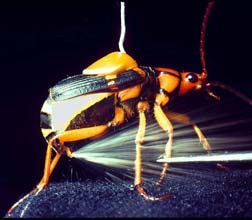
The Bombardier Beetle
Take the bombardier beetle for instance. The bombardier beetle is a small insect with an impressive defense: when threatened, it blasts irritating and odious gases out from two tailpipes at 100 degrees Celsius (212 degrees F). The beetle creates this explosive reaction by mixing together two dangerous chemicals (hydroquinone and hydrogen peroxide). To stop itself from blowing up, it also releases an inhibitor which also allows the beetle to store the chemicals indefinitely. When attacked by an enemy, the beetle releases it's chemical spray, then at just the right moment, it adds an anti-inhibitor, which neutralizes the inhibitor and allows the first two chemicals to blow up.
Now, according to evolution, this beetle must have spent millions of years with no protection against predators, being eaten into extinction, until it somehow accidently and simultaneously found the two chemicals to blow stuff up. It would have to have found them simultaneously, or "natural selection" would not give it sufficient reason to store one of them. Hydrogen peroxide in itself would not be any defense, it would just disinfect the predator. Then, it would spend another few million years blowing itself up before obtaining the third, protective chemical (unless of course it found all three chemicals at the same time, in which case they wouldn't do anything, so why bother using them?). Then after another few million years of being eaten by predators, it picks up the anti-inhibitor, and finally has their complete defense system (unless it found all four chemicals at the same time...in which case they would have blown up and not been of any use to the beetle). That's certainly logical, thinking that a beetle must blow itself up for millions of years in order to survive...except that if it blew itself up it would no longer exist to reproduce...but evolutionists tend to turn a blind eye to that.
Another life form that can disprove evolution has come to my mind now that it is spring in my part of the globe...The maple tree, or their seeds to be more precise. The maple tree's seed is made up of a germ (the centre part of the seed carrying the DNA), and the "wings" as I have called them. Each seed gets one wing, and when the seed is dropped, the wing gets caught in the air, twirling like a helicopter, until it hits the ground. This is an excellent way to disperse seeds, as I have occasionally seen maple seeds when there is no maple tree in sight, proving that the helicopter method can carry seeds substantial distances if the wind is strong enough. However, these seeds would not work unless they are fully formed; in other words, if evolution were true, the seeds would still just drop from the tree, no helicopter flying effects. The seeds would not work unless fully formed, and evolution does not allow for fully formed anything to happen on the first try, so according to evolution our maple trees drop their seeds straight to the ground. But wait a minute, I SEE them flying and twirling all over the place....But evolution says they drop straight to the ground, so they do, just ignore what you see.