Which came first?
There is also the second law of thermodynamics, AKA entropy.
Let us discuss the difference between a law and a theory (in scientific terms). A theory is an idea someone comes up with about how something works, such as Einstein's theory of relativity. It makes sense, but it has not been proven to be absolute. A law, however, is something that has been proven beyond a shadow of a doubt that it will hold true, such as the second law of thermodynamics.
What is the second law of thermodynamics?
The second law of thermodynamics says that every system left to its own devices always tends to move from order to disorder, its energy tending to be transformed into lower levels of availability, finally reaching the state of complete randomness and unavailability for further work. Simply put, energy becomes less useful with time. This is also known as entropy, which dictionary.com defines as "a quantitative measure of the amount of thermal energy not available to do work."
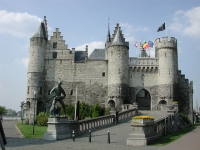
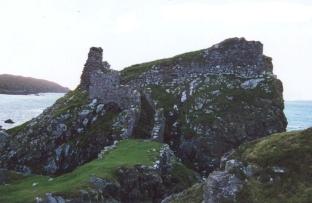
When all of this is considered, it is pretty simple to see that evolution would involve a complete reversal of the second law of thermodynamics. Think of it this way: which occurrs more often, a castle goes from ruin to grandeur, or from grandeur to ruin? Obviously a castle is not going to rebuild itself given time. It will continue to decay until it is absolutely useless.
And now, for a quote from an evolutionist site, trying to prove evolution does not defy thermodynamics:
Probability, as used in thermodynamics, means the probability that some specific change will occur. Probability is related to the thermodynamic concept of irreversibility. An irreversible physical or chemical change is a change that will not spontaneously reverse itself without some change in the surrounding conditions. Irreversible changes have a high degree of probability. The probability of an irreversible change spontaneously reversing itself without outside interference is zero.
When we say that a change is irreversible (in the thermodynamics sense) it means only that the change will not spontaneously reverse itself without some change in the surrounding conditions. It does not mean that it cannot be reversed by any means at all!
It is important to remember that a change that has a high degree of probability under one set of circumstances may have a very low degree of probability under a different set of circumstances. To illustrate: If the temperature drops below freezing, the probability of water becoming ice is very high. The change from water to ice is thermodynamically irreversible. If the surrounding temperature should happen to rise above the freezing point, the probability of water becoming ice, or remaining as ice, is zero. Under these conditions the reverse change of ice to liquid water is also thermodynamically irreversible." (The Second Law of Thermodynamics, Evolution, and Probability, by Frank Steiger)
"As will be shown later on, it is only the over-all entropy of a complete, or closed system that must increase when spontaneous change occurs. In the case of spontaneously interacting sub-systems of a closed system, some may gain entropy, while others may lose entropy. For example, it is a fundamental axiom of thermodynamics that when heat flows from subsystem A to subsystem B, the entropy of A decreases and the entropy of B increases. The statement that an increase in order can only occur as the result of a directional mechanism, program, or code is misleading. Any process that can be demonstrated to take place with an increase in order/decrease in entropy is arbitrarily deemed to be the consequence of an undefined "directional mechanism."
This argument to me seems a little desperate. The change from water to ice and back again is fairly simple, caused by changes that occurr in nature on a regular, yearly basis. These changes could hardly account for the amount of entropy reversal required to turn nonliving matter into a single celled organism, not to mention the evolution of that organism into what exists today. Also, his use of the example of heat from source A being transferred to source B to decrease entropy in one while increasing in the other was just a play on reference points. If you are looking only at B, entropy did decrease. If you are looking only at A, entropy did increase. But if you consider both, and their surroundings, not all of the heat made it to B, and some would have been lost as various other forms of useless energy, causing an overall increase in entropy.
The same can be said for the universe: taken as a whole, entropy is constantly increasing. At times it does appear that entropy decreases on Earth itself, as entropy decreased in source B in the above example, but simple interactions with meteors, comets, the sun, stars, the moon, the centre of the galaxy, and anything else you want to pull out of the cosmos simply is not enough to explain progression from inanimate to single celled, then to multicelled simple, and so on until the degrees of complexity that we see today are reached.
On a side note, the Frank Steiger (the author of the above quote) wrote at the bottom of his page that in order to stack three blocks on top of each other, "intelligent design is required, but stacking does not violate the laws of thermodynamics. The same relations hold for this activity as for any other activity involving thermodynamical energy changes. It is true that the blocks will not stack themselves, but as far as thermodynamics is concerned, all that is required is the energy to pick them up and place them one on top of the other. Thermodynamics merely correlates the energy relationships in going from state A to state B. If the energy relationships permit, the change may occur. If they don't permit it, the change can not occur."
He then goes on to admit that "On the other hand, thermodynamics does not rule out the possibility of intelligent design; it is just simply not a factor with respect to the calculation of thermodynamic probability." Although this is a significant admission, it is misguided: he made the assumption that all creationists say that evolution couldn't possibly overcome thermodynamics, while creation can. However, as in the example with the blocks, creation does not need to overcome thermodynamics, it just needs an inteligently guided force in order to work.
This is a long argument...try the next page