Melissa R. Benham is the author of codeswitching (Subday Press) and the chapbooks, repronounceable, surrealist object vs. narrated dream, and recounted. Her work has appeared in 3rd Bed, 3 therefore 2, Can We Have Our Ball Back?, El Pobre Mouse, How2, Fourteen Hills, One Less, Shampoo, Sleeping Fish, Small Town, The Stolen Purse, Watching the Wheels: A Blackbird and others. She holds an BA in creative writing from SF State and an MFA in writing & poetics from Naropa University's Kerouac School, and has studied with Diane di Prima, Andrew Schelling, Eleni Sikelianos, Anselm Hollo, Bhanu Kapil, Harryette Mullen, Michael Palmer, Joan Retallack, Anne Waldman (& others). Currently, Melissa curates Artifact: a monthly series of innovative writing with Chana Morgenstern at 2921B Folsom St. in San Francisco's Mission District (see www.artifactseries.blogspot.com) and publishes Artifact Press. Her present fascinations include the Swiss motion sculptor Jean Tinguely, the music of the Fiery Furnaces, and the work of Hannah Weiner. & now a lovely introduction to my work from my publisher, Kyle Kaufman (Subday Press): Melissa Benham is a poet who invites - insistently - a different way of reading, and hearing, text. Her poetry springs from a rich vein of the interior and discontinuous - not as an arty mode to exploit, but as a pressing and inescapable mode of being-in-the-world. Tiring of being labeled 'difficult' or 'obscure', Melissa once offered up her work as 'galactic': the word works. Not only have other outrider American artists, as diverse as Sun Ra, Robert Duncan, George Clinton and Harry Smith sought explicit inspiration in the cosmic harmonies of the universe - but the actual image of a galaxy, its step-outside-of-time (for we are told this image has traveled millions of years thru time and space), the strangeness of its actual journey (through all the cultural layers of telescopes, film development and computer renderings: if I look at the sky I will see stars, but nothing like what a photo of a galaxy displays) and its extreme condensation present us with something at first difficult to register: a world made of stars, and the space between them - and then- as it dawns - a pure marvel. By bringing her attention to the mind - to consciousness as it emerges and follows it quarry, the subject, through the crystallization of written language Melissa offers a intimate account of a normally unsighted territory. Listening to her work can be immensely rewarding, but the trick - a quite simple one - is simply to drop your expectations to 'have a handle' on the subject. Having heard her read many times, I have enjoyed it most fully to allow the work to be both foreign and familiar at once: her readings have the great beauty of eavesdropping on a conversation in another language, with all the rhythmic and dialogic intricacy, all the dramatic tension immediately palpable, but the specific narrative of what is being said, a secret to tease out, to allow to evade. And, as with this eavesdropping - which Melissa's work invites - there is some widening of our senses, some awakening of dormant knowledges and desires, even a stirring of compassion. By comparison, trying to chase down the "meaning" of her work, is like wandering in a maze with no exit. Her method is one of investigation - she follows junctures of openings, her work is one of learning and investigating. Only by repeated listenings, by giving yourself great space, can the themes - not hidden, but perhaps dormant, almost subliminal - emerge, in increasingly crystalline and fascinating forms. The deep and honest logic of her pages generously rewards such attention. |
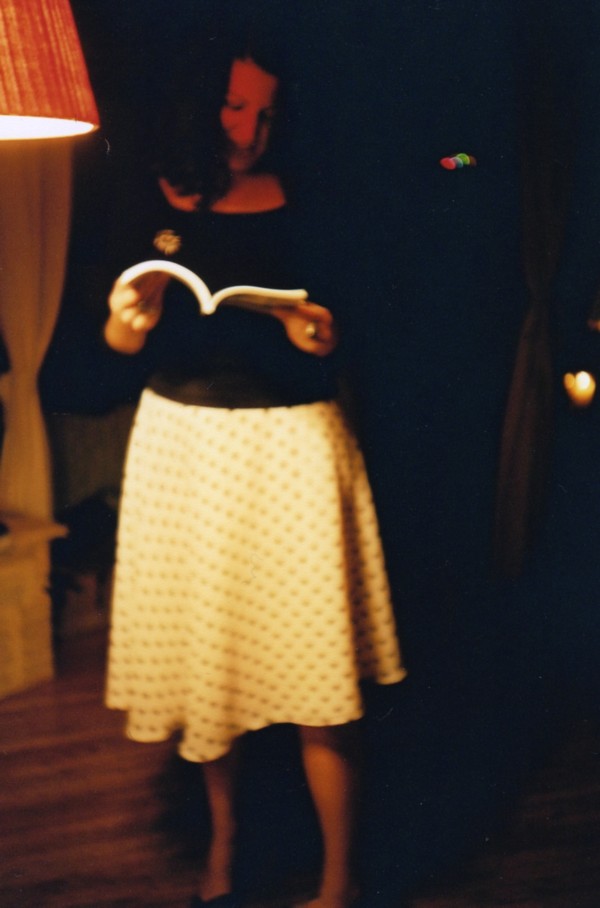
| about something like me: this picture was taken by jolie brown at our first artifact reading series in november 2004. |
 |