




The up�s and downs of importing a Capri from Europe, and how to do it.
By David Maughan, June 2006.
The up�s and downs of importing a Capri from Europe, and how to do it.
By David Maughan, June 2006.
Importing a �grey market� car into the US can be a maze of paperwork and can empty your savings account faster than a bad crack habit. However, for a few people having either a piece of their European youth (like myself) or just owning something that no-one else this side of the pond has is enough to make you try it.
I�ve lusted after two totally different cars since I was a child. Until now, I had owned both at different times of my life. The first is a Lotus Europa Special, and the second is a performance oriented Mk3 Ford Capri. Not the base model cars, but the big engined stiffly suspended ones! I drove Capri�s while in England before moving to the States in 1992. At that time, Mk3 Capri�s were just another used car, and could be had for next to nothing. Unfortunately, they came with a stigma. On British roads, if you heard squealing tires, or were passed at unreasonable speeds, you could almost bet it was a Capri. They had a bad reputation as a �Boy racers� car. Of course, being 18 years old I was happy to continue that tradition.
Fast forward 15 years, there�s been a lot of changes!! I�m now living in Florida, I�m an Engineer in the automotive industry, and I have a wonderful Wife, a newly built house, and a baby girl on the way. Things have changed in Capri world too. The Capri is starting to gain classic status. The remaining ones are being picked up by collectors and either used as parts cars or being restored. Before they get too expensive and with a new baby girl on the way, it was time to buy one while money, time and space permitted. Federal law states that complete cars must be 25 years or older to import into the US if they do not comply with bumper and emission regulations. I was only interested in Mk3 Capri�s (1978 and newer). I did my research on this, and found that if I came across the 1978, 79, or 80 Mk3 Capri I could bring it in.
December 2005 found me looking for a Mk3 Capri to import. I was considering either a 2.0S or a 3.0S. A 2.8 Injection special, or Brooklands would be nice, but they�re a few years away from being eligible to import (*unless you are creative). I found NEA543V for sale on the internet. The car looked nice, and fit the bill exactly. I contacted the seller and asked if they would be willing to work with an overseas buyer. After a few emails convincing the seller I was legit, and had the resources to pull it off, the seller and I agreed on a price and then the fun started.
I purchased my car in December 2005 from a Gentleman in the town where I went to College in England called Oldham. Oldham is basically a suburb of Manchester. The Seller provided pictures of the car and assured me the car was solid, complete and running well. I felt that I had done my research on importing �grey market� cars, and was pretty confident I could pull it off with the Capri. December 2005, I had the money, I found the car, and a willing seller. So I went for it!
Lots of people asked me why I wanted to bring a Capri over from England and why not just buy one already over here. The answer is, it�s very much a personal choice. As mentioned before, I drove Capri�s while living in England, all of them were Mk3�s, ranging from a 1300 Cameo up to a 2.8 Injection. The Mk3 Capri to me has fantastic lines, that although similar to the Mk2 has such a sweeter more refined look.. If possible in a Capri.
Side Note - Back in the late 1990�s I actually built a Mk3 replica using a �77 Federal Capri and a Mk3 X-pack kit with a 2300cc Turbo engine. She was a beauty in Venetian red. This car is now in upstate New York and owned by someone at a Ford dealership. I chatted with the owner and it sounds like the car is really being taken care of�. Nice to hear.
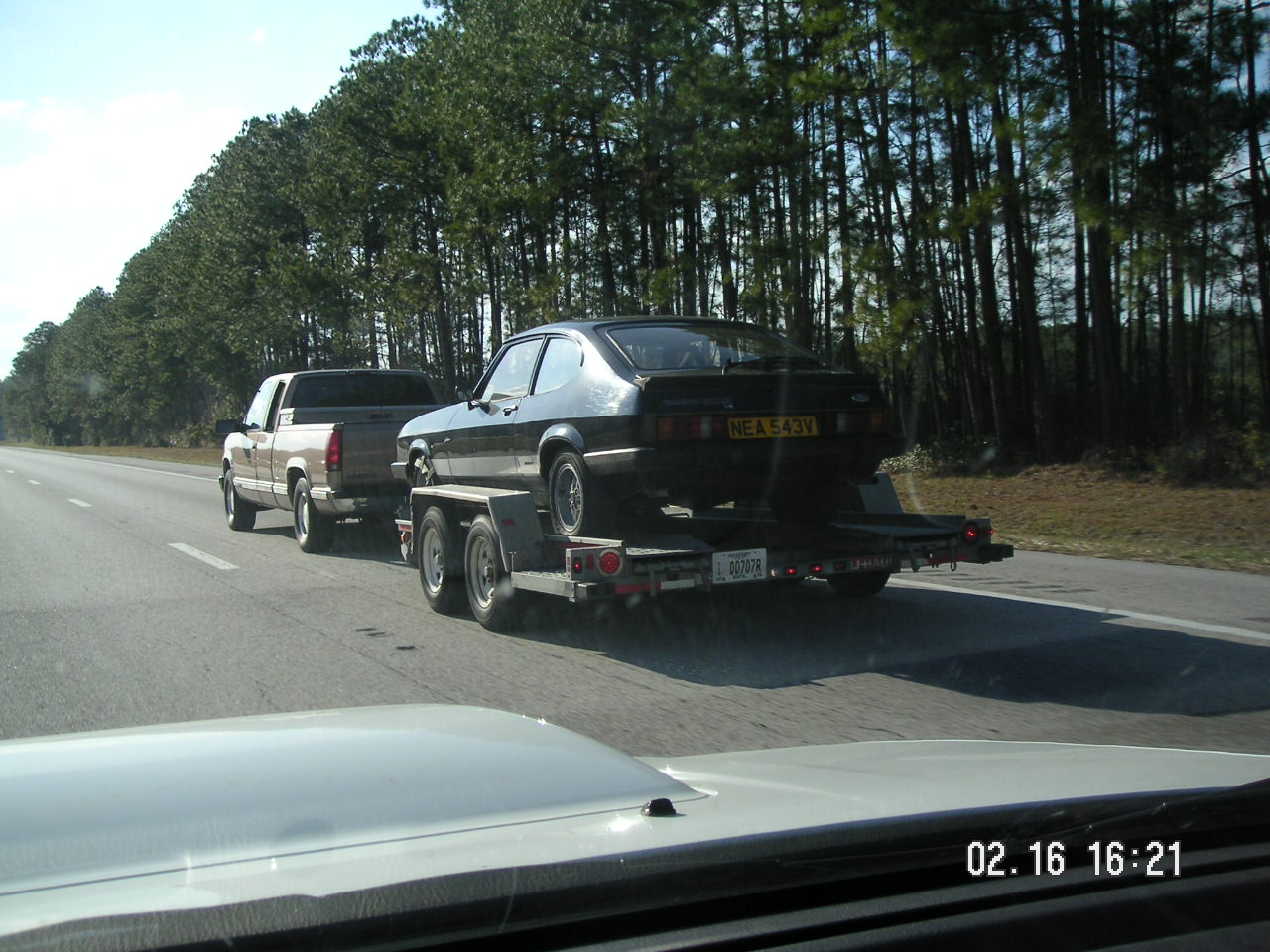
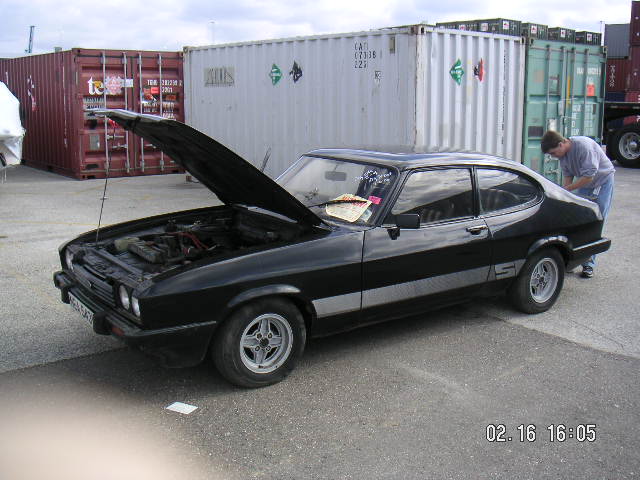
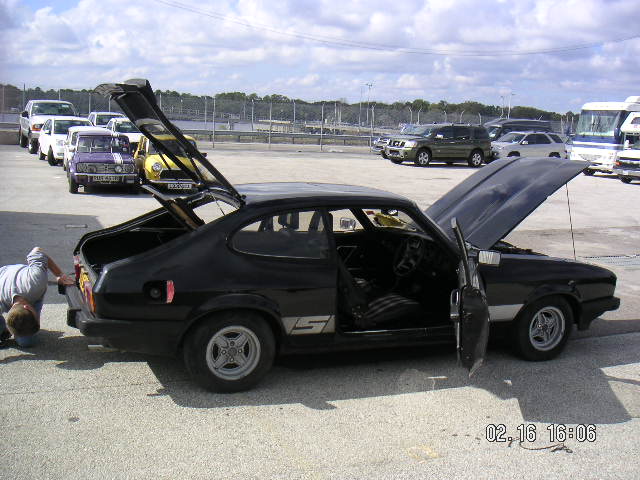
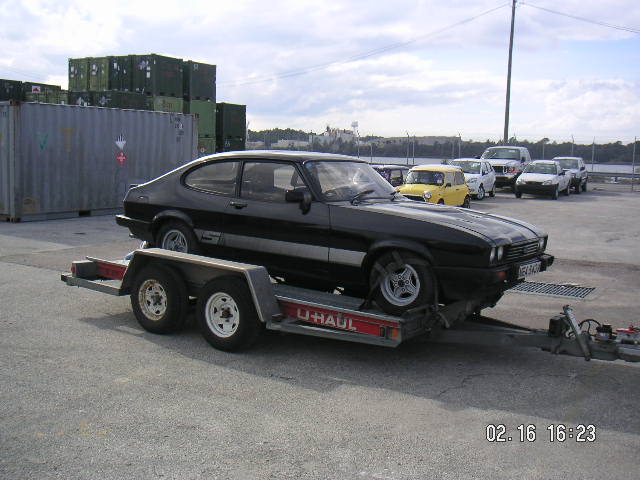
I collected my Capri from the port of Jacksonville on February 16 2006. I meant to take lots of pictures of the car at the dock when I first saw it, but didn�t. The excitement of the day and with lots of paperwork, ID showing, and navigating through the maze of the port I was just happy to find the car and get it on the trailer. I do remember the first glimpse I caught of the car though, and walking up to it for the first time. Imagine, the car has been sitting outside at the port in England for weeks, then it�s been loaded on a dirty ship and sent across the salty ocean. After that, it�s been subjected to a USDA chemical pressure wash which they let bake in the sun after washing� The car wasn�t pretty. Although it looked like the pick of the bunch, sandwiched between 3 Mini�s that looked like that had been sitting on the bottom of the ocean for a while.
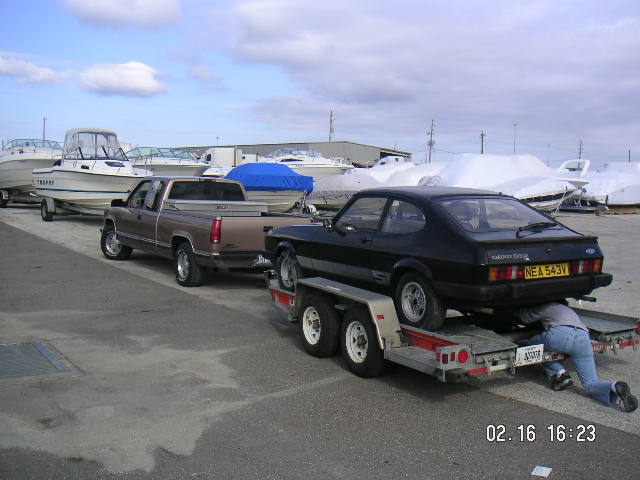
I did snap this picture following my Dad towing the Capri away from the port along I-10.
Update: January 7 2008, Dad to the rescue in Capri World again. I'm adding a few pics my Dad took as I was inspecting the Capri at the Docks in Jacksonville FL. I didn't know he took these until Jan 7 2008...
So, it�s June 2006. I�ve had my Capri over here for about 5 months now. I�ve driven it maybe 300 miles. It�s proven reliable, but in need of a little TLC. The seller was accurate in claiming the car was complete and driveable. As feared though, the dreaded tin worm has taken hold. At some point the car has been repainted (not surprising for a 26 year old car). However, the car used to be orange, and was painted black sometime ago. The quality of the paint job wasn�t bad, but the prep-work left something to be desired. This was evident by a few bubbles showing on the rear valance and right hand front fender. They obviously didn�t cut out and weld up this rust before re-painting. I had hoped not to have to undertake any major bodywork on the car for a while, but I�m not one to leave the car alone, especially knowing theres unknown amounts of rust lurking under the afore mentioned areas.
The Capri is now in my garage, completely stripped and receiving new metal everywhere I found the slightest hint of rust. I plan on completing all the bodywork and having it painted in black by the end of 2006. To complete the resoration, I�ve purchased parts from both the UK and Germany.
How to import a car...
There are some key things to consider when looking for a car to import, other than the usual mechanical condition etc.. I�m an Engineer, so lists are one of my favorite things to create. Below is a list of things to consider before parting with your hard earned money.
1. It�s going to cost a lot of money to bring it over. � Most likely more than the cost of the Capri itself.
2. The majority of 25+ year old cars from England are going to be rusty. Not surface rust, but deep, nasty �A� pillar destroying rot.
3. Companies are going to nickle and dime you to death. There�s no way around it, get ready for it, pay up and look happy.
4. Is the seller willing to complete the extra paperwork required?
5. Is the seller willing to clean the car thoroughly before collection (more on this later).
6. Is the seller willing to store the car while waiting for collection?
7. What forms of payment will the seller accept?
8. Can you trust the seller?
9. Find and use a reputable shipping company?
10. Can the shipping company arrange transport of the car from the seller to the docks (rollback)?
11. Hire a competent US based broker.
12. Which US port is closest to you?
13. What state are you bringing the car into? Some states may require modifications to the car before registering it. I�m in Florida, and it�s very lax here. � I was lucky.
14. Keep all your paperwork straight, you�re going to get lots of it.
15. Did I mention it�s going to cost a lot of money?
Put off yet?
Bringing in a Capri from Europe can be a daunting task. There is a lot to consider, but to me it was well worth it. Owning a genuine Mk3 Capri again is something I never thought I�d do. Whenever I drive it, I get interesting looks. More than once I�ve been shouted at to �Pull over � I want to buy your car�. Sometimes I wish I had a Klingon Cloaking device so I could drive it undisturbed. (OK I�m a little geeky).
Below is yet another list of things that should happen and the order they need to happen in to make your Capri importation as painless as possible. Hopefully this will help someone. Obviously all this applies to other grey market cars and not just Capri�s.
1. Contact shipping companies and let them know what you�re planning on doing. Get lots of quotes.
2. Get your paperwork started (HS-7 form).
3. Find your car.
4. Make sure the car was first registered at least 25 years before the day it will arrive in the US.
5. Make sure the Seller is trustworthy and up to the task. They have a few things to do beyond the normal sale of a car. Mostly paperwork. Hopefully the car isn�t rusty, get lots of pictures. Also, an MOT isn�t a sign the car isn�t rusty. �Bent� (forged) MOT�s are easy to get over in England.
6. What form of payment will the seller accept?
7. Buy the car.
8. Have the seller remove all loose items in the car, and pressure wash the outside top to bottom.
9. Have Seller immediately Fed-Ex all the paperwork to you (Log book, V5, Bill of sale � VERY IMPORTANT)
10. Hire the shipping company, have them collect it on a rollback and deliver it to the dock. Don�t let them drive it to the dock.
11. Get the extra insurance � it�s pennies and well worth it.
12. Shipping company will send you a package of paperwork containing lots of stuff. Keep it all safe, and copy it all as a back-up.
13. Make sure you have three original Bill of ladings.
14. Once you get notification of sailing, have the seller register the car as permanently exported. Now the seller is done�
15. Hire the US based Customs Broker. Sometimes the European shipper will recommend a US based broker.
16. You will receive notification from the shipping line (boat owner, not the shipping company), that the car is on it�s way and should arrive on XX/XX/XXXX date. This is called the �Arrival notice�.
17. Also included with the arrival notice will be a bill from the ship owner. Pay it, and include an original bill of lading. Without payment, they won�t release it! Remember, pay up and look happy.
18. Send copies of everything plus one original Bill of lading to your US based Customs Broker.
19. Car arrives in US port.
20. US broker is supposed to be notifed, but it�s best to notify them yourself.
21. US broker will file the HS-7. Make sure they file it under Box 1 of the HS-7 form.
22. Usually takes a couple of weeks to clear Customs.
23. Hope the USDA doesn�t get ahold of it. If the Seller did their job cleaning it, then the USDA will leave it alone. Otherwise they will take the car and subject it to an �Agricultural Cleaning�. This is no more than a pressure wash, but it will be the most expensive pressure wash you�ve ever paid for. It�s not the end of the world if they take it though, it�s just takes longer and costs more money.
24. US broker will notify you it�s cleared by customs and send you a bill.
25. Pay the Broker quickly and get a release/OK for delivery receipt from them.
26. Go to dock yourself and collect it. Be prepared for long waits, many questions and lots of ID showing. Don�t trust a towing company to collect it.
So, there are at least five payments you will have to make to get your car.
1. The car itself (Your choice)
2. Transporting the car to the dock (Probably half the cost of #3)
3. Shipping (The big one)
4. Shippers bill (Not much, but necessary)
5. US brokers bill (This includes their charges and customs clearance, and taxes).
Other costs:
1. USDA cleaning
2. State taxes (yep, more taxes)
3. Modification charges (Usually just lights)
4. Registration costs.
Really, it�s not as bad as it seams. Reading this over the span of a few minutes makes it seem like a lot. In actual fact, it seems to take forever, and you�ve got lots of time to get the paperwork in order. If anyone is considering importing a Capri or other car, I�d be happy to answer any questions you have. I can give you the name and contact information of the UK based shipping company I use, as well as the US based Broker.
David Maughan
June 2006
*Want to know how to be creative?
HS-7 form states that a complete vehicle most comply with Federal safety and emission regulations if not 25 years or more old. There is a way around this. A very close read of the HS-7 document and instructions will reveal a statement in there to the effect of: �A compete vehicle is one that consists of a chassis, body and drivetrain�. Removing any one of those items renders the car incomplete and is no-longer classified as a �vehicle�, it is now classified as �parts�. It�s hard to remove a body or chassis, but a part of the drivetrain is simple enough. Want to bring a newer car into the US? Have someone take the engine out and crate it up. Ship the car less the engine separately and re-assemble them once you get them home. Registering it once assembled may present a challenge. Perhaps calling it a Kit car would work� I haven�t tried this, nor do I know anyone who has. I�d be interested to hear from someone who has. I�ve also heard that US servicemen can bring a Euro-spec car over. Again, I haven�t tried this, I�ve just heard about it.