
Miscellaneous
The main cinematographer for this film is Christopher Doyle(Law Wai Keung does mainly camera lighting) who has cooperated with Wong Kar Wai for several films already. He is known for his artistic style and thus there are a few interesting scenes/shots which are worthy of mention.
- The three main characters in the second story all appear individually in the first story(scenes 10,14,15). However, the characters do not know each other and hence do not interact. This adds to the interweaving of the stories, as they occur at the same area, and also to the idea in 223's first voiceover(scene 1) -that everyday, we invariantly pass by people whom we will get to know very well later. Wong Kar Wai also mentions in an interview that in scene 14, Faye and the woman are actually the same, just ten years apart(hence Faye ends film with shades and hairstyle like the woman's?)...
- The two freeze scenes(2,28) and their subsequent fading away, illustrate the fading of our memories. Everyday, there are many occurences which we would not pay any attention to and forget quickly. 223 and the woman never remembered they had bumped into each other before, nor will Faye and 223. There are many other similiar parallel scenes in the film, like 28 and 44, 43 and 48, 42 and 57, 39 and 64. They may appear familiar and funny to us because we have just seen the same thing a few minutes ago, but to the people concerned, they are but separate occurences days apart which no one remembers. The time-lapse photography scenes(40,61) and handcam chase scenes also illustrate this idea.
- (Scene 54)The blue sandal which floated out with the water represents 663's memories of the stewardess. Despite Faye's attempts to hide them after replacing them with a pair of pink ones, the memories still remain and are not so easy to put away. 663 wears the old blue sandals while cleaning up the mess and projects his longing for the stewardess through the apartment.
- The film was shot at three main locations - Chungking Mansions(Midlands), Midnight Express(Central) and the escalator joining them. Chungking represents poverty and crime, while Express represents high-class pubs and the rich. The first story is filmed in the night while the second in the day(save for the start and end). This serves to contrast the difference in the two areas.
- 223 and 663 are both policemen who suffer parallel fates of being ditched by their girlfriends. They cannot get over the loss of the relationship, as they are both lonely people. The have no other friends save for their work, which only associates them with the criminals they catch. They both keep pets like goldfish for company, animals which cannot respond to their needs and answer them(hence the plentiful voiceovers). Thus they project their feelings to other inanimate objects instead. 223 to his pineapples and 663 to his toiletries. By the way, Wong Kar Wai says that the numbers bear no signifance. He is only lazy to give them names and was partially influenced by Kafka, who always names his heroes K.
Character Analysis
The following is an analysis the six major recurring characters in Chungking Express. I find it easier to analyse certain ideas of the film this way because they are brought forward by the thoughts and actions of these individual characters, and there is hence a loose association. This method also allows others to understand the characters more, which I feel is the greater theme of the show - for the audience to relate to the people and events in this world. Very importantly, all the characters exhibit some form of change by the ends of their respective stories, making us examine our own life as to whether there is a need for change or not.
Woman in blonde wig
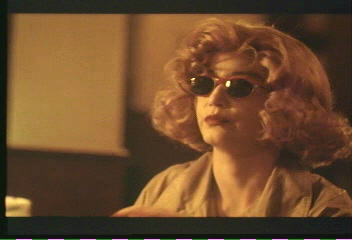
Wong Kar Wai mentions in an interview that she is the only one of the four main characters who does not display any emotion(see Comments). "She is like an animal, roving in Chungking Mansions like it was a jungle." She hides her feelings behind the wig, shades and raincoat(her uniform) which she wears all the time. Yet her explanation for this is the pessismism that she doesn't know when it will rain or shine. At the pub(scene 23), her pessismism is also used to twist the idea of the pineapples. She reveals that people will change too, just as their taste will, and thus helps convince 223 to accept this fact.
Change - She betrays her feelings once(scene 18) when she nearly crumbles in fear after failing to recover the drugs. And at the end she finally displays her emotions when she messages happy birthday to 223. After killing the Caucasian man, she drops her wig and reveals a glimpse of her black hair as she walks off. The expired sardine can was also left behind, all these perhaps indicating that she has abandoned this memory and is willing to start life afresh.
Cop 223
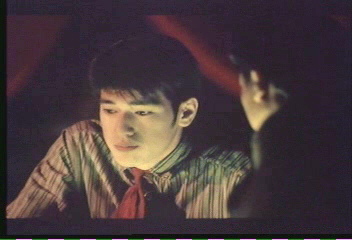
A plainsclothes detective who is always seen impeccably dressed with long-sleeved shirt, pants and tie, even when arresting criminals. An extremely lonely man, he was clearly very affected by the recent breakup. Yet from his jogging habit, it is known that this is not the first time he has fallen out of love. Clearly he has yet to learn how to handle breakups. He lives alone with his goldfish and dog and does not seem to have any other friends. He is optimistic and refuses to believe that he has been ditched. Instead, he tells himself the breakup is an April Fools Day joke . The fact that 1st May is his birthday makes him even more sympathetic. His pager code is 'Love You For Ten Thousand Years', revealing his desire for eternal love. (scene 16)He expresses his desire that nothing in this world will expire(change), specifically love.
He also has a lot of pride. (scene 3)He does not want to admit he called to look for May and asks her parents not to tell her he called. (scene 23)He insists the woman is the one who needs company after being heart-broken, when the case was just the opposite.
He brings out one of the strongest ideas of the film. That of the expiry date and that things like love and memories will not remain static but will change and fade with time.
Change - In the end, he finally learns how to cope with the loss, and that is to accept the change, let go of the memory and move on. He still continues to jog however, but now as recreation(a thing he used to frown on) as evident from his gear. His new casual dressing indicates that he is willing to accept changes in his life now.
Faye
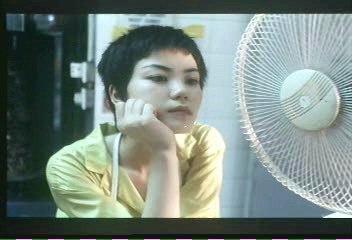
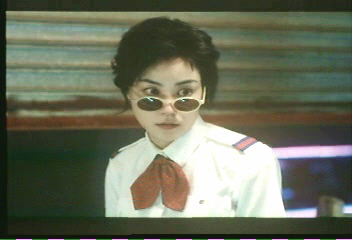
To many, her actions appear eccentric and unexplanable. But actually she expresses her love and concern for 663 in the most normal way possible, by helping him get over his ex-girlfriend. She is very quick-witted and lies cleverly on several occasions to help her(scenes 44,49,51,55,56,58,59!). Yet she is afraid to show her true emotions as she explains her actions as sleepwalking. Likes loud music like'California Dreamin'' and 'Dream Lover'(so that she doesn't have to think), but tries to listen to the gentle 'What A Difference A Day Makes'(scene 59) which is the stewardess' favourite song(to change herself so that 663 will like her). She likes to have fun, and has been saving to travel to California. Her longing is so great that on the day on the date, she decides to leave for California for a year after seeing the pouring rain outside. This is perhaps just her fear that things would not work out between her and 663.
Change - She copies what the stewardess does by likening herself to a flight, and writes a boarding pass to California(Pub) for 663 dated one year later. In the end, there is a role-reversal when Faye becomes an air stewardess(change is complete now!) while 663's girlfriend shows up in casuals. She is also wearing her shades indoors that night, something she used to do only in the day outside. This parallels the woman in the blonde wig, revealing that she is now fearful of showing her feelings. But she is willing to give another shot at a relationship with 663, as she volunteers to write another boarding pass for him so that they may 'fly' together.
Cop 663
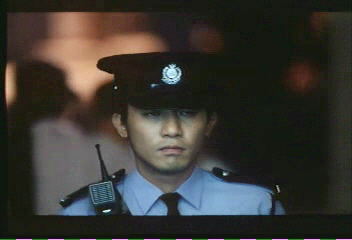
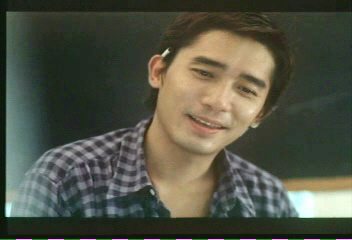
He is always seen in his uniform when outside and in his t-shirt and undies when in his apartment. Another extremely lonely man who does not seem to have any friends. He keeps goldfish and soft toys for company. He is easygoing(he says doesn't mind either three times in scenes 44,55,64), but he takes love seriously. He reveals(scene 34) initially that believed that his relationship with the stewardess would work out. He parallels the women in his life as aeroplanes. Unlike 223, he is a pessimist and knows that his girlfriend would not come back. However, he still cannot take the blow all the same. His pessimism can be seen by the fact that he does not bother to retrieve the letter she left for him. His talks with the inanimate objects in his apartment serve to console himself(scene 42), just as in a parallel scene(57) later, he talks to them again to gain confidence for a new relationship.
Change - He turns up for the date in casuals, which is the first time we see him not in uniform outside his apartment. In the last scene, the change is complete - he is no longer a policeman in uniform but the new owner of Express in casuals. He is also listen to the loud 'California Dreamin'', which he frowned upon in the beginning. He has also changed his pessismistic attitude and opens Faye's letter.
Air Stewardess
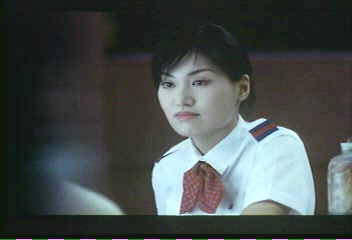
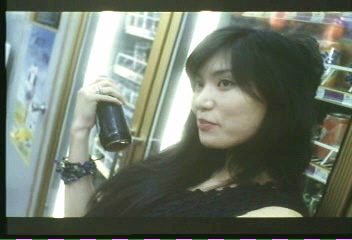
She is always dressed in a stewardess uniform and seen lugging her baggage. She describes herself as a flight to 663, both in her letter and voice message. Thus in her breakup letter to 663, she enigmatically says the there has been a change of flight(I'm looking for someone else!) and that his place has been cancelled(You're dumped!). This is accompanied by a real cancelled boarding pass for a flight to Hong Kong! When she wants to come back to 663, she informs him that the flight is returning to Hong Kong and asks if he wants to reserve a seat. Unlike the policemen, she does not view love as seriously.
Change - Towards the end, when 663 meets her again at the convenience store, she is finally in her casuals, like 663. And her long hair is no longer tied up, and she has found a new boyfriend. Before she leaves, she remarks that she likes 663 better in uniform and he says that he likes her better in uniform too. Both of them know that they have changed and should move on.
Owner of 'Midnight Express'
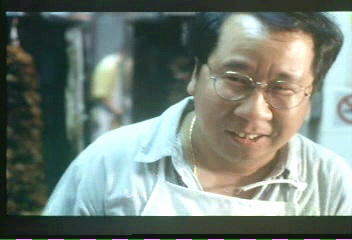
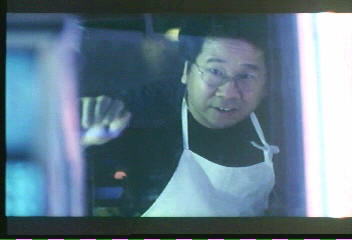
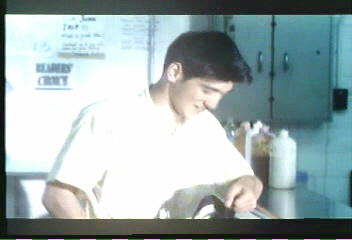
A very good businessman, as attested to by 663 at the end. "First he convinces me to buy fish and chips, then he sells me his shop!" The only recurring character to be detached from the theme of love, yet he readily dishes out advice to 223 and 663. Because of this, he appears to take love lightly like the air stewardess, and cannot ampathize with the policemen's pain when they fall out of love. His presence does serve out an important idea in the film though. The food he serves represent the different forms of love. Black coffee, bitter and dull, for the lonely heart-broken lover. 663 orders this after being ditched and again at the market(scene 52). Chef salad, good tasting but unfilling and uninteresting, like standard love fare. 223 stuffs himself with this in the hotel room while 663 used to buy it for his girlfriend. Fish and chips, pizza and hotdog, representing the other choices available. In the second story, he encourages 663 to let his girlfriend have a choice, to change what she eats for supper, instead of the usual chef salad. And the parallel is that she goes to look for another man.
Change - When he delivers Faye's letter to 663 at California Pub, he is wearing a black t-shirt under his apron, unlike the usual white one. Does this foreshadow his desire for a change? In the end, he too wants a change and gives up his uninteresting but settled takeout for a karaoke lounge.
Realm | Personal | Favourites | Pandora's Box | Field Signals | Eudaemonia | River Styx | Photo Gallery | Guestbook | Links | Epilogue