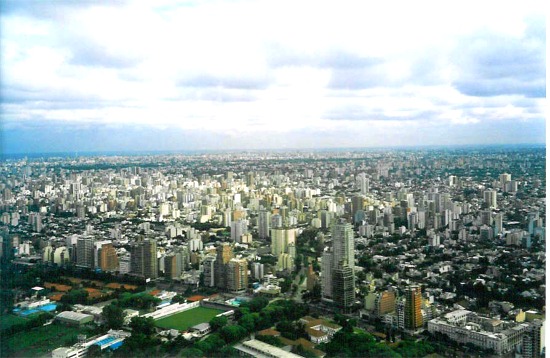
The Buenos Aires skyline, from a plane taking off from the Jorge Newberry Airport.
10 million inhabitants. One quarter of Argentina's population. Bigger than Paris, the size of New york, reminiscent of both. An american, almost all square-grid city, that grew around and out of its harbour and colonial clothes.
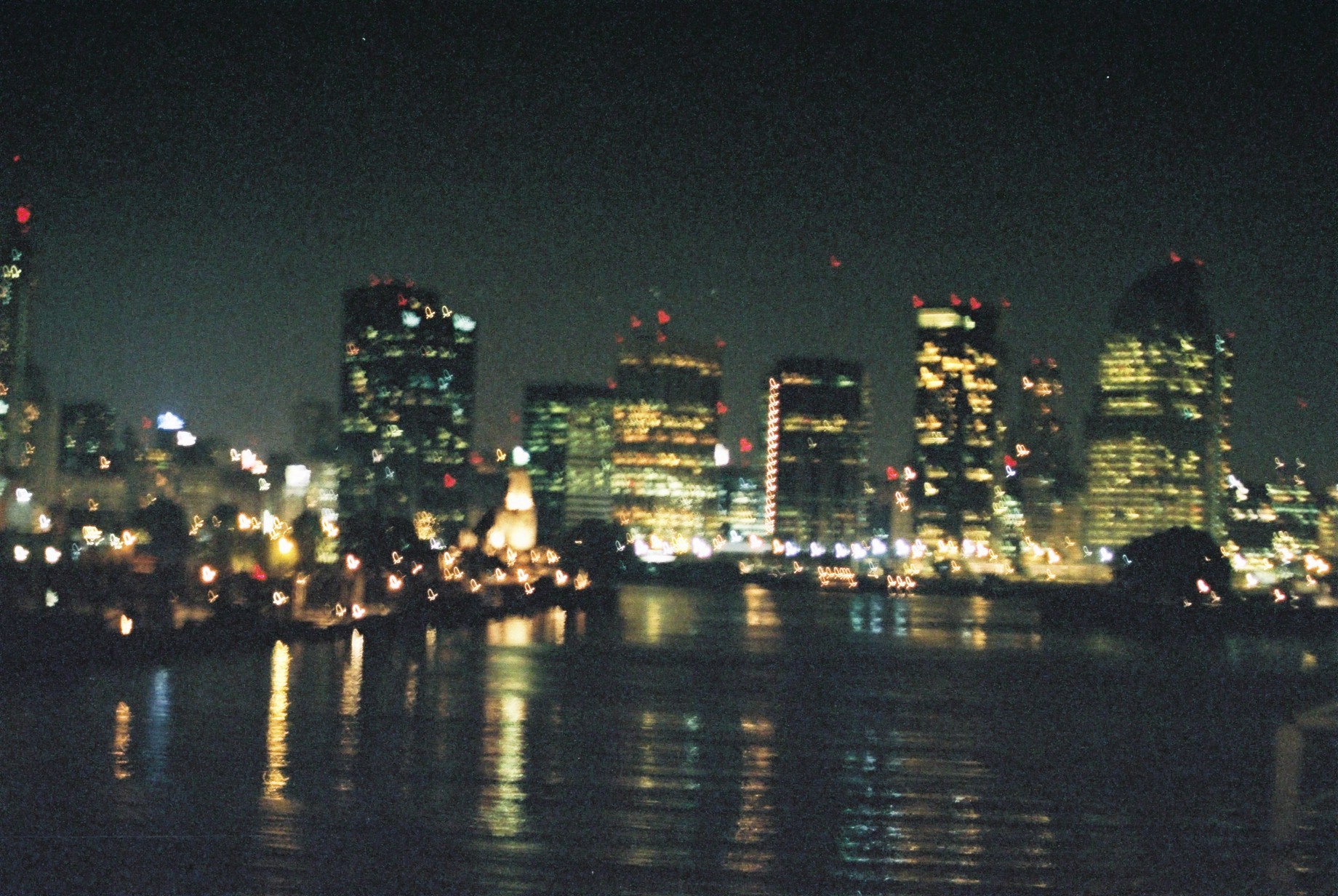
Taken from the shaky Ferry accross the river plate to Colonia.
The 9 de Julio Avenue The center of power Impressions and short reflection on Argentina: on the edge of the world. Back to Argentina Main Page
Page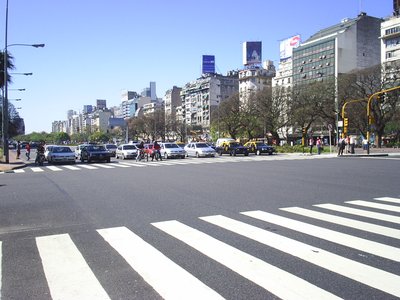
The big artery of the city, 8 lanes each way, visible from space. The 2 cars on the right are taxis (yellow and black). A 20min ride can cost you 3 or 4 Euros, or more if you're unlucky, as the seatbelts on the front seat are mainly there for decoration. Rides are impressively fast. Whether a customary 10% tip is expected from tourists is debatable.
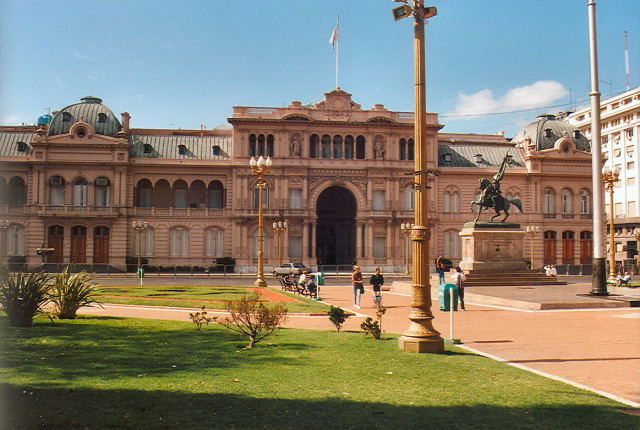
The plaza de Mayo, where the mothers of some 30,000 disappeared gather every Thursday afternoon. They "disappeared" during the military dictatorship, and are rumored to have been simply dropped by the military and "security services" over the south Atlantic ocean, possibly with concrete slippers.
In the background, the Casa Rosada, or Pink house, the presidential palace. I dont know much Spanish, but I remember in 1983 or 1984, hearing on TV the president of the democracy that followed the military Junta, Raul Alfonsin, speaking from its balcony, after thwarting a military coup, saying these words:
"La democracia no se compra, ni se vende, la democracia no se negocia"
....Democracy can not be bought, nor sold, democracy is not up for trade.
This flies in the face of the neo-liberalism since the 90s where the markets are more /less supposed to decide of pratically everything, including the destiny of a nation, which Charles Stuart -No-man-has-a-right-to-fix-the-boundary-to- the-march-of-a-nation- Parnell would have abhorred. I thought of these words particularly in 1993 when a wave of financial speculation almost undid the drive towards the European Monetary Union, which led to the Euro, which I believe was both the will and the interest of the European peoples (yes, with an s). Including the Brits, but don't tell them!
Two opposed conceptions that still need be reconciled: the "one man-one vote" of democratism and the "one Euro/Dollar-one vote" of liberalism.
I still think some things in life should never be up for trade anyway. Life with a price on everything is not life. It's just survival.
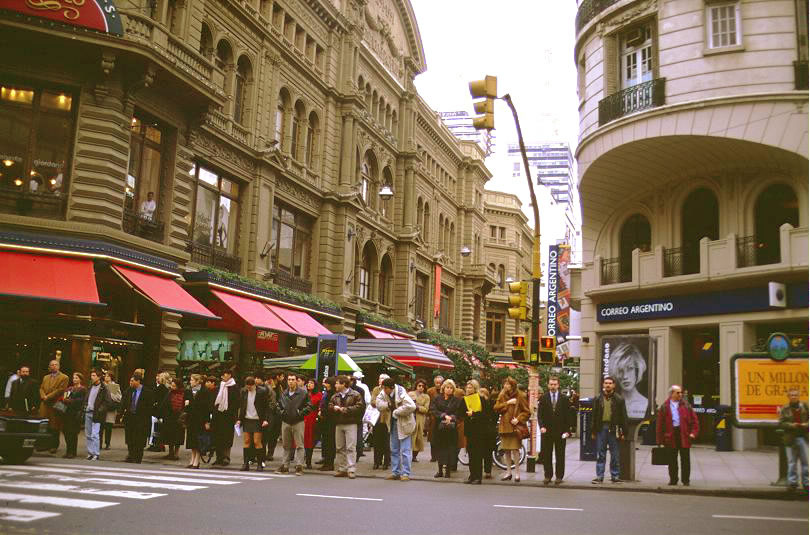
Florida. The Grafton street of Buenos Aires. Where everything has a price... Cheap though. So I survived.
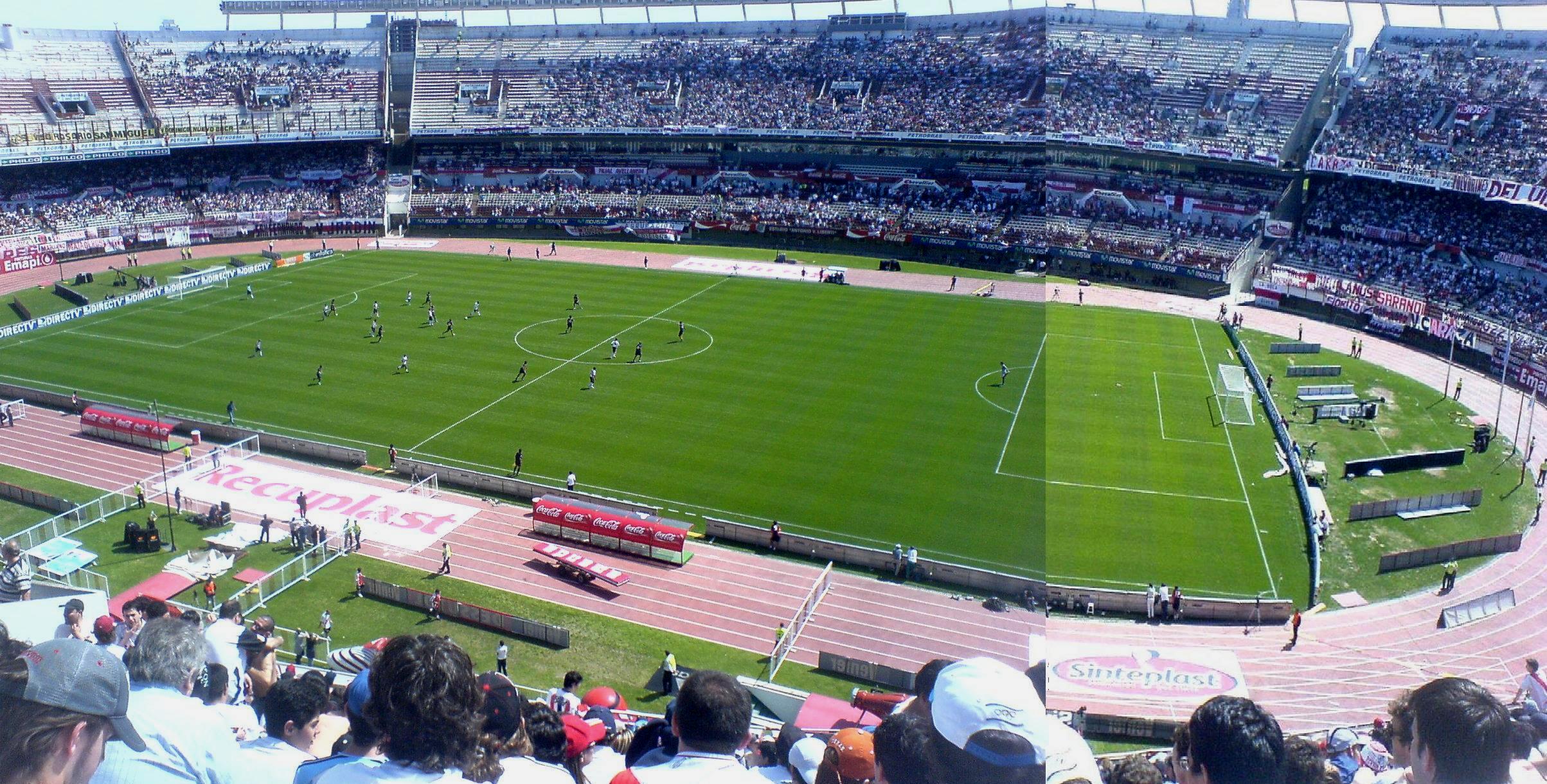
El Monumental. River Plate Football Club's pitch. This was a match where River Plate played the Boca Junior's, Maradonna's club. River Plate won 3-1, but Boca was still on top of the league after that. You can't win every day.... .
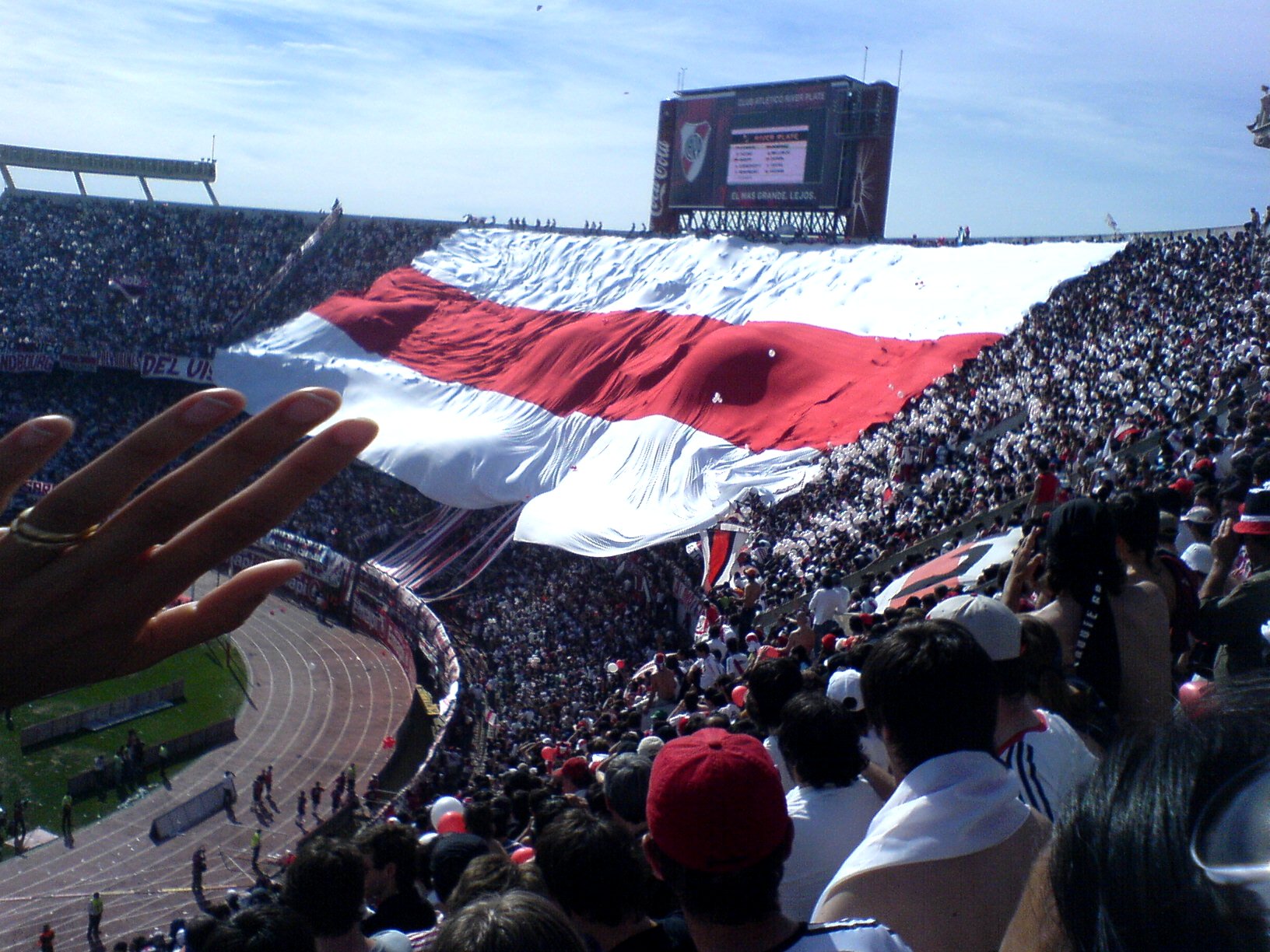
To give you an idea, River Plate are like Rangers or Lazio, and Boca are the local Celtics or AS Roma. Only more violent. There are scores of supporters of both clubs in jail for stabbing each other. This game was partly sponsored by the interior ministry....
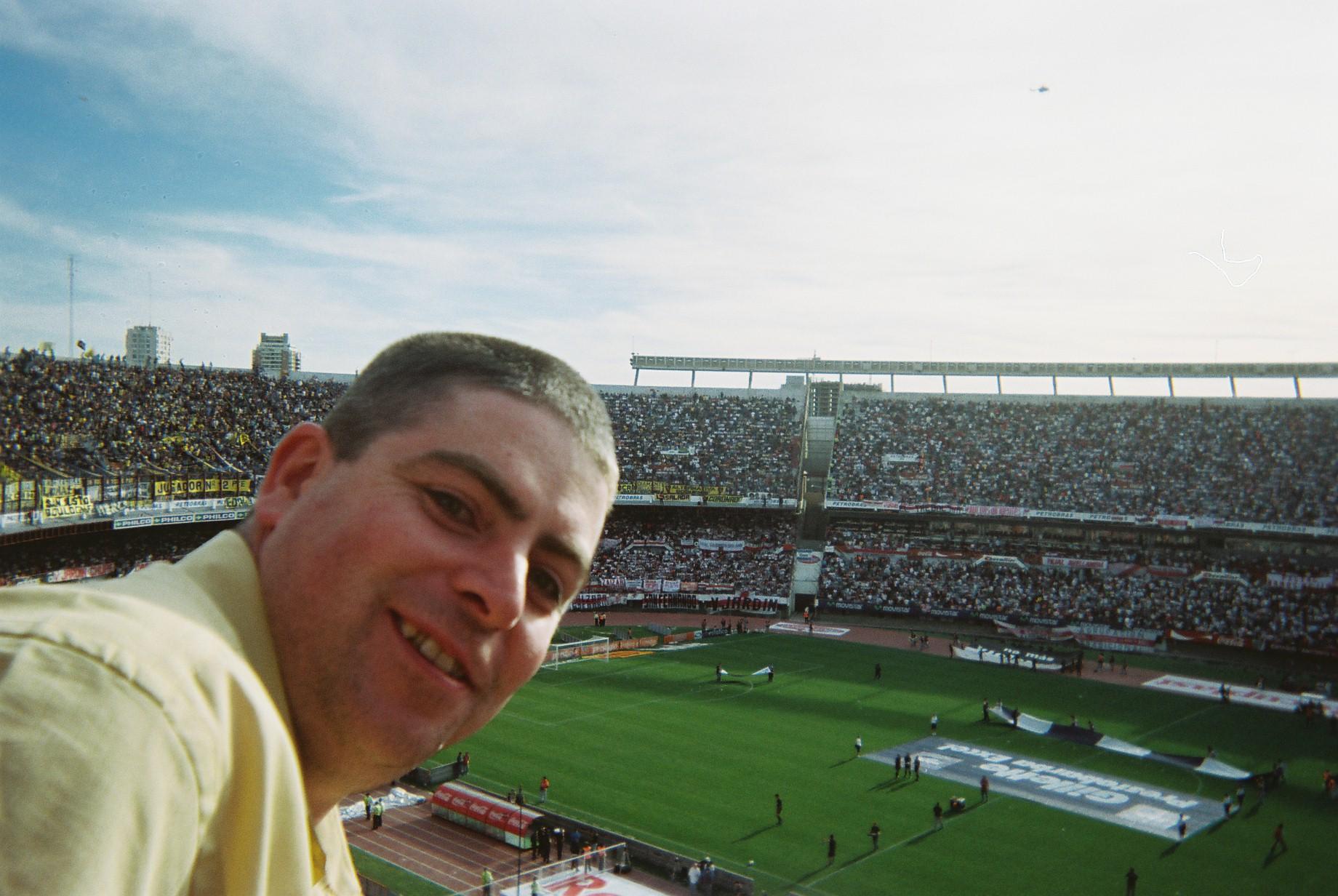
We were on an organised tour, sitting, rather against my instinct, in the River Plate stand. But the athmosphere was great, everyone was very friendly. They came from all walks of life. Even from as far as Planet Mars:
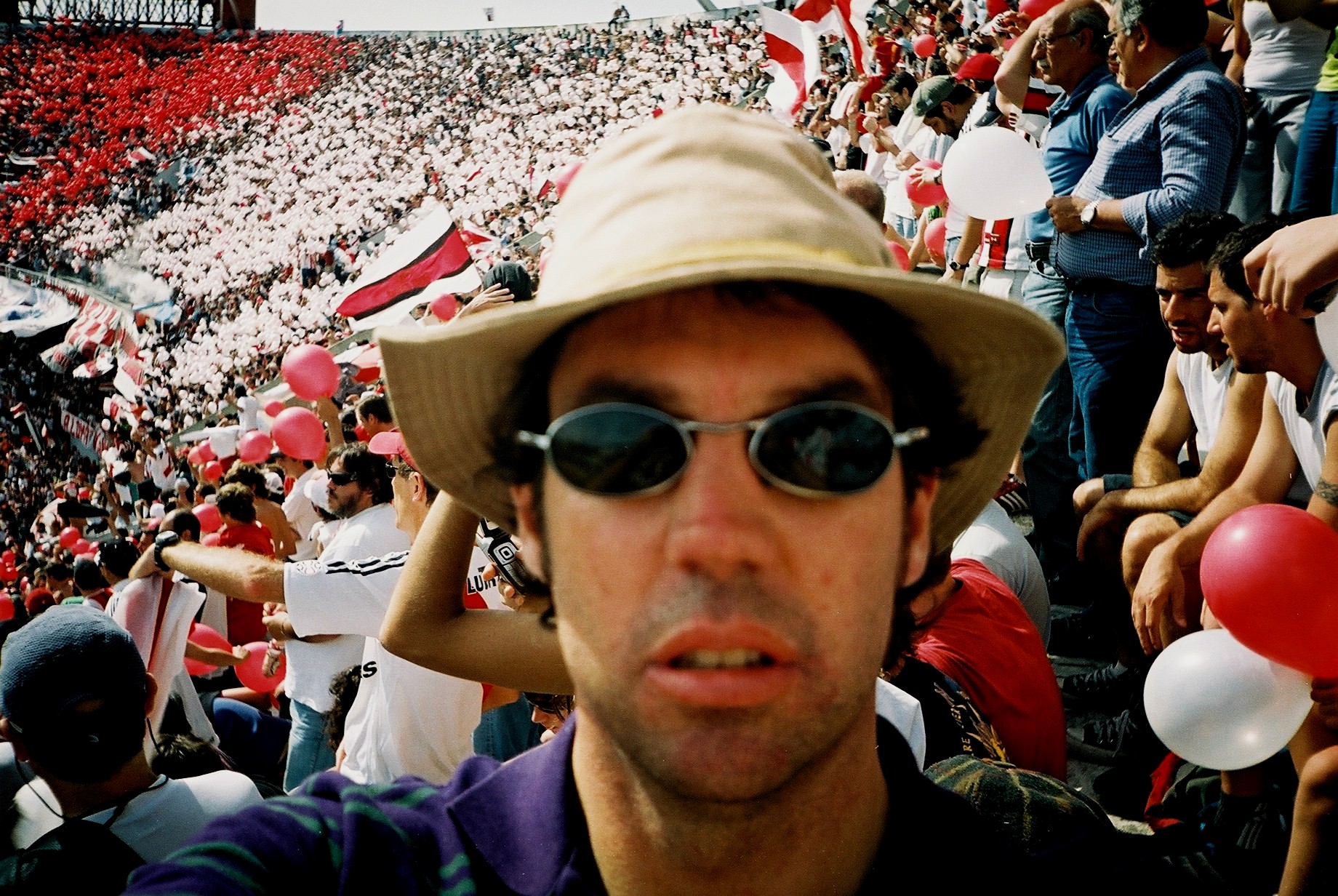
I learnt a lot of vocabulary from the supporters, like "puto": bastard, or "burro": ass or donkey.
This is how I understood that burrito means little donkey. Next time you go to a Tex-Mex and feel you could eat a horse, don't be so greedy, ask for a little donkey instead.
In the next episode: The Hot Dog explained....
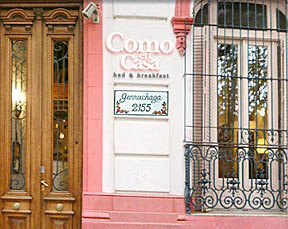
The B&B where we stayed. Nice and quiet, in a nice area. really did the trick. Friendly athmosphere. (http://www.casaalfaro.com.ar/cas/index.html)
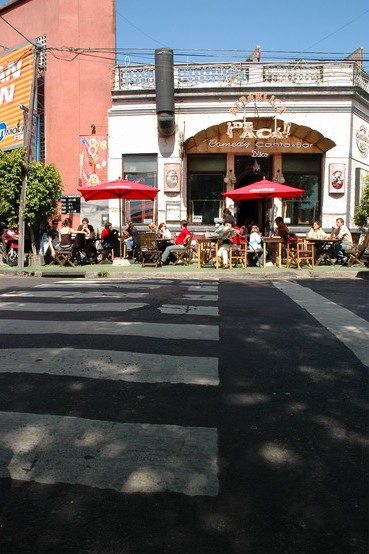
A restaurant on the Plaza Serrano in Palermo Viejo....
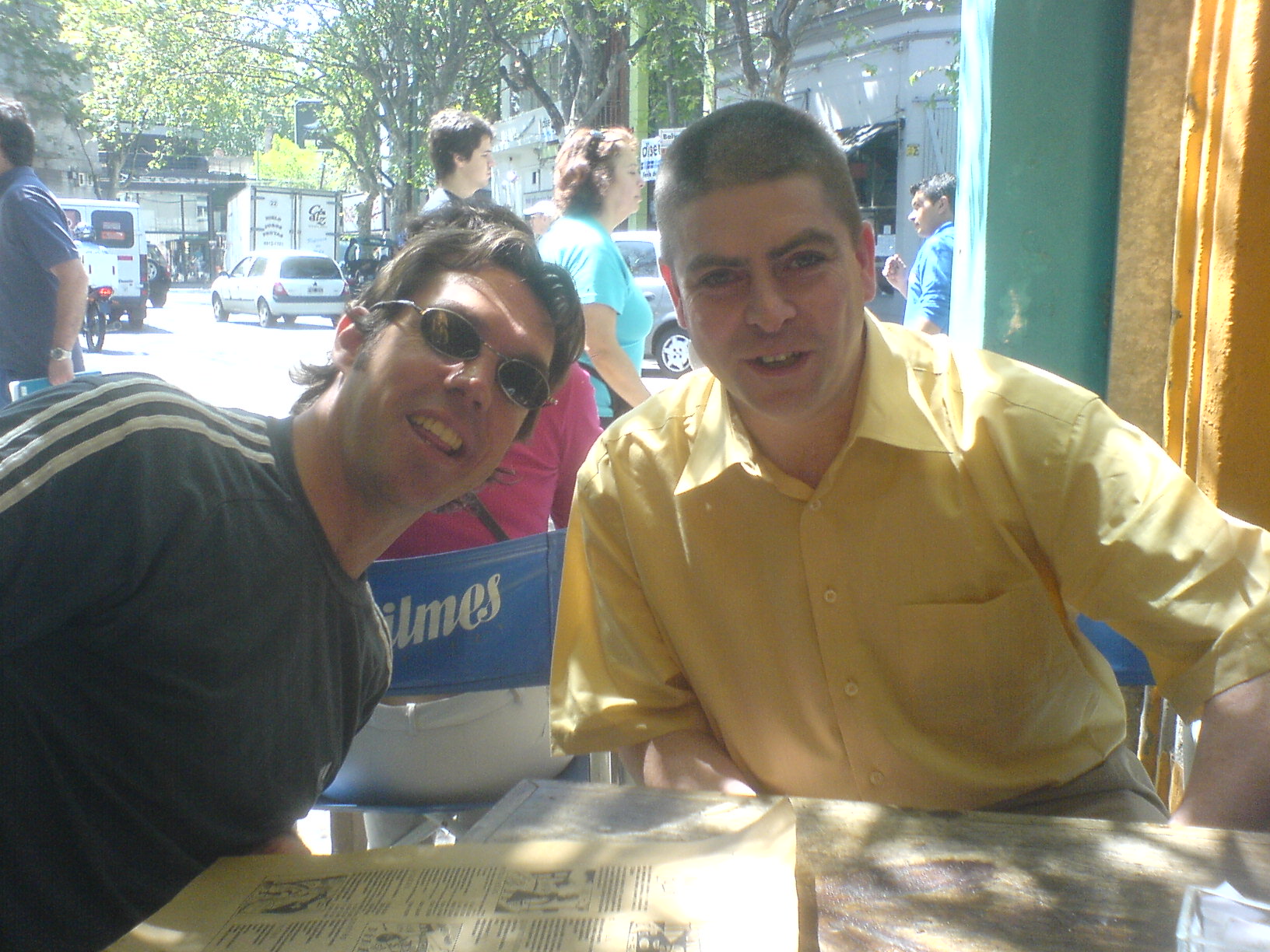
...where we filled our stomachs with food and spirits ran high.
I recommend this plaza, especially on a Saturday, where you have a little arts market. And an Irish pub... Yes I know. The concept of the Irish Pub is believed to have originated from Ireland, but sometimes you wonder which planet it comes from... Irish pubs seem to be everywhere now. No region is spared. They have conquered the whole planet. Resistance is futile!
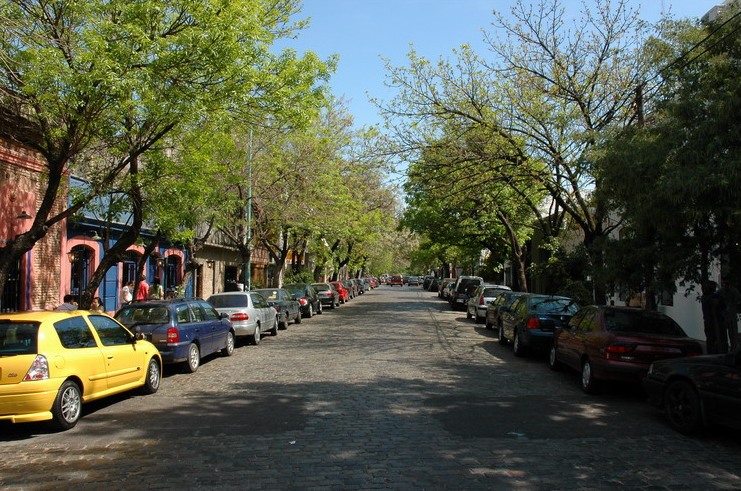
Another view of Palermo Viejo.
Palermo Viejo is one of the main italian quarters in Buenos Aires. Another one is La Boca. Palermo is a quiet artistic residential area, home to the late Jorge Luis Borges, and in some way reminiscent of Montmartre in Paris.
The ideal place for sudents....
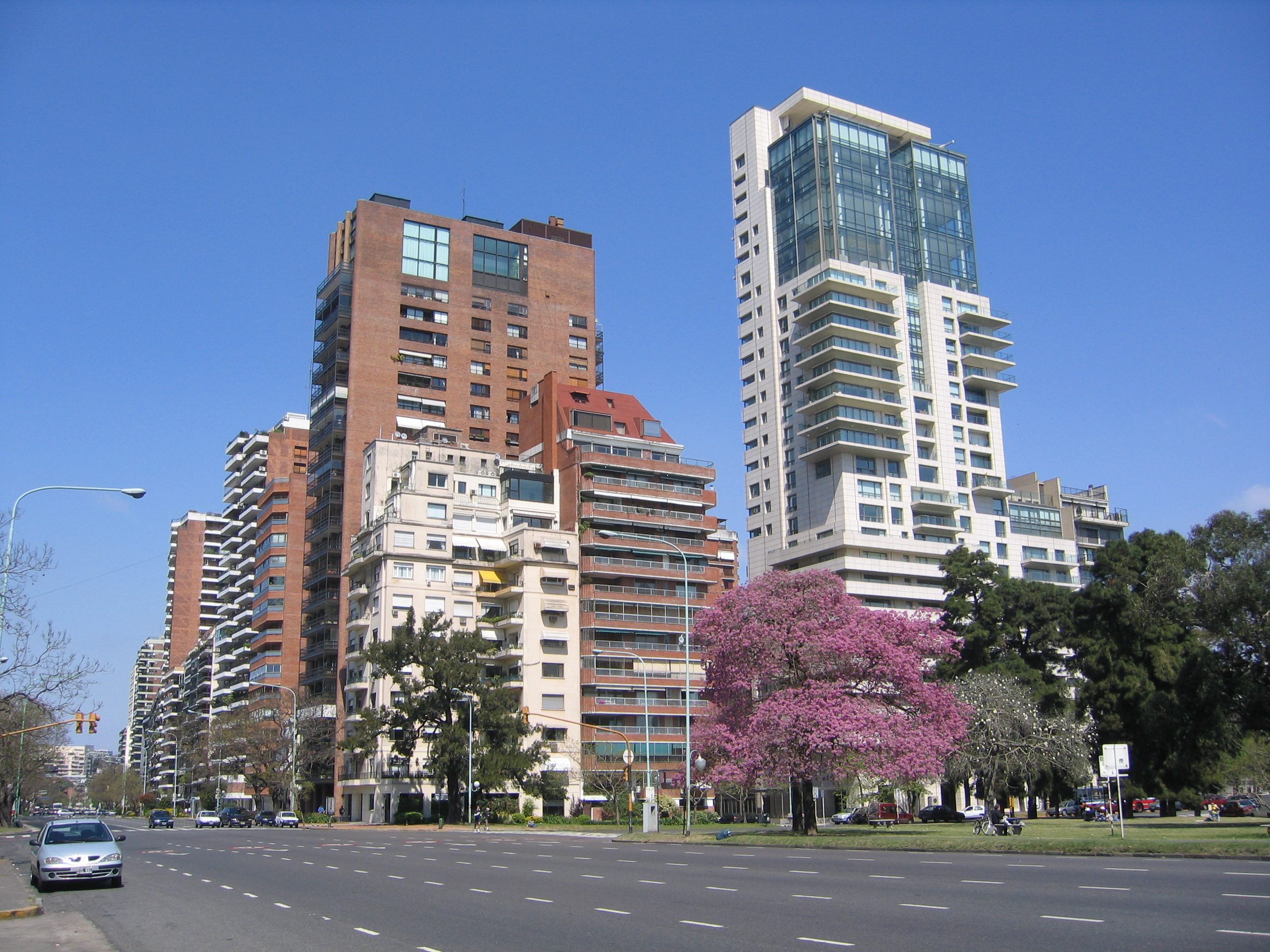
.....whose parents would probably prefer to live next door: Palermo Chico, the new Palermo. Dunno if Chico means little or chic, but its surely more chic than little.
Note that this one-way street only has 6 lanes!
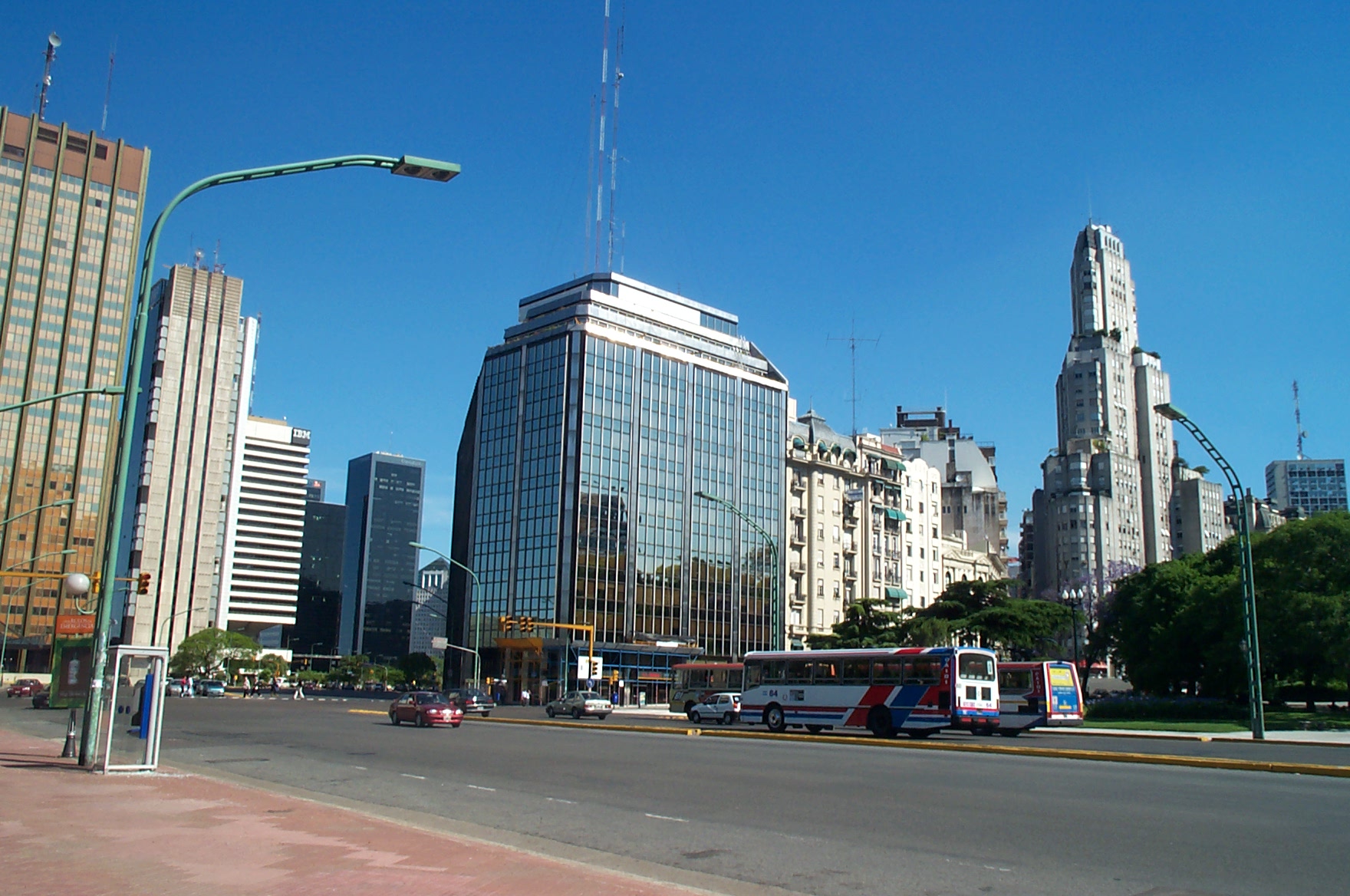
The Recoleta or Retiro (can't remember). Only a stone's throw from the train and bus stations, with slums behind. Some peculiarity I observed: the rich and poor are never too far from each other in this country.
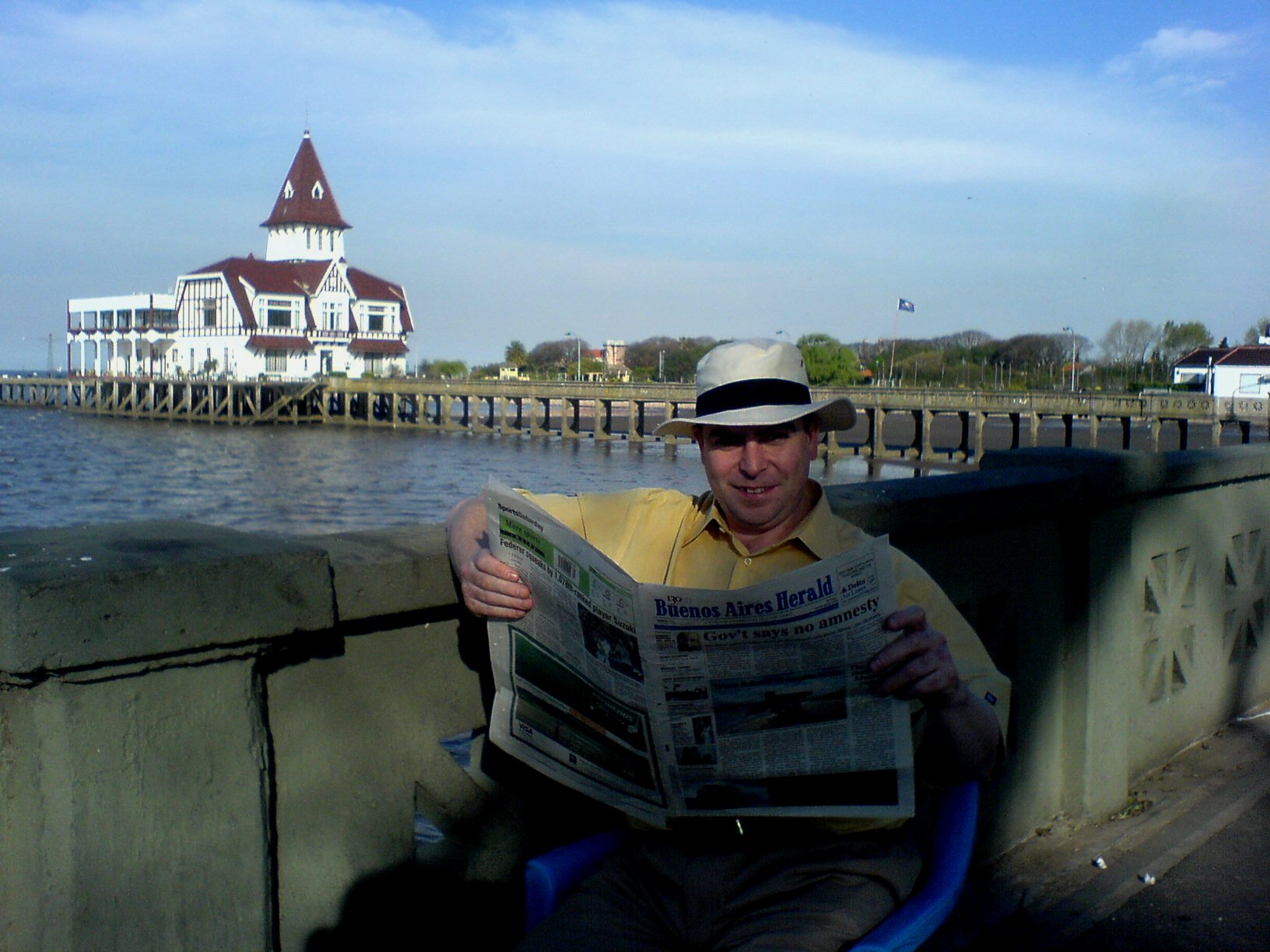
Not far from there, the river Plate, with its Fisherman's Club House, where John felt quite at ease!
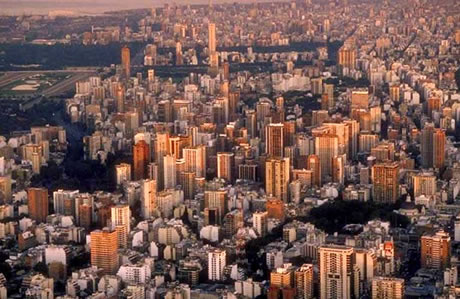
Buenos Aires just before landing from Iguazu, 2-3 days before leaving Argentina....

....but not before a last tango with Tina!

Well, take a look at the map of the world, or try it on Google earth: why would someome stopover in Argentina on the road to somewhere else? If you come from New Zealand, and want to sail to South africa, it's 9,000 miles thru the Magellan straits, and just over 7,000 thru the south indian ocean, so why would one bother even approaching the "Southern Cone". Maybe if you are a Kiwi going to Brasil. Or if you are on your way to the South pole. Not a frequent point of passage, Argentina seems to be on the road to nowhere else. The final frontier.
All that lies beyond Argentina is effectively the south pole. When global warming has melted the snow on the south pole, Argentina may become a major hub... for submarines: most of the Pampa isnt that high up in altitude, in case of dilluvian floods.
So end station Argentina. The tip of the world. But what a tip! World's End, with a bang!
So big the whole population of Europe could live in it!
And there is enough variety of climates to suit every European's tastes. So from a european perspective alone, the country seems to have potential.
I also found that the Argentinians may be living on the edge, they are nevertheless rather well "tuned in", well informed of what is happening in the rest of the world, which seems to indicate they aren't self-centered, and that they aren't really isolated.
In other words, I felt Argentina pays more attention to the rest of the world, than the rest of the world pays attention to Argentina.
With cheap labour costs and cost of living, the highest level of education in South America (although from a European perpective, there is room for improvement there), a developped infrastrucure and all the traipsings of a modern western-like country, Argentina appears to have potential. Which in some sectors like tourism, seems to be at least partially realised.
The big problem weighing on Argentina is Credit. Both financial and political credit are at an absolute zero. The 2001 crisis has exposed a structurally inflation-prone country, and a corrupt political "elite" devoid of any credibility, for both foreign investors and the population as a whole.
What I sensed, and also sense when in France, is that the country seems to be politically too polarised corrupt and imbalanced to bring everyone to a durable national consensus. The resulting lack of long term political visibility would normally tend to limit long term development prospects. La Casa no es en orden? Maybe, but that is also true of most Latin american countries (save Cuba of course), Italy and even France.
As I once heard, "the country is getting out of the hole, but the hole keeps getting bigger."
What I also felt, judging from the little I saw from both countries, the middle class in Argentina seems more important than in Chile, and the boundaries between riches and poors is more blurred than in Chile, where inequalities are so obvious to the naked eye. One point in favor of Chile though: the economy seems more dynamic than in Argentina, if one believes the statistics. But Chile seems to have been poorer most of the time up till now. (I could be wrong on this one though. But hungry cats do tend to catch the mouse before the fat ones can bat an eyelid, so maybe Chile is still hungrier...)
One reason to be positive though, is that there seems to be a drive towards regional integration. The Mercosur (Southern Common Market) still has development potential, and Europe, with the experience of its own recent integration, could have a facilitating role there.
Viva Bolivar!
Bolivar was the leading South American character who helped oust the last bit of European (Spanish) power in Latin America, so it would be a bit like twisting the arm of history if Europe helped South America assert its independence through an integration Bolivar himself was promoting in his time.
O tempora O mores!
(I'm just pretending to be an intellectual there. I learnt most my Latin thru Asterix comics).