







Latest Updates
12th March
Site Established
Contact The Site!
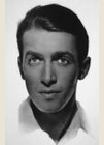
James Stewart
 Birth
Name: James Maitland Stewart
Birth
Name: James Maitland Stewart
Nickname: Jimmy Stewart
Date of Birth: 20 May 1908, Indiana, Pennsylvania,
USA
Date of Death: 2 July 1997, Los Angeles, California,
USA (pulmonary embolism following respiratory problems)
Sometimes Credited as: Jimmy Stewart / Lt. James Stewart
Spouses: Gloria Stewart (9 August 1949 - 16 February
1994) (her death) 2 children
James Stewart was a highly acclaimed American film and stage actor, best known for his homebred, idealistic screen persona. Over the course of his career, he starred in many films widely considered classics and was nominated for five Academy Awards, winning one in competition and one life achievement Oscar.
Along with fellow screen icon James Cagney, Stewart became so familiar to American audiences that he was most often referred to by them as "Jimmy" Stewart--a billing never found on the credits of any of his films. While technically incorrect, the public's use of the 'nickname' was a testimony to Stewart's impact.
Born in Indiana, Pennsylvania, he first pursued a career as an architect before being drawn to the theater in college. His first success came as an actor on Broadway, before making his Hollywood debut in 1935.
With several favorably reviewed performances on Broadway, he attracted the interest of MGM, and signed a contract with the company in April of 1935. At first, he had trouble breaking into Hollywood due to his gangly looks and shy, humble screen presence. His first film was the poorly received Spencer Tracy vehicle, The Murder Man, but Rose-Marie, an adaptation of a popular opera, was more successful. After mixed success in film, he received his first substantial part in 1936's After the Thin Man, playing a psychotic killer. Stewart found his footing in Hollywood thanks largely to ex-University Player Margaret Sullavan, who campaigned for Stewart to be her leading man in the 1936 romantic comedy Next Time We Love and rehearsed extensively with him.
Stewart's career gained momentum after his well-received Frank Capra films, including his Academy Award nominated role in Mr. Smith Goes to Washington.
His "aw shucks" demeanor has served him well as the good guy, the shy guy or the nice guy in films like Harvey (1950) and You Can't Take It with You (1938). Alfred Hitchcock turned him into a dramatic leading man in films like Rear Window (1954) and Vertigo (1958). Stewart also starred in his share of westerns, including The Man Who Shot Liberty Valance (1962), The Naked Spur (1953) and The Man from Laramie (1955).
He was awarded many of the industry's highest honors, including Lifetime Achievement awards from every substantial film organization. He died in 1997, leaving behind a legacy of classic performance and is considered one of the finest actors of the "Golden Age of Hollywood."
Stewart was a lifelong supporter of Scouting. He was a Second Class Scout when he was a youth, an adult Scout leader, and a recipient of the prestigious Silver Buffalo Award from the Boy Scouts of America (BSA). He made advertisements for BSA, which led to him sometimes incorrectly being identified as an Eagle Scout.