







Latest Updates
12th March
Site Established
Contact The Site!
History of the Genre
 The
Western is an American genre in literature and film. Westerns are art
works films, literature, sculpture, television and radio shows, and
paintings devoted to telling stories set in the American West (and sometimes
Mexico), often portraying it in a romanticized light.
The
Western is an American genre in literature and film. Westerns are art
works films, literature, sculpture, television and radio shows, and
paintings devoted to telling stories set in the American West (and sometimes
Mexico), often portraying it in a romanticized light.
While the Western has been popular throughout the history of movies, it has begun to diminish in importance as the United States progresses farther away from the period depicted.
Westerns, by definition, are set in the American West, almost always in the 19th century, generally between the 1860's and 1900. Some incorporate the Civil War.
 Westerns
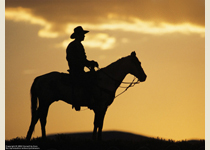
often involve semi-nomadic wanderers, often cowboys, with life reduced
to its elements. Their sole possessions consisting of:
Westerns
often involve semi-nomadic wanderers, often cowboys, with life reduced
to its elements. Their sole possessions consisting of:
* clothing,
* a gun, and (optionally)
* a horse.
The high technology of the era – such as the telegraph, printing press, and railroad – may appear, usually symbolizing the coming end of the frontier soon to give way to the march of civilization.
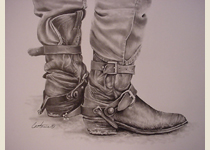
The Western takes these simple elements and uses them to tell simple morality tales, usually set against the spectacular scenery of the American West. Westerns often stress the harshness of the wilderness and frequently set the action in a desert-like landscape. Specific settings include lonely isolated forts, ranches, the isolated homestead, the saloon or the jail. Other iconic elements in westerns include Stetsons and Spurs, Colt .45s, prostitutes and the faithful steed.
The western film genre often portrays the conquest of the wilderness and the subordination of nature, in the name of civilization or the confiscation of the territorial rights of the original inhabitants of the frontier.
The Western depicts a society organized around codes of honor, rather than the law, in which persons have no social order larger than their immediate peers, family, or perhaps themselves alone.
In the Western, these themes are forefronted, to the extent that the arrival of law and "civilization" is often portrayed as regrettable, if inevitable.
 The
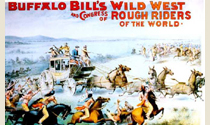
idealized version of the "Wild West" can be traced at least
as far back as Buffalo Bill's Wild West shows which began in 1883. In
fact Buffalo Bill and Texas Jack Omohundro performed one of the earliest
western stage dramas, The Scouts of the Prairie, for eastern audiences
in 1872, while the events being dramatized were still occurring on the
western frontier. In literature, Owen Wister's The Virginian, published
in 1902, was an American start (though not the first Western published
in the United States); but the German writer Karl May was writing Wild
West stories as early as 1876. His books were a major influence on the
founder of Universal Pictures, the German immigrant Carl Laemmle; and
May himself traced ideas at least to the American writer James Fenimore
Cooper, who wrote Last of the Mohicans in 1826.
The
idealized version of the "Wild West" can be traced at least
as far back as Buffalo Bill's Wild West shows which began in 1883. In
fact Buffalo Bill and Texas Jack Omohundro performed one of the earliest
western stage dramas, The Scouts of the Prairie, for eastern audiences
in 1872, while the events being dramatized were still occurring on the
western frontier. In literature, Owen Wister's The Virginian, published
in 1902, was an American start (though not the first Western published
in the United States); but the German writer Karl May was writing Wild
West stories as early as 1876. His books were a major influence on the
founder of Universal Pictures, the German immigrant Carl Laemmle; and
May himself traced ideas at least to the American writer James Fenimore
Cooper, who wrote Last of the Mohicans in 1826.
The western was a distinct literary genre before the rise of motion pictures; other important writers were Zane Grey, Louis L'Amour and Elmore Leonard.