|
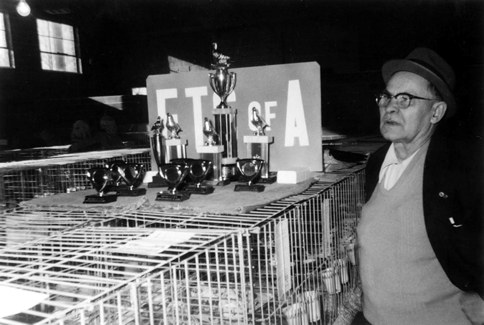
Paul J. Stefanson, ETCA secretary-treasurer
and founder of the modern English Trumpeter pigeon in the United
States. Here at the 1967 ETCA
Annual Meet in New Ulm, Minnesota. (Photo by Scott Perrizo)
Site Menu
Home
About Us
Links
Guide
News
Standard
Club Officers
Gallery
Archives
Contact Us
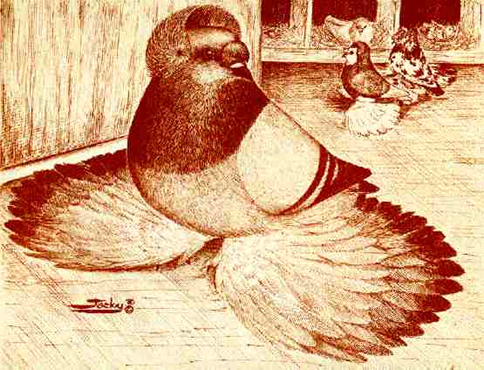
Image used by permission of artist
Diane Jacky |
Standard
ENGLISH TRUMPETER
General Description
The English Trumpeter is a medium sized (similar to a Show Racer),
double-crested, (head and beak) muffed trumpeter. It has many colors
in four basic patterns: self, splash, barred, and marked. The breed
is distinguished from the other double crested, muffed trumpeter
varieties by its short "cobby" low stationed body and relatively
narrow tuft supported by side boards. It has a gentle behavior, rich
"drumming" voice, and is a prolific breeder. The quality specimen of
either sex always shows power, bullyness, proudness, style, type,
and refinement. These distinctive qualities conform to the standard
requirements in a harmonious manner producing a well balanced,
powerful and stylish English Trumpeter.
STANDARD DESCRIPTION
CONFORMATION OF THE HEAD (10 pts.): The size of the head shall be
medium to large while being in balance with the whole bird. The head
shall be broad, full, and flat. When viewed from the top the head
shall be broad, flat and wedge-shaped (wider at the back than the
front). Great width at the back of the skull gives the head a
powerful appearance. Faults: Head shall not be too small (pinched)
or too large, making it out of proportion and balance with the whole
bird. From the top view it shall not appear elongated or lack a
wedge-shape. Head shall not have any appearance of ovalness.
CREST (12 pts.): A desirable crest shall be constituted of the
following:
Height – Crest feathers shall be as high as possible providing the
crest is in proportion and balance with the rest of the bird.
Width – The crest shall be as wide as possible. Its width is
determined by the head’s size, direction of feather growth, feather
length, and wedge-shape. The crest’s distinct demarcation line
(junction between the base of the crest face and skull feathers) and
crest face (front row of crest feathers) emphasizes the width of
both the crest and head.
Wrap – From the top view the crest shall be a semi-circular outline,
wrapping around the back of the head and extending both forward and
outward just beyond but not below the ears, ending in prominent
rosettes (Note: see rosette section for description).
Cushion – The crest’s cushion (feathers located between the back of
the crest face and top of mane) shall be as dense as possible and of
the same height as the crest face. The cushion feathers shall blend
smoothly into the mane without any break.
Placement – The crest shall be positioned on the highest point on
the back of the head. Crest’s position shall remain stationary when
the bird is being handled as well as in the judging pen. From side
view the crest shall rise at a 90 degree angle from the skull with
the top of the crest feathers curving slightly forward. The 90
degree angle will realize the crest’s greatest height potential.
Crest’s demarcation line shall be distinct, defining the base of the
crest face with a finely etched unbroken line.
Faults: Lack of proper feather length. Lack of density in cushion.
No crest wrap. Crest placed too low. Relaxation of crest causing its
displacement into the mane and/or neck feathers (too "loose").
Capping of the crest (falling forward).
TUFT (5 pts.): The tuft is a tassel shaped growth of feathers
protruding from the front of the head towards the beak and curving
over the wattle. The tuft is supported underneath and contained on
both sides by sideboards (dense plumage that grows vertically at the
rear of the beak). Sideboards curve slightly forward to prevent the
tuft from being too high and dense enough to prevent it from being
too wide. The wattle shall not be completely hidden by the tuft from
the side view but it shall be hidden from the top view. The less
skin showing at the line where the tuft originates the better. The
bird’s eyes shall be visible from the front view without any
obstructions. From the front and top view the tuft shall be neat and
narrow. Tuft and sideboards shall be neat, dense, clean-cut, and
have the appearance of a smooth, solid unit. Faults: Circular or
rose tufts as found on Bokhara or German Trumpeters. Tuft feathers
that are swirled, twisted, or growing straight up. Lack of
sideboards or when they are too prominent. Disheveled and sparse
appearance of tuft and sideboards.
ROSETTES (4 pts.): The rosette is a small swirling outgrowth of
feathers radiating from a tiny central point near the ear hole.
There shall be two rosettes, one on either side of the head, marking
the ends of the semi-circular crest. The rosette shall be
approximately ½ inch in diameter. It shall be positioned at the
bird’s eye level and as near the ear hole as possible. Rosettes
shall be prominent when a bird is in the judging pen as well as when
being examined in the hand. Faults: The absence of one or both
rosettes. Rosettes that are too large or too small. Rosettes placed
too low or placed to the rear of the crest. Rosettes that are
unequal in size, or uneven in shape.
EYE (2 pts.): Note: See color descriptions for eye colors. Eyes
shall be deep orange in all colors except: whites, baldheads,
saddles, and those marked patterns where the head feathers are
white; these markings shall have bull eyes (solid black). Eyes shall
be clear, alert, and indicate robust health. Faults: Non-orange eyes
except: whites, baldheads, saddles, and those marked patterns where
the head feathers are white. Non-bull eyes in whites, baldheads,
saddles, and those marked patterns where the head feathers are
white. Cracked, split or odd colored eyes. Wrong colored eyes to be
a fault but not a disqualification.
EYE CERES (0 pts.): Note: See color class description for eye
cere colors. Ceres shall be narrow and as fine in texture as
possible. Ceres shall be flesh color in all colors except: blacks,
blues, lavenders, mealies, and silvers which shall be grayish in
color. Faults: Ceres that are too wide and coarse in texture.
Non-flesh color ceres except: blacks, blues, mealies, and silvers.
Bright red ceres, especially in whites and baldheads, are to be
avoided. Feathers missing around the eye making it appear too
prominent.
WATTLE (0 pts.): Wattle shall be small, white, and fine in
texture. Faults: Too large, non-white, and coarse in texture.
BEAK (0 pts.): Beak shall be medium in length with good substance
and width. Angle of beak setting to be slightly declining (less than
straight). Faults: Too long or too short. Too wide or too narrow.
Not substantial in appearance. Improper angle of beak setting: too
low or horizontal.
NECK (5 pts.): The neck is the area located between the bottom of
the head and the chest. It shall be short, stout and well-developed,
showing "bullyness" and power. The neck length shall range from 1"
to 1 ¾". The neck shall be in proportion to the size of the bird. It
shall have enough length (1") and taper to make it clearly
distinguishable from the head and chest. The neck shall gradually
enlarge from the bottom of the head to the chest from any point of
view. It shall be slightly arched when viewed from the side in order
to give the bird a proud, graceful appearance. Faults: A neck longer
than 1 ¾" or shorter than 1" from chest to bottom of the head. A
neck so short as to appear that the head sits on the shoulders. A
neck so long as to appear gangly. It shall not be thin or snakey.
The neck must not lack taper or cut back sharply under the beak.
MANE (4 pts.): The mane consists of horizontal feathers, on each
side of the head, extending backwards from the ear areas and meeting
under the base of the cushion and above the neck feathers. The mane
feathers shall be long enough to blend harmoniously into the crest
cushion and neck as well as complete the mane. It shall have enough
feathers to give a dense appearance. Mane feathers must have the
quill strength to give the effect of tightness. Faults: Mane
feathers that are too short or lack strength. Loose plumage, lacking
density. A gap in the mane when its two sides do not meet and blend
together. A "break" between the neck feathers and the crest cushion
that disrupts their continuity.
BODY (20 pts.):
Body conformation and weight – The body shall be short, cobby, and
heart-shaped when viewed from the back. This heart-shape shall be
created by the bird’s broad shoulder tapering down to where the wing
tips meet. From the side view the distance between the underbody and
back shall be as deep as possible. Body shall both appear and be
heavy, firm, and robust. Faults: Narrow shoulders. Insufficient
chest to back measurement (caused by lack of underbody). The bird
shall not appear to be, or actually be, light.
Chest/underbody – The chest shall be prominent and its lower
underbody area shall be as deep as possible preventing daylight from
showing between the bird’s legs. From the front view it shall be
full, wide, and deep. The underbody shall conceal the space between
the legs. The shape of the chest shall be well rounded in a graceful
curve when viewed from any angle. The chest feathers shall cover the
wing butts. Faults: Exposed wing butts. Narrow chest from the front
view. Shallow underbody. Flat chest. Broody or over-filled crop
appearance.
Back – The back shall be broad and flat at the shoulders (no
hollowness or roundness) and taper to the end of the rump pad,
giving it an appearance of width and strength. The rump pad shall be
broad and full. Faults: Narrow shoulders. Lack of flatness, i.e.
hollow or round back. Insufficient taper. A rump that is too small
and lacking in density of cushion.
Wings – The wings shall fit tightly to the curvature of the body and
always be carried on the top of the tail. Wing butts shall be hidden
by chest feathers. Wing flights shall end ½ inch from the tip of the
tail. The flights shall lie flat on the tail from the rump to the
wing tips. Faults: Exposed wing butts. Flights not lying flat on the
tail from the rump to the wing tips (these are called "sideboards";
not to be confused with the sideboard of the tuft). Flights dragging
or falling below the tail. Lack of feather cover from shoulder to
rump. Crossed wing flights. Flights extending beyond ½ inch from
inside the tip of the tail. Any missing primary feathers.
Tail – The tail shall be 1 to 1 ½ feathers wide. It shall be short,
extending ½ inch beyond wing tips. A short tail and short flights in
balance with each other are necessary ingredients in having a short,
cobby body. The angle of the tail shall be a continuation of the 45
degree body angle. Tip of the tail shall barely clear the floor.
Faults: Tail wider than 1 ½ feathers ("shovel tail"). Tail that
extends more than ½ inch past the end of the wing tips. Tail that
consistently touches the ground. Less or more than 12 tail feathers.
MUFFS & HOCKS (14 pts.): The muff shall consist of three layers
of circular rows of feathers. The first row on the ground is the
longest and is covered by the second and third layer, each of which
is respectively shorter. Each muff shall have a round shape, dense
plumage, and lay flat on the ground. They shall be as big as
possible providing they are in proportion and balance with the rest
of the bird. The circular outline of the muffs shall be continuous
without any break ("split"). The feet, toes, and legs shall be
completely hidden by muff feathers. The bird shall have good control
of its muffs and shall be able to walk without stumbling. The hock
is made up of feathers above the leg joint that extend rearward,
parallel to the wing flights, ending at the rear of the back muff
feathers. There shall be no space between the hocks and muffs, this
provides the desired appearance of continuity between muffs, hocks,
and body. Faults: Space between muff feathers ("split"). Any feather
not laying flat (twisted or inverted feathers). Non-circular shape
(especially when the muff’s front feathers are longer than the
others). Broken or frizzled feather caused by weak quill strength.
Hock feathers longer or shorter than the back edge of the muff. Any
break between hock and muff.
STATION & LEGS (10 pts.): Station refers to the position or
bearing of the bird while standing. The back (shoulders to rump)
shall be at a 45 degree angle to the ground. The tip of the tail
shall be as low as possible without touching the ground. The angle
of the full rounded chest shall rise gradually and blend with the
short, stout neck giving the bird a proud, alert appearance. The
length of the legs and their setting are important features that
influence the station of the English Trumpeter. Legs shall be short,
the underbody at the leg setting shall be 1 inch from the ground.
Legs shall be set relatively wide apart to give the appearance of
stability and power. It is very important that the English Trumpeter
be calm and alert, yet poised in the judging pen, positioning itself
so as to advantageously show all its features. Faults: The angle of
the back being more or less than 45 degrees. Listless station. Legs
more or less than 1 inch from the floor. Legs set too far apart
giving bow legged appearance. Legs set too close together so that
walking is impaired. Legs that show lameness or deformity. A tail
that consistently touches the ground. Rearing back and sitting on
the tail. Wild or nervous, not showing feathers advantageously while
being judged. A general lack of proudness or elegance ("type" or
"style").
CONDITION OF PLUMAGE (4 pts.): Feathers (plumage) shall be close
fitting, giving an even smooth appearance. They shall be clean and
shiny. Feathers shall be free of any signs of lice, mites, pigeon
flies, or other parasites. Each feather shall not be broken, bent,
or frayed. Faults: Soiled, frayed, broken, bent, or loose fitting
feathers. Presence of parasites (lice, mites, pigeon flies, etc.).
Feathers damaged by parasites. Feathers not completely grown
("green", moulty, or "unfinished").
COLOR (10 pts.): Color referee makes final decision on color
disputes.
SELF: (any solid color; spread factor)
Black – Shall be intense jet black throughout and covered with a
rich, beetle green luster. Orange eyes with gray ceres and black
beak. Faults: Non-orange eye color. Non-gray eye cere. Non-black
beak, stained beak. Smutty or sooty shade of black, any signs of a
bar in the wing or tail.
White –(absence of color pigment in feathers) Shall be pure white
throughout. The feather’s quill and all its parts shall be white.
Shall have "bull" (solid black), with flesh colored beak and eye
ceres. Faults: Non-flesh colored eye cere (especially red) and beak.
Non-bull eye. A stained beak in whites is a disqualification.
Red – (red pigment; intense; recessive red factor) Shall be a deep,
rich, clear, intense red throughout. Shall have as much sheen as
possible. Orange eyes, light horn colored beak, and flesh colored
ceres. Faults: Non-orange eyes. Non-flesh colored ceres. Non-light
horn colored beak. Stained beak. Ash tincture.
Yellow – (red pigment; dilute of red; recessive red factor) Shall be
a deep, rich, golden yellow throughout. Orange eyes, flesh colored
ceres, and light horn colored beak. Faults: Non-orange eyes.
Non-flesh colored ceres. Non-light horn colored beak. Stained beak.
Ash tincture.
Dun – (blue pigment; dilute) Shall be a rich, even shade of brownish
steel gray throughout. Orange eyes, flesh colored ceres and light
horn colored beak. Faults: Non-orange eyes. Non-flesh colored ceres.
Non-light horn colored beak. Stained beak. Showing any signs of bar
or check pattern.
Lavender – (ash red pigment; intense) Color shall be a clear, soft,
ash-gray rather evenly distributed over the entire body. Color
hackle (neck feathers) is slightly darker. Color of flights and tail
slightly lighter. Eyes shall be orange, ceres gray, and beak dark
horn color. NOTE: The color lavender referred to in English
Trumpeters is not the genetic lavender, which has the milky factor.
Faults: Non-orange eyes. Non-gray ceres. Non-dark horn colored beak.
Stained beak.
AOC Self (Any Other Color) – This color class includes all selfs
(showing no white) that have not been described elsewhere in the
standard. Examples: checkers, bronze, kite, smokey bar,
multi-colored birds lacking white feathers. Self colors in this
class must be able to be genetically described. The AOC Self Class
does not include dull colors from the previously listed classes,
e.g. dun bars, dun checks, faded blacks, poor colored reds or
yellows, etc. NOTE: A self colored bird with a few stray white
feathers shall be show in its appropriate self class. The white
feathers shall be considered a fault. Birds fitting this description
do not belong in a splash class.
ALMOND: (Any pigment; T-factor; almond factor) Almond is a factor
which alters or modifies any color that it is introduced into by
causing flecks of various colors to appear in the feathering over
all part of the bird. In the flights and tail three colors: rich
rust yellow, black and white shall occur in combination, each
clearly separated as to color on each feather (this separation is
called "break"). Eyes shall be orange, ceres shall be flesh colored,
and beak shall have a light horn color. Faults: Non-orange eyes.
Non-flesh colored ceres. Non-horn colored beak, stained beak. Color
that deviates from the above description.
SPLASH: Any random distribution of white and colored feathers, no
fixed pattern. There shall be the appearance of an equal number
colored to white feathers, 50% to 50%. Colored feathers shall be
described in their appropriate self color class. NOTE: Due to the
large number of black splashes (at some shows) they are divided into
two classes: light black splash (less than 50% colored feathers) and
dark black splash (more than 50% colored feathers).
MARKED COLORS: Fixed pattern of colored (and white where
appropriate) feathers.
Whiteside – All feathers, except wing shield and secondary wing
flights shall be properly colored according to appropriate self
color class description (currently red and yellow are the only
colors bred but new colors are possible in the future). Wing shield
and secondary wing flights shall be white. Eyes shall be orange,
ceres flesh colored, and beak a light horn color. Faults: White
feathers anywhere except wing shield and secondary flights
(especially flecking in neck, chest, rump or muffs). Colored
feathers on the wing shield or in the secondary flights. Non-orange
eyes. Non-flesh colored ceres. Non-light horn colored beak. Stained
beak.
Mottle – Head and neck shall be splashed or speckled to the chest.
Entire chest, underbody, and tail shall be a solid color. All ten
primary wing flights shall be colored for a perfect mottle pattern.
A minimum of the first three flights (outside flights) shall be
colored to qualify as a mottle. Remaining seven primaries are
preferred to be colored; however, white feathers will be allowed but
recognized as a fault. Colored feathers shall be colored according
to appropriate self color class. Eye ceres, beak color, and eye
color shall conform to appropriate self color class requirements.
Faults: Any deviation from the above description. Feather lacking
intense color. Eye, cere or beak color not conforming to appropriate
self color class requirements. If any of the first three outside
flights are white, the bird does not qualify for mottle competition.
Baldhead – Chest, body, and wings shall be a rich solid color that
conforms to appropriate self color class. Tail to be either a rich
solid color or completely white but not mixed. Front of the head
(including tuft) to the front of the crest face shall be white.
White neck (bib) shall extend around the neck to approximately ½
inch below the tip of the beak when pressed down on the chest. All
the primary flights and muffs shall be white. Eyes shall be bull
(black), ceres flesh colored, and beak light horn color. Point
distribution: The ten points given to color are to be broken as
follows: Four points for quality of color, six points for markings.
Faults: Colored feathers in designated white areas and white
feathers in designated colored areas (called mismarked). Feathers
lacking intense color. Non-bull eyes. Non-flesh colored ceres.
Non-light horn colored beak, stained beak.
GENETIC COLORS: This is an experimental class for new colors and
markings currently being developed and established for future
inclusion as official color classes in the standard. A color or
marking becomes recognized as an official class when there are a
minimum of 3 exhibitors and 16 birds shown in a single show.
Saddle – Entire bird except wing shields shall be white. First ten
primary wing flights shall be white. Wing shields and secondary
flights shall be a solid color like those described in self color
classes. Eyes shall be bull (black), ceres flesh color, and beak a
light horn color. Faults: Colored feathers in designated white areas
and white feathers in designated colored areas (called mismarked).
Colored feathers poorly colored. Non-bull eyes. Non-flesh colored
ceres (especially red). Non-light horn colored beak. Stained beak.
Andalusian – (blue pigment; intense; spread and indigo factors) Body
and tail shall be an even shade of midnight blue shading to black on
the head and neck. Wings are a bit lighter with dark blue edging on
each feather. The indigo factor may be applied to any standard color
but only black indigo is to be known as "andalusian".
Barless – (recessive trait that can be introduced into any barred
color). Any barred color without the wing bars. Barless shall have a
single tail bar. The color description shall be the same as the
barred description with the exception of the missing wing bars.
Eyes, beak and cere requirements to be the same as the barred
variety. Faults: Any sign of a bar or check on the wing shield. Any
deviation from the required eye, cere, and beak colors called for in
the barred variety.
Numpeter – Marked exactly as a Nun (see official Nun Standard).
Muffed Marked – Self colored with white muffs and hocks.
Magpie Marked – Marked exactly as a Komorner Tumbler (see Komorner
Standard).
White Bar – Self colored bird with white wing bars.
BARRED: (solid color; coarse spread factor).
Blue – (blue pigment; intense; bar pattern). Head color to be a
rich even shade of blue-gray. Neck feathers (hackle) to be a bit
darker shade showing a rich sheen of primary green, and secondary
purple, with the color carried out through the secondary feathers
and blending in with the blackish tips of these feathers. Wings,
when folded into the body, should show two distinct black bars. Muff
feathers to be a shade of blue-gray and blending into blackish tips.
Lower back and rump should be powder blue-gray, all other body
feathers should be an even shade of blue-gray. Tail is a bit darker
shade of blue-gray. Slight albescent strip on the outer edge of the
outer most tail feathers. Eyes shall be orange, ceres to be grayish,
and beak black. Faults:Sign of third bar or check pattern. Bronzing
in feathers. Non-orange eyes. Non-grayish ceres. Non-black beak, or
stained beak.
Silver – (blue pigment; dilute; bar pattern). Head, wings, muffs and
body shall be an even shade of light silvery gray. Hackle, flights,
and tail shall be a darker shade. Wings shall have two well defined
dark dun bars. Tail shall have one bar close to the tip of the tail.
Muff feathers shall end in a dark dun tip. Orange eyes, grayish
ceres, and light horn colored beak. Faults: Non-orange eyes.
Non-grayish ceres. Non-light horn colored beak. Stained beak. Yellow
or gold tinge, especially in wing bars or chest. Showing any sign of
a third bar or check pattern.
Mealy – (ash red pigment; intense; bar pattern). Ash red and mealy
are the same color in English Trumpeters. Head, wings, body, tail,
and muffs shall be a soft, light lavender. Hackle (neck feathers)
shall be a dark red ground color with light frosting. Wings shall
have two dark red bars. Orange eyes, gray ceres, and light horn
colored beak. Faults: Non-orange eyes. Non-gray ceres. Non-light
horn colored beak. Stained beak or black beak. Showing any signs of
third bar or check pattern.
Cream – (ash red pigment; dilute; bar pattern). Head, wings, body,
tail, and muffs shall be a light, soft, clear cream. Hackle (neck
feathers) shall be a dark yellow with light frosting. Two well
defined dark yellow wing bars shall be present. Eyes shall be
orange, ceres a grayish white, and the beak a light horn color.
Faults: Non-orange eyes. Non-grayish white ceres. Non-light horn
colored beak. Stained beak. Sign of a third bar or check pattern.
DISQUALIFICATIONS: Birds showing any evidence of cross-breeding
(allowed only in genetic class).
Stained beak in whites only.
Excessive plucking, i.e. leaving a noticeable bare spot or any other
artificial alteration such as scissoring of feathers (most commonly
in crest area).
Three or more wing flights, or primary tail feathers not full grown
(or missing), thus making the bird appear shorter than it is.
Sickness or serious physical deformity.
AWARDING COLOR POINTS IN THE FINALS: When judging for champion of
the show and a white self is involved, the white is to be awarded
the same number of color points as the highest scoring bird in the
finals. A white may never score more points than the highest scoring
colored, splashed, barred or marked bird in the finals.
POINT CARD SYSTEM: The point card system shall be in effect
during the judging for champion. Not less than the final three birds
going for champion shall be point carded. More birds than three may
be point carded if the judge desires. The point system shall be in
effect during all judging (only in the finals must it be written).
SCALE OF POINTS
Conformation Of The Head 10 pts
Crest 12 pts
Tuft 5 pts
Rosettes 4 pts
Eye 2 pts
Eye Ceres 0 pts
Wattle 0 pts
Beak 0 pts
Neck 5 pts
Mane 4 pts
Body 20 pts
Muff & Hocks 14 pts
Station & Legs 10 pts
Condition of Plumage 4 pts
Color 10 pts
TOTAL 100 pts
|
