MAIN EXTERNAL SOURCES OF
DISTURBANCE OF A SPACE VEHICLE
Aerodynamic torque:
The upper atmosphere will create a resistance force that, usually,
it will produce a disturbing torque on the space vehicle due to any
deviation between the aerodynamic pressures centre and the centre of
mass. Exist important uncertainties with respect to the evaluation
of the aerodynamic force therefore it must be treated with the
appropriate conservatism.
Gravity-Gradient torque: An object in orbit
will experience a strongest attraction on its "lower" side
than its "upper" side. This differential attraction, if is
applied to a body that has unequal principal moments of inertia,
results in a moment that tends to rotate the object to align its
long axis (moment of minimal inertia) with the local vertical.
Solar radiation pressure torque: The solar
radiation pressure can produce disturbing moments in addition to
forces, that they can require compensation by the system of control
of attitude. The moment by solar radiation is independent of the
speed or the space vehicle position, exists while the vehicle be
illuminated by the sunlight, and it is always perpendicular to the
sun line. To the altitude of the geostationary orbit, the pressure
by solar radiation can be the primary source of disturbance torque.
Magnetic torque: The Earth and the others
planets such as Jupiter, that have a considerable magnetic field,
yet exercise other moment on the spatial vehicle in low orbits.
Miscellaneous disturbance torques: In addition
to the torques introduced by the foreign environment of the space
vehicle, exists a variety of other disturbance sources of the
attitude, many of they generated by the space vehicle during the
course of its operation. The fluids ventilation, accidental as well
as deliberate, they are a common source of disturbance torques of
the spatial vehicle. The disposable pieces, such as doors or lens
covers, will produce an instant torque of reaction when are untied.
Of greater meaning also in the control of attitude of the spatial
vehicle are the internal torques, resulting from the exchange of
momentum between internal mobile pieces. This not has any effect on
the total momentum of the system, but it can influence and influences
the sensors direction mounted in the vehicle and in the circuits of
control of attitude that they could be operating. Typical internal
torques are ones due to antennae, solar panels, movements of
exploration instruments, or to other deployed arms and appendices.
Go to main page.
PASSIVE ATTITUDE CONTROL
The passive stabilisation techniques are taken advantage of basic
physical principles and of forces that are produced spontaneously to
design the space vehicle reinforcing the effect of a force while
other are reduced. In effect, will be used the analysed disturbance
torques previously to control the space vehicle, choosing a design
such that emphasise a torque and ease the others.
An advantage of the passive control is the capacity to achieve a
very long life of the satellite, not limited by onboard consumable
or, possibly, even by the wear and mobile pieces break. The typical
disadvantages of the passive control are the relatively poor total
accuracy and response something inflexible to changing conditions.
Where these limitations will not be of interest, the passive
techniques will operate very well.
Stabilisation by rotation: A basic passive
technique is the stabilization by rotation, in which the gyroscopic
intrinsic "inflexibility" of a rotary body is used to
maintain its direction in the inertial space. If is not manifested
any external disturbing torque, the momentum vector stays fixed in
the space, constant in module, address and sense. The stabilization
by rotation is useful in a number of special cases where the
reliability and the simplicity are more important than the
operational flexibility. The satellites intended for geostationary
orbits, for example, they are usually stabilized by rotation for the
two ignitions required for the transfer orbit.
Stabilization by gravitational gradient: Space
vehicle, in a reasonably lower orbit, will tend to be stabilized
with its axis of moment of minimal inertia in vertical direction.
This property can, obviously, be used as an advantage by the
designer when is wished a zenith or nadir direction for particular
instruments. The usual way to obtaining the inertia properties of
the required space vehicle (that is to say, long and thin) is to
deploy an arm moved by motor with a relatively heavy mass in the top
(several kilograms). The control of attitude by pure gravitational
gradient does not provide yaw stability; the space vehicle is
thoroughly free to rotate on its vertical axis.
Aerodynamic and solar pressure stabilization:
As the case of the gravitational gradient, the existence of
aerodynamic torque and solar radiation pressure torque induces to
think about the possibility of its use in the control of the space
vehicle. In fact, this already has been accomplished, though its
flights record will be considerably small compared with the case of
the gravitational gradient.
Go to main page.
ACTIVE ATTITUDE CONTROL
Concepts of control by feedback: The basic concept
of active control of the attitude is that the attitude of the
satellite is measured and compared with the wished value. The signal
error thus developed is used then to determine a correcting torque
maneuver, that it is implemented by onboard actuators. Since the
external disturbances will follow occurring, and since the
measurements as well as the alterations will be imperfect, the cycle
will continue indefinitely.
Reaction steering wheel: Reaction wheels are a
common election for the control of active attitude of the
spacecraft, particularly with unmanned spacecrafts. In this manner
of control an electrical motor united to the spacecraft makes to
turn a small wheel, of free rotation (as the plate of a record
player), of which, the rotation shaft is aligned with the vehicle
axis to control. The spacecraft must carry a wheel by axis for a
complete attitude control. The reaction wheels give a very rapid
response compared with other systems. With such system, the
spacecraft rotates in one way and the wheel of the way opposed in
response to torques applied externally on the spacecraft. Of the
application of the theorem of the momentum, the integral of the
total torque applied in a period of time will produce a variation of
the total momentum stored onboard of the spacecraft, that will go to
the wheel or rotary wheels, depending on how many axis are
controlled.
Inertia wheels: When a reaction wheel is
destined to operate at a relatively high speed (perhaps several tens
revolution per minute), then is effected a change in the terminology
as well as in the logic of control. It is said that the spacecraft
possesses an inertia wheel; a circuit of control based on a
tachometer maintains the speed of the wheel to a value nominally
constant with respect to the body of the spacecraft. This speed is
adjusted slightly up or down in response to the external torques.
When the range of these adjustments exceeds what the designer of the
system of control has fixed as the limit, the exhaust of momentum
permits that the speed of the wheel will be returned in the wished
range. The use of an inertia wheel in a spacecraft offers the
advantage of a considerable gyroscopic stability. This is, a given
level of the disturbing torque will produce a much smaller change in
the wished nominal position of the spacecraft because of the
relatively small percentage of change that produces in the total
momentum vector of the spacecraft.
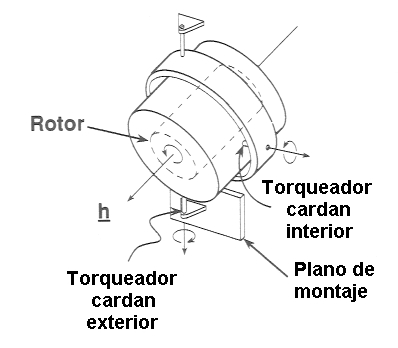 Inertial
gyroscope of control : The inertia wheels can be used yet in
other configuration, as inertial gyroscopes of control. The inertial
gyroscope of control is basically an inertia wheel in a fork, as the
shown in the figure, with the fork put perpendicular to the rotation
shaft of the wheel. A torque applied to fork produces a change in
the momentum perpendicular to existing momentum vector, and thus a
reaction torque on the set.
Inertial
gyroscope of control : The inertia wheels can be used yet in
other configuration, as inertial gyroscopes of control. The inertial
gyroscope of control is basically an inertia wheel in a fork, as the
shown in the figure, with the fork put perpendicular to the rotation
shaft of the wheel. A torque applied to fork produces a change in
the momentum perpendicular to existing momentum vector, and thus a
reaction torque on the set.
Magnetic torquers: A spacecraft that travel to
the relatively lower height on a planet with an appreciable magnetic
field is able to do effective use of magnetic, torquers particularly
for the initial acquisition manoeuvres of attitude and to unload
excess of momentum of reaction wheels.
Reaction jets: The reaction jets of control are
some effective and common means of providing control of attitude to
the spacecraft. They are the standard equipment of the manned
spacecrafts because can exercise quickly forces of large control.
They are also common on satellites destined to operate in relatively
high orbit, where no magnetic field will be available for the unload
of momentum. As consideration to these advantages, the reaction jets
of control use consumable, such as a neutral gas (e.g., Freon or
Nitrogen) or hydrazine so much in mono-propellant as bi-propellant
systems. Generally it is unacceptable to have only a jet operating
for a axis of control, because its failure will let incapacitate to
the spacecraft in that axis.
Go to main page.