


Yakovlev Yak 9D
Country: Soviet Union
Period of activity: 1940-1945
Crew: 1 member
Dimensions: 10 m. breadth; 8,48 m. length;
2,64 m. height.
Weigh: 2.347 kg. in emptiness; 2.847 kg. maximum in takeoff
Autonomy: 900 km.
Engine: Klimov M105P, of 12 cylinders in V and 1.100 CV
Speed: 600 km/h maxim; raise to 5.000 m in 5'24"; 10.000 m. service's roof
Armament: A fixed cannon 20 mm.; two machine guns of 7,62 mm.; load of 200 kg. of bombs and rockets
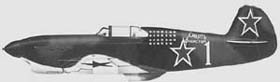
Of the Yak, which was taking its name from his designer Alexander S. Yakovlev more than 30 several models were produced. The Yak 1, which realized its first service in January 1940, was a light and agile monoplane of lower wings that was weighing 2.820 kilos. It was obtaining the 595 km/h. and had autonomy of 700 kilometres. It was armed with two machine guns and one cannon of 20 mm. This airplane could compete with Bf-109 F-2 German, who began to go out of Messersmicht's factories one year before. Yak-1 was consisting of a tense wing "cantilever" very low, closed cockpit and retractable landing gear. Begun to produce at the end of 1940, for the summer of 1943 8.721 units had to be built. There carried out several models of the same series (Yak-1B, with a back cut away fuselage, which was leaving a diaphanous cover "of bubble" of the cockpit; Yak-1M; Yak-3; Yak-7 or Yak-9).
The type 9, most spread during the II World war, was lightly faster than its predecessors, but it was overcoming in much as for autonomy, 900 kilometres, for what it turned into the device of escort most estimated by the Soviet bombardiers that were attacking the German industries and, especially, the Romania's oil fields. It was arming with a cannon of 20 mm. of front shot mounted in the engine; two machine guns fix in the most top part of the front fuselage, that shoot ahead and a load of bombs and rockets of 200 kg.
