


Messerschmitt
109 E MCountry: Germany
Period of activity: 1940 h.
Crew: 1 member
Dimensions: 9,87 m. breadth; 8,64 m. length;
2,5 m. height.
Weigh: 2.125 kg. In emptiness; 2.915 kg. maximum weight in takeoff
Autonomy: 660 km.
Engine: A Daimler-Benz DB 601N, 12 cylinders in V inverted and 1.200 CV
Speed: 560 km/h. maxim; 7 '45" in raise to 6.000 meters; 10.500 m. service's roof
Armament: 2 machine guns of 7,92 mm. In frontal shot on the front fuselage; 2 fixed cannons of 20 mm. of frontal assault, on the wings. 250 kg. of bombs
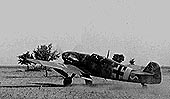
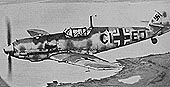
The Messerschmitt Bf 109 were begun to use from 1940 in missions of fighters-bomber, carrying a bomb of 250 kg., while other variants as the Bf 109E-5 and E-6 were used as recognition fighters without cannons. The model Bf 109E-7 was a development of E-4/N, being able to take an engine for to be thrown instead of a bomb.
Other models were the Bf 109E-7/Trop, the Bf 109E-7/U2, with bigger armour for missions of assault air -land; or the Bf 109E-7Z provided with major power thanks to a system of push based on nitrous oxide. A new model was the Bf 109E-8, developed from 109E-7, equipped with an engine DB 610E of 1.350 CV; or the Bf 109E-9, recognition fighters developed from E-8, capably of carrying cameras and without cannons in the wings. Stopped making at the beginning of 1942 of its version Bf 109E, practically all the variables were taking two or three cannons of 20 mm, with great capacity of fire and scope.
Its bigger lack was the limited radius of action, which was not revealed as a serious problem until the Battle of England. Thought as a weapon of support to the rapid advances of the Werhmacht during the Blitzkrieg, it was made necessary change airport several times, or even to improvise runways on fields of grass, which was provoking a few accidents. In the Battle of England, they met an enemy of its level, Spitfire Mk I.
The German fighter was a little faster, was carrying cannons and could realize fall down that the English could not execute, however this one was any more manoeuvre. In spite of it, a disadvantage was revealed like decisive: its scarce autonomy come down to 80 minutes, was turning out to be fatal in combat against the English fighters, which besides were flying on its own air space, what was allowing fill up quickly. Going out from the French airports, after crossing the English Channel only it were having of 20 minutes to fight, for what many fighters sank in the sea on not having been able to return to its bases. Besides, its scarce radius of action was limiting its assaults to the southern zone of the British Isles. The principal mission entrusted Me 109, was to escort to the average bombardiers He 111, Do 17 and Ju 88, which were turning out to be very vulnerable without its support. Such a defensive mission turned out to be a strategic mistake, since they were forced to not separate of the bombardiers, which was reducing capacity of action against the English Spitfire.
