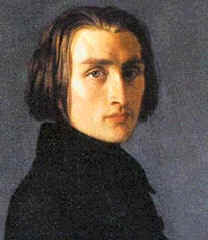
Franz Liszt
Considered
to be one of the world’s greatest pianists, Franz Liszt’s career spanned
virtually the whole of the Romantic period.
He
taught and aided two generations of younger musicians and laid the foundation for much of
the 20th century’s composition.
He
was the son of a talented amateur musician who was a steward in the service of the
Esterhàzy family.
Liszt
was a child prodigy at the piano and, by the time he was eleven, he had performed in many
parts of Europe.
In
1821 he left Hungary and moved to Vienna where he studied piano with Czerny and
composition with Salieri.
Two years later he went with his family to Paris where he was recognised as a brilliant performer and quickly became a favourite of the wealthy French families.
In
1830 he met Chopin, Berlioz and the violinist Paganini, whose virtuosity inspired Liszt to
explore the expressive possibilities of the piano.
As
a young man in Paris, Liszt was as famed for his affairs of the heart as for his piano
technique.
In
1835 he eloped with his mistress, the Countess Marie d'Agoult, to Switzerland and they
spent the next few years in the Alps and in Italy.
Soon
Liszt began a vagabond life that took him to every capital in Europe where he achieved
tremendous success as a pianist.
In
1844 he separated from his mistress, by now the mother of his three children, and four
years later he settled in Weimar, with Princess Carolyne Sayn-Wittgenstein, and was
appointed Court Kapellmeister.
In
Weimar he abandoned his performing career and turned his attention to composition.
Public
denouncements on his relationship with the princess forced Liszt to move to Rome in 1861.
Here
he found expression for his long-held spiritual leanings and he composed many religious
works. In 1865 he joined the Franciscans and was given the title of Abbé.
From then on he divided his time between Rome, Weimar, where he had many pupils, and Budapest, where he was regarded as a national hero.
Some of his most famous works are:
Transcendental Etudes (No. 10)
La Campella (Paganini Etudes No. 3)
Hugarian Rhaspodies 1-20 (You are listening to No.2)

 Baroque
Classical
Romantic
Modern
Baroque
Classical
Romantic
Modern