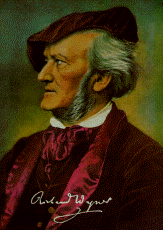
Richard Wagner
Wagner
was a remarkable innovator both in harmony and in the structure of his work, creating his
own version of the Gesamtkunstwerk, dramatic compositions in which the arts were brought
together into a single unity.
As
a man he was prepared to sacrifice his family and friends in the cause of his own music
and his overt anti-semitism has attracted unwelcome attention to ideas that are remote
from his real work as a musician.
In
the later part of his career Wagner enjoyed the support of King Ludwig II of Bavaria and
was finally able to establish his own theatre and festival at the Bavarian town of
Bayreuth.
He
developed the use of the Leitmotiv (leading motif) as a principle of musical unity, his
dramatic musical structure depending on the interweaving of melodies or fragments of
melody associated with characters, incidents or ideas in the drama.
His Prelude to the love tragedy Tristan und Isolde led to a new world of harmony.
But
perhaps the most famous and well-known one is his opera, 'Die Ring dus Niebulung', or 'The
Ring is Niebulung'.
Some of his most famous works are:
"Die Walküre": Ride of the Valkyries
 Home
Home