Summer Adventure '01
(i.e. I heart NY)
Among other things, I spent ten weeks
of the summer prior to my Senior year in Albany, New York doing research
for the New York State Dept. of Health. I had a really awesome time
and would do it all over again - provided it was in the summer and I could
find my earmuffs.
Here's the best way I could come up
with to tell you about it all (or "awl" in NY speak):
Who
What
When
Where
Why
Summer Updates
With whom did I spend
my time?
During the day I spent my time with
my lab mates in the Wadsworth Center. I did research for Dr. Xinxin
Ding and there were about ten people in his group. Specifically,
I worked with Guoyu, who is a grad student there. Much like the rest
of the folks in the lab, he's a M.D. and native Chinese. It was an
interesting summer in that respect because I learned a ton about China
and stunned them with my comparatively relaxed GRE study habits and love
for doughnuts.
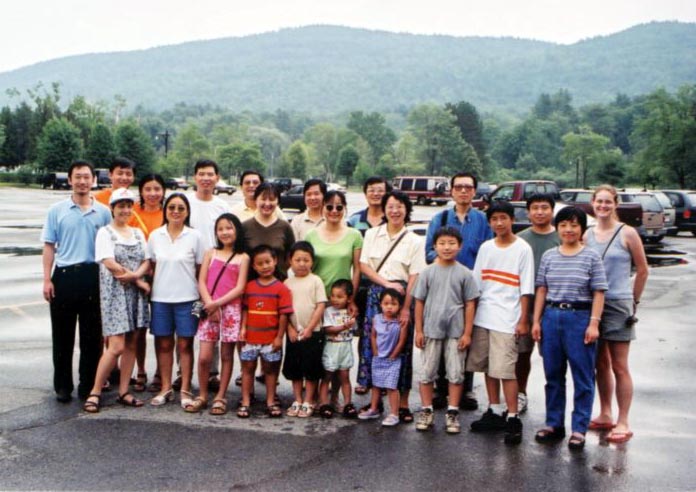
One Saturday we all went to Lake George and cooked
out, played volleyball, and got wet (via lake and rain). It was a
lot of fun and I liked chilling with the cute kids. Guoyu is in the
blue polo on the left and I'm the pale girl on the far right. I know
you were having difficulty finding me.
But in reality, lab schmab, I spent time
with the other interns living at the College of St. Rose. We were
an eclectic bunch. There were twenty-two of us, so there was pretty
much always something going on and if there wasn't, well, there was always
the option of video games in Mark's room. I never played, but watching
was far more interesting than studying for the GRE as was about anything,
including watching water drip from my ceiling.
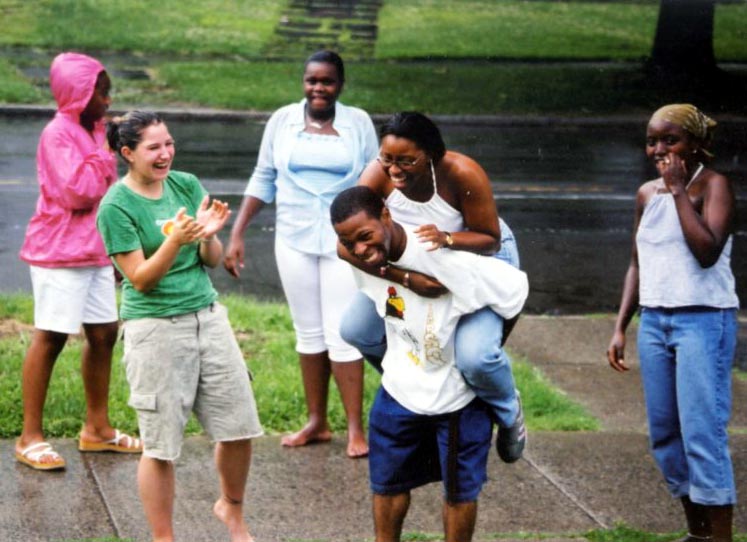
Playing in the rain was a favorite pastime.
L to R: April, Vicki, Christal's sis, Stanley, Darralyn,
Jacque
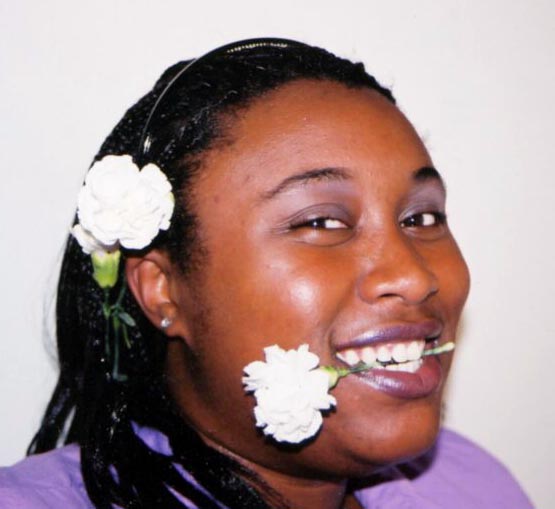
This was the stunning Christal on her birthday.
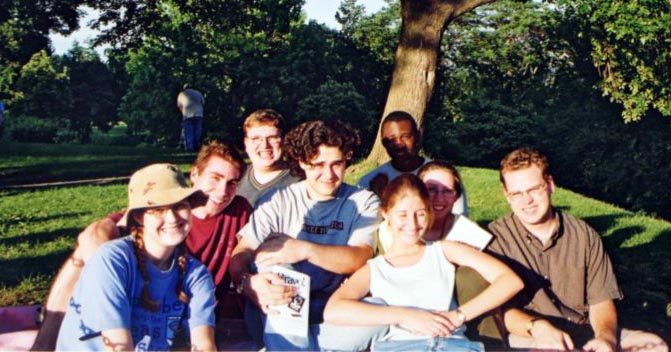
One evening a group of us went to go see a performance
of "Oklahoma" in Washington Park. As a show, it was okay. If
you've never seen it, don't let me ruin it for you but let's just say it's
a tad predictable. The song for which it is known is pretty cool,
though. Anyway, the point was it was free, we had fun, and I wheedled
a bag of Skittles off Steve. L to R: Me, Steve, Eli Sean, Aleck (in
back), Megan (in front), Chrysa (great accent!), and Mark. Dave should
be in there too, but he's camera phobic or something.
Up
What did I do this
summer?
In more or less random order:
Up
When was I there?
My internship was from June 4 - Aug
10, 2001.
Up
Where was I?
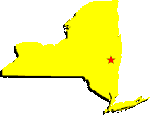
I lived in the lovely city of Albany,
NY. It's a cute place, right on the Hudson River in a valley.
It has a bunch of historical homes, too. It's the red star, which
is roughly sixteen hours from Charlotte, NC, three hours from NYC, and
four hours from Rochester.
Up
Why was I there?
Well, simply put, I was there to do
biological research, thanks to the nice people at NSF who saw fit to pay
me. But then, I know you are far too interested in my facinating
summer to be content with that answer. I can't tell you everything
I did because technically it belongs to NYS DOH, but I will show you the
introduction to my end-of-internship summary paper. Don't get too
excited.
Cytochrome
P450s have optimal spectral absorbency around 450nm when bound by carbon
dioxide in a reduced state and are monooxygenases that oxidatively biotransform
a plethora of chemicals, including xenobiotics and steroids. These
proteins are capable of interaction with substrates by either detoxifying
harmful chemicals or converting inert compounds to reactive intermediates
that cause biochemical and / or physiological alterations that produce
toxic effects, such as cellular damage, cell death, or tumorigenesis (1).
P450s are most commonly found in the liver, though they are present throughout
the body. P450s vary from individual to individual, both within and
across species.
One important P450 is CYP2A3,
which is found in the olfactory mucosa of rats. This protein is homologous
to CYP2A6 and CYP2A13 in humans and is involved in the bioactivation of
nitrosamine compounds commonly found in tobacco, which are carcinogenic.
Within the promoter region of this gene is a nasal predominant transcriptional
activating (NPTA) element that has a similar sequence to the binding site
for The Nuclear Factor proteins (2). The NF1 family is a group of site-specific
DNA-binding proteins that are involved in the regulation of transcription
of numerous cellular and viral genes due to the common presence of their
binding sites in the promoter, enhancer, and silencer regions of the genes.
Though NF1-like factors are found in nearly all organs and tissues (3),
the NPTA element within CYP2A3 interacts only with a form of NF1
located in the olfactory mucosa. NPTA element is considered to play
a critical role in the expression of this gene in the nasal tissue and
is conserved in rat CYP2A3, mouse Cyp2a5, and human CYP2A6.
Little is understood about
the mechanism of tissue-specific gene expression. The application
of this knowledge to P450s would explain tissue-selective toxicity, which
is important in assessing the risk of an individual exposed to exogenous
compounds, such as tobacco smoke. Because of its relevance to public
health, CYP2A3 was studied. In this project, the gene expression
of CYP2A3 due to the NPTA element in its promoter region was investigated.
An adenovirus-infected mouse model will be helpful in order to confirm
the role of the NPTA element in CYP2A3 transcriptional activation in vivo,
as suggested by in vitro data obtained in previous studies (2). An
adenovirus containing a LacZ reporter gene driven by a CYP2A3 promoter
with a mutated NPTA element was generated for this purpose. This
was accomplished by constructing a plasmid carrying the mutation, recombining
it to an adenoviral shuttle vector, and transfecting mammalian cells to
generate the mutant virus.
1. Cytochromes P450: Metabolic and Toxicological
Aspects. ed. Costas Ioannides. 1996. CRC Press, Inc.
2. Zhang, J., and Ding, X. (1998) The Journal of
Biological Chemistry. 273, 23454-23462
3. Gronostajski, R. M. (2000) Gene. 249, 31-45
If that was a bit overwhelming, here's
the gist: I made a mutant virus so we could see if a DNA sequence did what
we thought it did.
Up
I want to go
where the heart is.