
|
|
|
by Gay Bouterey |
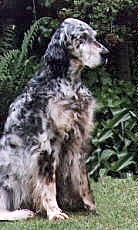 |
1977-1989 Pet Name: Pepper Tri-Colour Bitch Breeder: Mrs S D J Ridout Sire: Shelta Snow Star Dam: Ch Jasele of Lasscinda Owner/Trainer: Gay Bouterey |
| In 1978 I started training my first English Setter. She was destined to become the first of her breed in New Zealand to qualify C.D.X. and became an Obedience Champion, Ob Ch Sensation of Sunbury CDX. Pepper, as she was known, was bought for a pet and speyed while young. She showed some early promise by winning her first Ribbon Trial, but it was several years of trial and error training, before she became good enough to be competitive in top competition. Pepper was a dog with tons of character. Together we won a lot of prizes, and had some great times. She was still working well when retired from competition at 11 years of age, and proved this by winning one of her last shows with a Challenge Certificate. While she would never have made a good "show" dog, she was a fine example of the lovely nature typical of the breed. I will never forget her. |
|
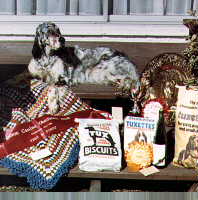
Obedience Career Record 5 Obedience Challenge Certificates 32 1st Placings 46 2nd Placings 43 3rd Placings |
 |
| Since 1980, several other owners
have also qualified their dogs Companion Dog Excellent (C.D.X.)
- |
| Mr P. Brennan | Ch Lord of Glenbrennan, CDX |
| Mr K. Culverwell | Jetsetter Ado Annie, CDX |
| Mr P. Hodges | Tudor Court Banner, CDX |
| Mrs G. Bouterey | Ch & Ob Ch Saxilby Sunshine Sika, CDX |
| Mr D. Ross | Ch Glengordon Golden King, CDX |
| Mrs S. Ross | Ch Velenetter Heaven Sent, CDX |
| Mrs G. Bouterey | Ch Saxilby Sylva Lace, CDX |
| A very short list, compared to many
other breeds, but I consider this to be more a reflection of handler
ambition (lack of), rather than dog ability. Top obedience competition
handlers tend to be very competitive, highly motivated people - often not
the type of person who acquires an English Setter.
Many owners have done domestic level courses in basic obedience, and have managed to do this very well. The time spent doing a course is not wasted, as a young English Setter can be just as naughty and in need of discipline as any other puppy. The few owners who have gone on to competition obedience have often found the Retrieve exercise to be a real stumbling block. Many have tended to give up at this point, but a few dedicated handlers have progressed beyond this. It takes a lot of work, though, to achieve the precision needed to be competitive in the higher Tests. The English Setter is a breed that needs time to mature, and they seem to produce their best efforts after about 2 - 3 years of age. Early basic training is very important, to instil an interest in retrieving, and to establish a good handler/dog relationship, which will be an advantage whether or not you carry on to do competition work. With Pepper, due to my inexperience, I spent a long time teaching the retrieve exercise (over a year), but eventually I triumphed, and she became very reliable. I didn't spend as long teaching my second dog, Sika, as I had a lot more knowledge of training techniques by this time. Fortunately, English Setters are generally very forgiving, and training mistakes can usually be corrected given time. Training an English Setter is really not a lot different from training many other breeds. You need a firm (but not harsh) hand and a lot of determination and perserverance, as well as patience. Heavy use of a thick choke chain is not the way to do it. I now use a plain collar. Training sessions must be animated and varied - if you don't show enthusiasm, your dog won't either. The use of food, as a training aid, should not be underrated. It can sharpen up their responses considerably. In my experience, they are not a "fast" dog, as say a Border Collie is, their reactions tend to be slower. This certainly doesn't mean they lack intelligence. I consider it more a reflection of their calm temperament. This calm temperament is a distinct advantage when it comes to the stay and scent exercises. While they may not have the heeling brilliance of some breeds, they more than make up for it by being very reliable in other exercises. |
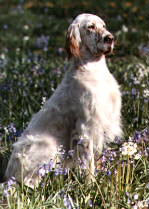 |
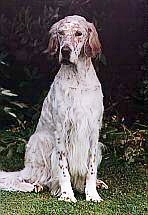
1983-1995 Pet Name: Sika Orange Bitch Breeder: Mr & Mrs D. Swift Sire: Ch Sunswift of Sunbury Dam: Saxilby Smarty Pants Owner/Trainer: Gay Bouterey |
| In 1984 I started training my second English Setter bitch, Sika. She was closely related to Pepper, but their temperaments were completely different. While they both had the typical placid nature of the English, Pepper was an independent type, with a mind of her own. Sika was clingy, very dependent on me, and quickly lost confidence if she made a mistake. But, because she was constantly trying to please me, in some ways she was easier to train, and her work was neater and more precise. Sika won her way steadily through each grade, and one of my biggest thrills was winning a Test B on the same day that Pepper won her last Test C. I also did a limited amount of breed showing with Sika, and made her up to a Show Champion. While I initially struck a few problems with Test C, not to mention gaining five second place Challenge Certificates before managing a winning one, I was very proud when she gained the title of Ch & Ob Ch Saxilby Sunshine Sika CDX, the second Obedience Champion and the first dual Champion of the breed. Sika was retired at 10 years of age and lived out a happy retirement as my close companion until nearly 12. |
|
Obedience Career Record 10 Obedience Challenge Certificates 43 1st Placings 34 2nd Placings 37 3rd Placings |
 |
 |
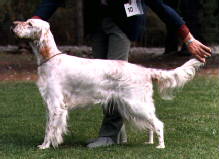
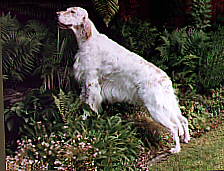
1991 - 2002 Pet Name: Lacey Orange Bitch Breeder: Mr & Mrs D. Swift Sire: Boisdale Forest Prince (Imp UK) Dam: Ch Saxilby Shantilly Lace Owner/Trainer: Gay Bouterey |
|
In 1991 I acquired my third bitch, Lacey. Also closely related to my other two, she is a totally different kettle of fish, as they say. She is outgoing and a real tomboy (probably the result of being the only bitch in the litter!). Of the three, she has been the easiest to train, being somewhat of a lateral thinker and with a good memory. Despite being quite boisterous at times, Lacey still has that easy-going gentle nature typical of the breed. Not long after I got her, I attended a Workshop on obedience training held by Sylvia Bishop, a well known dog trainer who was visiting from the United Kingdom. This together with books written by Dr William Meisterfeld, a dog psychoanalyst from United States, as well as a Seminar held by him in New Zealand, has greatly influenced my training techniques. Lacey has also been successful in the breed ring and was made up to a Show Champion. I sometimes hear people comment that you can not do both showing and obedience at the same time, but I would often go straight from a breed ring to an obedience ring (or vice versa) and have equal success in both. Lacey also competed in agility competitions for a short time and gained a few clear round certificates to prove she was capable if not very fast! In Obedience, Lacey won her way through the grades and competed successfully at Test C level, but because of health problems didn't get a chance to win her Obedience Champion title. |
|
Obedience Career Record 36 1st Placings 26 2nd Placings 32 3rd Placings |
 |
| Often people ask me if it is easier to
train dogs or bitches. As I have only ever trained bitches, I can not
really say, but I have noticed that some dogs are easily distracted by
smells and are considered by some to be more stubborn. But that is a
matter of opinion, and I suspect that the ability of the handler has a lot
more to do with it. I have certainly found it easier to train a speyed
bitch. Both Sika and Lacey’s training suffered setbacks, when after every
season they would have a false pregnancy and sink into a deep depression
for several months. This was not conducive to getting the best out of
them, but I used to keep plugging on. After having them speyed I found it
a lot easier to keep their training consistent, and in Lacey’s case, the
improvement was quite dramatic.
Very few English Setter owners have ventured into other related activities such as tracking and agility training. I have done a limited amount, but while Pepper and Sika were good at the tracking and scent work side of it, I was unable to get either of them to do the scale jump. They were quite happy, though, to go around a regular agility course; over clear jumps, long jumps and through tunnels etc. Lack of spare time has previously prevented me from getting into these areas seriously. English Setters make wonderful companions and family dogs. While they will never be the first choice of most people looking for a top obedience competition dog, I think I have managed to prove that, with the right training, they can be very successful at this as well. They will always be my first choice! |
|