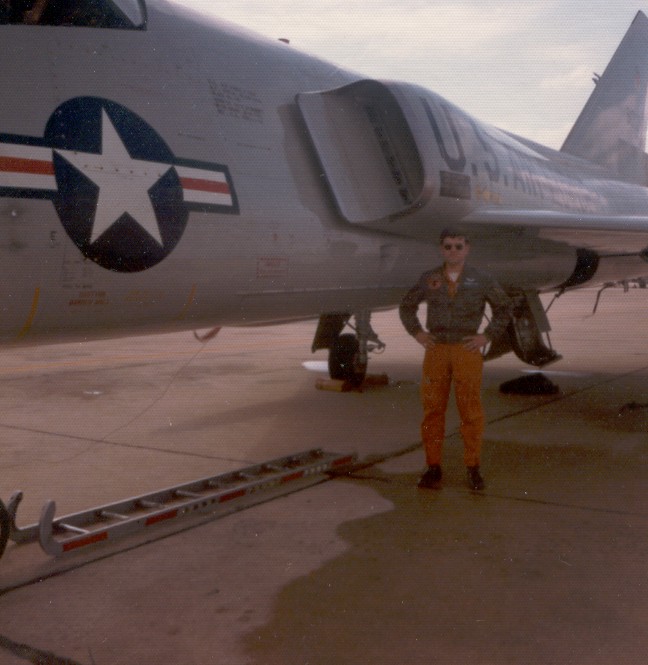
The 400 pound canopy was gone in the blink of an eye, then the seat cooked off, hurling me up and out of the cockpit into the 400 knot blast. I can remember that feeling to this day, a feeling as if a giant hand had reached down from the heavens and grabbed me by the scruff of the neck and just yanked me up with more power then I could ever imagine. My eyelids closed, unwillingly, but I never lost consciousness and about then I realized that everything was going in slow motion. It takes about 2.5 seconds after pulling the ejection seat handles to be under a full chute. To me it seemed like eternity. I kept track of each event in the ejection sequence in my mind, the seat going up the rails, the seat belt being blown from my lap, the butt snapper being reeled in by the force of its explosive shell tearing my hands from the death grip I still had on the ejection handles and hurling me away from the seat and its possible entanglement with the opening parachute, then falling away from the seat, my eyes still forced shut, the parachute arming lanyard being pulled and the 12 gauge shotgun shell tearing the canopy from its pack. My arms were straight out to my sides, the force of the wind so great it took all my strength to pull them into my lap, then like a rag doll on the end of a rope, I was snapped by the deploying canopy above my head.
I immediately reached up to shift my helmet, which had come down over my eyes, and pulled my oxygen mask back up, over my face. I then quickly looked around to see if Jack had made it out all right and I soon saw his white, billowing canopy several miles north of me and a lot lower to the ground; he had made it out at least.
I then noticed the impact area of the aircraft; it had already gone in. I could see fire, swirling water and an oil slick just 50 to 100 yards east of the main power plant in Marquette. It was in the lake, but just barely. I breathed a sigh of relief that it had not gone in on the city. Of course there was nothing Jack or I could have done to prevent it if it had, after all there was no controlling its direction after the hydraulics went out.
I then quickly went through my post ejection procedures. I looked up and checked the canopy, no tears, fully deployed; all lines intact, no twisted or entangled lines to deal with there. I raised my helmet visor and discarded the oxygen mask. I reached down to the left side of the seat kit and pulled the small yellow handle to deploy it. Next step; perform the four line cut. Two red rope loops were positioned an arms reach up the rear two risers, by pulling sharply on these you would cut four lines connected to the back of the parachute canopy, allowing trapped air to escape and thereby giving you the ability to steer the chute. I tugged sharply on the two loops and the lines gave way. Now by pulling down on either rear riser I could turn left or right. I could now appreciate the strong north wind that day because it was now evident I wasn't going to land in the frigid waters. As I looked down, I could see that the wind was taking me right down Route 41, the main thoroughfare coming into Marquette from the southeast. But I was still high enough to try to steer clear of the road, so I started pulling down on the left rear riser, sure enough it turned left. I saw an open field to the east about half a mile. If I could just make it there I would not have to worry too much about my landing. As I approached the ground I got my feet and knees together, but had to close my eyes. Before I knew it I was on the ground, on my right side and had landed on soft moss. The mesquitos began feasting on me, but I was soon spotted by a linesman working nearby and he helped me out to a waiting chopper.
The safety investigator later told me he had never seen anyone do all the post ejection procedures so flawlessly. |