The Cuban Missile Crisis

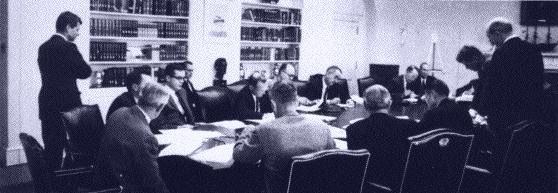 |
A meeting of the ExComm during the missile crisis of 1962.
���In April of 1962, Khrushchev began to ponder the idea of placing missiles in Cuba, for several reasons: to increase Soviet nuclear power; to prevent the United States from invading Cuba, and to eliminate the advantage the U.S. held due to their military bases along the perimeter of the USSR. Soviet officials decided that twenty-four medium-range ballistic missile launchers and sixteen intermediate-range launchers would be placed in Cuba. On May 30, 1962, Castro informed Soviet officials that they would accept Soviet nuclear weapons on Cuban soil. The reported reasoning of Castro is that he felt the missiles would prevent a U.S. invasion of Cuba, he hoped to give the upper hand militarily to socialist forces, and he felt indebted to the Soviet Union for its support of his regime.
���The first hard evidence of medium-range ballistic missile sites is not obtained until October 14th, 1962. The morning of October 16th, President Kennedy is informed of this information, and he immediately calls a meeting of 14 or so of his top advisors. This group becomes known as �ExComm��the Executive Committee of the National Security Council. The missiles do not appear to be operational at this time, however they should be fully operational in two weeks. ExComm comes up with four possible ways to deal with the situation: an air strike on the missile bases, an attack on certain Cuban facilities, a comprehensive series of attacks and invasion, or a blockade of Cuba. At first, military action is favored, but by the time the committee brings its recommendations to the President, almost all of the members are for the blockade. On October 20th the final plans for a blockade are set and a speech is drafted for President Kennedy. As a blockade is against international law, they call it a quarantine. It is decided that each ship heading to Cuba shall be stopped for an inspection. If the ship does not comply, measures can be taken to immobilize the ship, such as shooting the rudder.
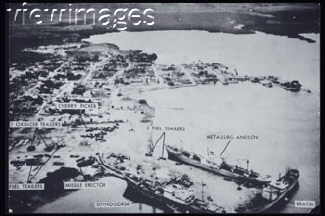 |
A reconnaissance photo of Cuba taken by the U.S.
���The evening of October 22nd, President Kennedy addressed the nation in a televised seventeen-minute speech. He announced the quarantine of Cuba due to medium and intermediate range ballistic missile sites, and he warned the Soviets that the U.S. would "regard any nuclear missile launched from Cuba against any nation in the Western Hemisphere as an attack by the Soviet Union on the United States, requiring a full retaliatory response against the Soviet Union." At this time, the U.S., Cuba, and the Soviet Union all place their militaries on the highest stage of readiness possible. The following evening, Castro tells the Cuban public in a ninety-minute speech that Cuba will not disarm under the present policy of aggression from the United States. Though he denies that Cuba has offensive missiles, he states that Cuba has every right to have them if they want.
���The quarantine officially started on October 24th, the same day that it is perceived by U.S. intelligence that of the 19 ships en route to Cuba from the USSR, only three are on course. As two of the ships approached the quarantine line, tensions ran high within the ExComm. Then, news came that both of the ships had stopped dead in the water. Dean Rusk, a member of the ExComm, then said what is arguably the most famous quote associated with the Cuban Missile Crisis; "we're eyeball to eyeball and I think the other fellow just blinked."
���The evening of October 26th, Khrushchev sent a letter to Kennedy proposing a compromise. Kennedy and the ExComm deliberated on it. Castro also sends a message to Khrushchev encouraging him to launch the missiles against the U.S. because he felt that a U.S. invasion of Cuba was imminent. The next day a U-2 plane is shot down over Cuba and the pilot is killed. That evening, President Kennedy unofficially agrees to the terms of Khrushchev�s letter, which allowed for the removal of the Soviet weapons from Cuba as long as the U.S. removes the quarantine immediately and assures that they will not invade Cuba.
���On October 28th, the CIA reported that all twenty-four nuclear missile sites are fully operational. That night, Khrushchev made a radio broadcast in Moscow that agrees to the terms set by he and Kennedy. This effectively ends the missile crisis. However, Fidel Castro was not informed of these negotiations, and he reportedly became outraged when he heard of the compromise, calling Khrushchev a slew of derogatory names. He intended to shoot down a U.S. surveillance aircraft the next day, but none flew overhead.
���Castro declared that the assurances of the U.S. that they will not invade Cuba were not enough. He specifically demanded five promises from the U.S., including the end of the economic blockade against Cuba, the return of Guantanamo Bay naval base, and the cessation of all military reconnaissance flights. The U.S never answered these demands.
���History brought to light that the terms of the compromise between the U.S. and the Soviet Union were not as they seemed. In actuality, the United States agreed to get rid of their nuclear weapons stationed in Turkey, on the border of the Soviet Union. The U.S. government first explored this idea, but it was not made public at the time of the crisis.
Back to Homepage