Why There's A Conflict in the First Place

���The U.S. and Cuba differ on their ideas of freedom and human rights. Cuba, unlike the U.S., does not tolerate complete freedom of speech. Though Cuba is not a highly militarized police state, as many Americans think, the average Cuban would definitely think twice before saying anything negative about the government. Though the government does tolerate some dissent, they keep a close eye on all who chose to do so. There are currently several hundered political prisoners in Cuba (See Amnesty International's Annual Report on Cuba). More recently, Cuba has become tolerant of religion. For thirty years it was officially an atheist state, but since 1991 or so the government has changed from atheist to secular. The Pope recently made a visit to Cuba and made several speeches and preached. There is only one official political party in Cuba, the Communists. Though there are free elections in Cuba, in many races there is only one candidate. The U.S. also says that Cuba is not economically free. Of course, their position is that the capitalist system is the only system that provides true economic freedom. Before the collapse of the Soviet Union, the welfare of the average Cuban was much better than when the U.S.-friendly governments of the pre-Revolutionary era. There were remarkable advances in education and health care. Before Castro the only source of economic success was in tourism, and even then the bulk of the profits went to American companies that had established themselves in Havana. For the most part, the people were still extremely poor and without basic human necessities. The lack of political, economic, and personal �freedom� goes against everything that the U.S. was founded on. These reasons are the cornerstone of the embargo the U.S. has held against Cuba.
���The United States has maintained an economic embargo on Cuba for four decades. The Cubans refer to it as �bloqueo� or blockade. Neither of these is 100% correct. An embargo would simply prevent U.S. companies from trading with Cuban companies. A blockade would prevent even foreign companies from trading with Cuba, with military support. The U.S. position is technically a partial blockade for two reasons. The OAS (Organization of American States) has voted to halt trade with Cuba, mostly due to U.S. influence on smaller countries that depend on U.S. aid. However, the U.S. does not back this up militarily, which would prevent it from being a full blockade. To end the blockade against Cuba, the U.S. demands that Cuba be a democratic, capitalist country. Though Cuba has elections, the U.S. contends that the Communist Party controls them. However, many Cubans reply that large corporations control the U.S. political system. They also point out that the U.S. does not persecute other countries where the political system is not 100% free, like Mexico, because they are capitalist and aligned with the U.S.
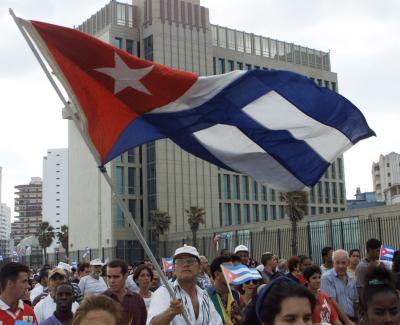
���There are many ideological differences between the governments of Cuba and the U.S., but there is only one group that truly looses out on both sides of the argument: the people. The opening up of trade relations between the two countries would mostly likely bring economic change for the better for both sides, but especially Cuba. However, there does not seem to be any change on the horizon. The United States is rich enough to be able to maintain this position for as long as they want; American lives are not depending on it. It is clear that beyond all the differences explained above, this is just a remnant conflict of the Cold War that both sides are unwilling to let go. In an age where the U.S. has normalized trade relations with China and is making diplomatic visits to North Korea, politics, human rights and economics are obviously not the only issues.