Brief Political History of Cuba
 In 1901, the United States ended its military occupation of Cuba, but did not give up its political and economic influence within the country. A Cuban Constitution was created with strong American influence, including the Platt Amendment, which insured good relations between the neighboring nations and gave the U.S. control of Guantanamo Bay. From 1902 to 1933 a long string of corrupt presidents ruled Cuba, most of who were merely puppets of U.S. interests. During this time period, American companies owned 75% of Cuba's sugar industry and 60% of all the land in Cuba. All of the Cuban presidents used the office to gain personal wealth.
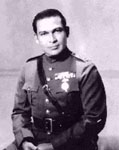 |
Fulgencio Batista
In 1933, a popular revolution threw President Machado from office and put Cespedes in his place. However, the military did not support Cespedes, and a Sergeant's Revolt took place, getting rid of Cespedes. The people voted Dr. Ramon Grau as President, though Fulgencio Batista had emerged as the leader of the Revolt. Due to U.S. opposition of Dr. Grau, he resigned, and the 25 year reign of Fulgencio Batista began. For the most part, Batista ran the country using puppet Presidents, though he successfully ran for President in 1940. In 1944, Batista's puppet candidate was defeated by Dr. Grau, the sole contender to Batista's power in Cuba. Grau ruled until 1948. On March 10th, 1952, Batista staged a coup, forcing President Carlos Pria from office. Batista then made himself the dictator of Cuba, eliminating the Congress. Throughout his entire time in power, Batista maintained policies that favored the United States.
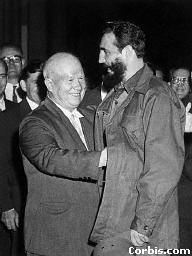 |
Khrushchev and Castro
On July 26th, 1953, Fidel Castro led an attack on the Moncada Army Barracks, hoping to spark a military revolt. Though the attack failed, Castro became a national celebrity and widespread hatred of Batista began to grow. Castro, who was in exile in Mexico training troops after the attack, returned to Cuba and began to drum up support. On January 1st, 1959, Castro's revolution succeeded, and Batista fled to Spain, taking $300 million dollars with him. The success of the Revolution of 1959 marked the end of U.S. political influence in Cuba.
Castro has remained firmly in power since then. Today, Cuba is a communist state, and it aligned with the Soviet Union during the Cold War. U.S.-Cuban relations hit rock bottom in 1962, when Castro allowed the Soviets to place missiles in Cuba. The Cuban Missile Crisis was more of a conflict between the United States and Soviet Union, but Cuba was quite obviously a major player in the conflict. The United States have held economic restrictions on Cuba since the Eisenhower administration, but an embargo was not made official until after the Missile Crisis during the Kennedy administration. The United States and Cuba have not had diplomatic relations since Castro came to power.
Back to Homepage