The Positon of the United States

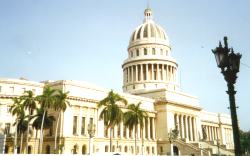 |
The Cuban capitol in Havana
���In October of 1960, the United States officially instated an embargo on Cuba, and all diplomatic relations were cut off in January of 1961. The initial catalyst for the degradation of relations was the Cuban government's nationalization of all property, including land owned by Americans. It was becoming increasingly clear to the U.S. that Cuba was a Communist state, and Castro quickly sought to become allies with the Soviet Union, the U.S.'s Cold War enemy. The U.S. created many plans to try to asassinate Castro or remove him from power, including the Bay of Pigs invasion. Relations continued to worsen with the Missile Crisis of 1962.
���The U.S. and Cuba began to talk about normalizing relations in the �70s under Nixon, but the talks came to a halt in 1975 when Cuba launched a intervention in Angola. In September of 1977, special interest sections for each country were placed in the Embassy of Switzerland in each capitol, in order to facilitate consular relations.
���In the 1980s the focus of friction in U.S.-Cuban relations shifted to include immigration. Under the Reagan administration, normalization talks began again in 1981-82, but one again were stopped because Cuba continued to intervene in other countries. In 1983, the United States and allies forced the withdrawal of the Cuban presence in Grenada.
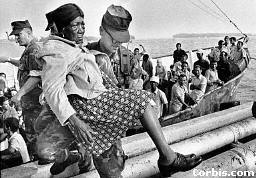 |
A U.S. Marine assists a cuban refugee
���
���Migration was also the primary concern of the U.S. in the 1990s. In September 1994 and May 1995 the U.S. and Cuba signed migration accords that set standards in place to help produce safe and legal migration. On February 24, 1996 U.S.-Cuban relations took another turn for the worse. The Cuban military shot down two U.S. civilian airplanes, killing four people. In response to this, Congress and President Clinton passed the Cuban Liberty and Democratic Solidarity Act, also known as the Libertad Act. The legislation made the trade embargo of Cuba initiated in the �60s official law and imposed additional sanctions on the Cuban regime.
���In instating the Libertad Act, the U.S. government hopes for a twofold effect: the creation of a stable, democratic government and the amelioration of the lives of the Cuban people via this governmental transition. The U.S. intends to facilitate this transition by keeping a hard-line against the Cuban government, yet allowing for humanitarian assistance to the Cuban people. "(Our policy) demonstrates the United States' compassion for the Cuban people, our strong interest in building bonds between the citizens of our nations, and our determination to provide the people of Cuba with hope in their struggle against a system that for four decades has denied them even basic human rights." President Clinton, March 20, 1998.
���In response to the Pope�s call to end the embargo of Cuba, President Clinton announced the easing of several sanctions in January of 1999. The new measures include the increasing of direct flights to Cuba and the sale of food to entities other than the Cuban government. In the autumn of 2000, the U.S. Congress approved a bill that eased the sanction against Cuba in regards to the sale of food and medicine. However, this brings no real change to the situation in Cuba because of stringent standards in the legislation that does not allow money to be lent to Cuba from the U.S., so Cuba must pay cash or find a foreign bank to finance their purchases (see NYTimes article). The position of the U.S. is that any significant change in the embargo will only be initiated if the Cuban government begins to make changes to convert to a democratic system and betters their human rights standards.
Back to Homepage