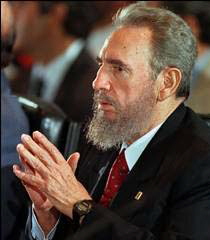
Fidel Castro: A man with a misson

� � �Fidel Castro was born on August 13, 1926. He attended Catholic schools and went on to the University of Havana, where he obtained a law degree. After graduating, he practiced law and became politically active in the Socialist Orthodoxo Party. Fulgencio Batista seized control of the Cuban government in March of 1952, and after all legal means failed to dislodge him from power, Castro and a group of 160 men launched an attack on the Moncada army barracks on July 26th 1953. This attempt to cause a popular uprising failed, and Fidel was captured, convicted, and sentenced to 15 years in prison. At his sentencing, he made his famous speech �History Will Absolve Me.�
� � �After serving only two years, he was released from prison and went to Mexico, where he created a revolutionary group called the 26th of July Movement. He and the Movement returned to Cuba in 1956, hiding in the Sierra Maestra Mountains, gaining peasant support for a revolution. On January 1st, 1959, Fulgencio Batista was forced from power, and Fidel began his rule over Cuba. At first, Castro was very popular, even in the United States, but that quickly wore off when it became evident that he was not a fan of the American system. Once Castro nationalized all land, taking enormous amounts of property from Americans, U.S.-Cuban relations officially became sour. The U.S. government launched many plans to assassinate Castro or overthrow him from power. In 1961, the United States began the Bay of Pigs invasion, which was an invasion of Cuba by Cuban exiles in America to create a popular uprising and overthrow Castro. The invasion failed miserably, but in turn Castro aligned himself more closely with the Soviet Union, the arch-enemy of the U.S. This only lead to the worsening of relations between the two countries.
� � �Castro has remained firmly in power since he began his rule in 1959. He created many social programs, including universal healthcare for all Cubans and an excellent educational system. As a result, Cuba has a very low illiteracy rate. Unfortunately, most of Castro�s economic programs were fueled by Soviet aid. Since the Soviet Union collapsed, Cuba has faced economic troubles. He remains a strong critic of American social and economic imperialism, despite the fall of his Communist allies.
Back to Homepage