Proper mix design, adequate thickness, and diligent
construction and control techniques are prerequisites to
the successful performance of a
cement-treated base (CTB) layer and, in turn, the entire
pavement structure. A critical review and verification
of the structural design procedures are presented.
Highlighted are the structural characteristics relevant
to the design procedure and design criteria, including
distress modeling. Structural characteristics paramount
to the thickness design procedure are discussed. On the
basis of those properties only the predominant failure
modes of CTB and the governing failure criteria are
discussed. A short description highlighting the failure
criterion of various design methods, six in all, is also
discussed. Those methods vary widely in their use of
mechanistic principles: for example, three methods are
strictly fatigue-based and two others rely on precedent
and experience. The validity of each design procedure is
assessed by performance history of pavements in service,
which is compiled from the literature. A comparison of
CTB pavements for a typical sun-belt area for a range of
traffic indicates that the structural thicknesses
mandated by the six design procedures are different. The
most conservative design is approximately 30% thicker
than the least conservative design.
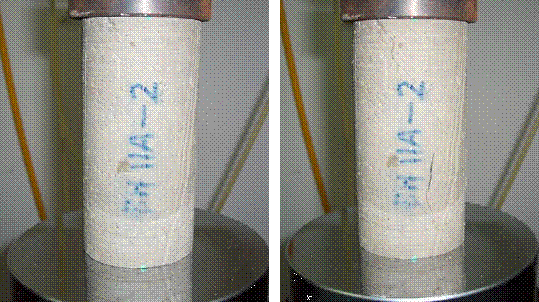
Microstructural,
chemical, mineralogical, and thermal analysis was
carried out in a study to use Power
Station (Panki Power plant, Kanpur, INDIA)
fly ash as pavement material. The fly ash was
stabilized with cement and lime separately. The effects
of cement and lime stabilization were
examined in terms of chemical composition,
crystalline structures, and hydration products.
Unconfined compressive strength of samples
was measured to observe the effect of
stabilization over time.
Coal fly ash can be used as a mineral filler in hot mix
asphalt paving applications. Asphalt mixtures containing
low addition levels (approximately 5 percent by dry
weight of aggregate) of fly ash as a mineral filler
exhibit mix design properties that are usually
comparable to asphalt mixtures containing natural
fillers such as hydrated lime or stone dust. Gradation,
organic impurities, and plasticity characteristics
ordinarily associated with mineral filler specification
requirements can normally be met without difficulty.
 TOP
TOP
PERFORMANCE RECORD
Research conducted over many years has
determined that fly ash is a suitable mineral filler
material. The earliest study of this application dates
back to 1931, when the Detroit Edison Company compared
the physical properties of fly ash with those of
limestone dust. Fly ash was shown to have comparable
physical properties to limestone dust, to possess good
void filling characteristics, and to be hydrophobic,
meaning it sheds water easily, thus reducing the
potential for asphalt stripping.(1)
The U.S. Bureau of Public Roads (now the
Federal Highway Administration (FHWA)), compared the
retained strength of asphalt mixes containing various
mineral fillers by means of the immersion-compression
test.(2) This test is used as an indicator to
evaluate resistance to stripping. Four sources of fly
ash were evaluated, along with silica dust, limestone
dust, mica dust, and traprock dust. Similarly, North
Dakota State University compared lignite fly ash as a
mineral filler with hydrated lime and crusher dust.(3)
In both investigations, mixes containing the fly ash
fillers had higher retained strengths than the other
filler sources tested, indicating that fly ash fillers
can be expected to provide excellent resistance to
stripping.(4)
Further confirmation of the beneficial
anti-stripping characteristics of fly ash mineral
fillers was provided from an investigation of two
western coal fly ashes (one Class C and one Class F) in
combination with, or as a replacement for, Portland
cement or hydrated lime. All mixes which contained fly
ash showed comparable or improved retained strengths in
the immersion-compression test using two different
sources of aggregate.(5)
A study of Texas lignite fly ash
indicated that the use of these fly ashes as mineral
filler retards the rate of age hardening of asphalt
cement. The high lime content of these fly ashes also
appears to be particularly beneficial as an
anti-stripping agent for polish-susceptible aggregates.(6)
A 1994 survey of all 50 state
transportation agencies indicated that eight states have
made some recent use of fly ash as a mineral filler in
asphalt paving. These states included Connecticut,
Louisiana, Michigan, Nebraska, New York, Ohio, Oregon,
and Pennsylvania. Most of these states reported that the
performance of fly ash as a filler material was fair to
good. However, in two states (Michigan and Nebraska),
fly ash reportedly performed poorly as a filler material
and was either discontinued or eliminated from further
use.(7)
An earlier survey of all state
transportation agencies in 1992 also indicated that
eight states reported using fly ash as a filler. In that
survey, Arkansas and Kansas were noted in place of
Connecticut and Oregon. There were also two states that
reported poor performance, these being Nebraska and New
York.(8) It has also been indicated by at
least one asphalt producer that using fly ash as a
filler material during hot weather has resulted in
tender mixes that tend to push or shove under the action
of a steel-wheeled roller.(9)
Previous surveys of state transportation
agencies by the American Coal Ash Association have
indicated that at least 14 other states, besides those
noted above, reported having used fly ash at one time or
another as mineral filler. These states included
Alabama, Arizona, Colorado, Illinois, Kentucky,
Maryland, Minnesota, Montana, Nevada, New Mexico, North
Carolina, North Dakota, West Virginia, and Wyoming.
There is no indication from these surveys regarding fly
ash performance. The American Coal Ash Association has
reported that approximately 96,000 metric tons (107,000
tons) of fly ash were used in 1995 as a mineral filler
in asphalt.(10)
TOP
MATERIAL PROCESSING REQUIREMENTS
Drying
Fly
ash must be in a dry form when used as a mineral filler.
This means that moisture-conditioned fly ash and
reclaimed ponded fly ash are unsuitable for this
application.
Storage
Fly
ash is collected at the power plant and stored in silos
in a dry form. As a result, it can readily be loaded
into pneumatic hauling vehicles and delivered to a hot
mix asphalt plant.
ENGINEERING PROPERTIES
The
physical requirements for mineral filler in bituminous
paving mixtures are defined in AASHTO M17 and are shown
in Table 5-3.(11) These requirements include
gradation, organic impurities, and plasticity
characteristics. Other properties of interest include
fineness and specific gravity.
Table 5-3. AASHTO M17 specification
requirements for mineral filler use in asphalt paving
mixtures.
|
Particle Sizing |
Organic
Impurities |
Plasticity
Index |
|
Sieve Size |
Percent Passing |
|
0.006 mm (No. 30) |
100 |
Mineral filler must be free from any organic
impurities |
Mineral filler must have plasticity index not
greater than 4 |
|
0.003 mm (No. 50) |
95-100 |
|
0.075 mm (No. 200) |
70-100 |
TOP
Gradation: The AASHTO specification
limits for mineral filler call for a range of from 70 to
100 percent passing the 0.075 mm (No. 200) sieve. Most
fly ashes typically fall within a size range of from 60
to 90 percent passing the 0.075 mm (No. 200) sieve.(12)
Fineness: Although most sources of fly
ash are capable of meeting the AASHTO gradation
requirements for mineral filler, consistency of
gradation is also important, especially the size and
shape of the particles finer than a 0.075 mm (No. 200)
sieve. Theoretically, higher fineness may indicate a
more effective mineral filler, although the higher
fineness also means a greater surface area of particles
that must be coated, resulting in an increase in asphalt
content of the mix. Fly ash fineness is often specified
by the percentage by weight retained on the 0.045 mm
(No. 325) sieve, especially when used in Portland cement
concrete;(13) however, this is not a standard
for fly ash used as a mineral filler.
Specific Gravity: The specific gravity of
fly ash varies from source to source. It may be as low
as 1.7 to as high as 3.0, but is more often within a
range of 2.0 to 2.8. Most conventional mineral fillers
have a specific gravity in the 2.6 to 2.8 range;
therefore, a given weight percentage of fly ash will
usually occupy a greater volume than that of a
conventional filler material.
Organic Impurities: Some fly ash from
boilers that burn oil during start-up periods may have
some residual oil in the fly ash. Although no standard
for carbon content or loss on ignition (LOI) is
specified for fly ash used as a mineral filler, it is
probably more practical to use a fly ash with a
relatively low LOI (less than 5 or 6 percent) to
minimize the potential absorption of asphalt by
carbonaceous particles.
Plasticity: Fly ash is a nonplastic
material with no plasticity index.
TOP
DESIGN CONSIDERATIONS
Mix
Design
The
same mix design methods that are commonly used for hot
mix asphalt paving mixtures are also applicable to mixes
in which coal fly ash is used as a mineral filler. The
percentage of fly ash filler to be incorporated into the
design mix is the lowest percentage that will enable the
mix to satisfy all the required design criteria.
One
of the most recognized ways to improve the
anti-stripping characteristics of an asphalt paving mix
is the addition of a modest amount (usually 1/2 to 2
percent by weight) of commercial hydrated lime into the
mix. Lignite or subbituminous fly ash contains up to 30
percent or more calcium, compared with anthracite or
bituminous fly ash, which may only contain 4 to 6
percent of calcium. The use of high calcium fly ash may
improve asphalt stripping with many aggregates, although
there is not a great amount of field performance data to
corroborate this assumption.
Structural Design
Conventional AASHTO pavement structural design methods
are applicable to asphalt pavements incorporating fly
ash as a mineral filler in the mix.
CONSTRUCTION PROCEDURES
Material Handling and Storage
Fly
ash is a dusty material and its use may result in more
dust generation than that normally experienced from
using conventional filler sources.
At a
hot mix plant, the fly ash can be discharged directly
into a storage silo, like conventional mineral fillers,
prior to input into the mixing plant.
Placing and Compacting
In
isolated instances, asphalt paving mixes with fly ash as
the mineral filler have been observed to be tender and
difficult to compact during hot weather. This does not
appear to be a widespread problem and also does not
appear to be universally true for all sources of fly ash
during hot weather, or even at other times of the year.
UNRESOLVED ISSUES
Although most fly ash sources are capable of satisfying
specification requirements for asphalt mineral filler,
which relate mostly to particle sizing, not all fly
ashes have performed satisfactorily in asphalt paving
mixtures. The reasons for this are not altogether clear,
but are probably related to the fineness of the fly ash,
its chemical composition, and its affinity for the
asphalt cement used in a paving mix. A better means of
classifying fly ash for use as a mineral filler is
needed.
A
method for assessing the potential suitability of a
given source of fly ash as a mineral filler in asphalt
paving is needed. The loss on ignition (LOI) of fly ash,
especially fly ash with a low calcium content, may not
be a significant factor affecting its performance as a
mineral filler. The calcium content, and in particular
the free or available lime (CaO) content, of fly ash
with a high calcium content is believed to be
instrumental in its performance as a filler, especially
as an aid in the prevention of asphalt stripping.
Additional field performance data are needed to draw
valid conclusions regarding these factors.
TOP




