|
 The landscape of Arta with the waters of the Amvrakian Gulf, its orange groves, its olive trees and the Tzoumerka mountain, makes it easy for the visitor to be a natur worshipper and enjoy a different aspect of Greece. The area has inspired lots of artists and writters and has been used as the background for many plays and a number of excellent films.
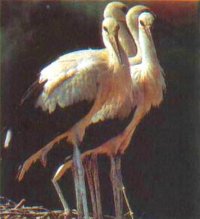
The Amvrakian Gulf itself is a separated ecosystem with preserved wetlands such as Logaros, Tsoukalios and Rodias. They are protected by the RAMSAR international convention. A great number of rare plants, animals and birds make their home there among which a small colony of the rare wild pelican Pelecanus Crispus. The lagoons are also renowned for their fish farms and the eel fisheries, famous since Byzantine times.
The Panayia of Vlacherna, one of the best known Byzantine churches, is situated in the village of the same name, 9 km from Arta. This church is sometimes thought of as the Mausoleum of the Komninos-Doukas rulers since so many members of that family are buried there. the village of Vlacherna has a beautiful view to the town of Arta.
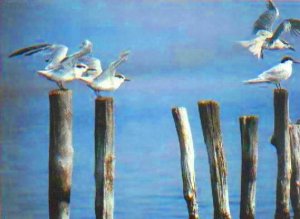 Koronisia, 25km away from Arta, is at the tip of a long narrow peninsula on the Amvrakian Gulf. The setting is particularly picturesque and in the little tavernas along the shore one can sample the many varieties of fish from the Gulf.
Komboti, 12km away, is famous among Greeks as the birthplace of the founder of the Revolutionary Friendly Society (Filiki Etaireia), Nikolaos Skoufas. Among the region's most fertile villages, it was the site of a School of Greek Letters during the Turkish domination.
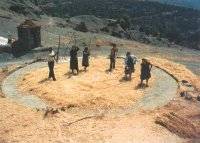 The Seltsou Convent, founded in 1697 with funds donated by two ship captains named Nikos and Apostolis, was the scene of a famous siege in 1804. Here a band of women from Souli, led by Kitsos Botsaris, were besieged for four months by the Turks. When, finally, the convent succumbed, the women and children threw themselves over the nearby cliff rather than be captured by the enemy.

|
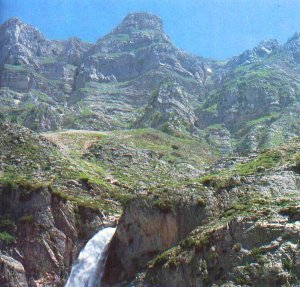 The prefecture of Arta is bordered by the Tzoumerka mountains and the Amvrakian Gulf. Its diversified landscape combines the wild and striking loveliness of the Greek mountains with the serenity of the Gulf's shallow shores and the fertile Aracthos valley that cuts it in two.
The city of Arta is the capital. It is the second largest town in Epirus (after
The prefecture of Arta is bordered by the Tzoumerka mountains and the Amvrakian Gulf. Its diversified landscape combines the wild and striking loveliness of the Greek mountains with the serenity of the Gulf's shallow shores and the fertile Aracthos valley that cuts it in two.
The city of Arta is the capital. It is the second largest town in Epirus (after 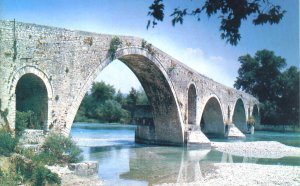 In 295 AD King Pyrrhus transferred the capital of his state to Amvrakia, using it as a base for his attacks against the Romans. The city is mentioned under the name Arta for the first time in 1082. In 1204, after the conquest of Constantinople by the Crusaders, Arta became the capital of the Despotate of Epirus, a state stretching from Epirus to Dyrrachium (now in Albania), which was founded by Michael I Angel Doukas (1205-1215). Between the 13th and the 15th century Arta became a leading commercial centre. Its castle and most of its Byzantine monuments and churches were built then. In 1449 it was taken over by the Turks but it retained lots of religious and economic privileges which allowed its citizens to prosper through cultural and trading activities. In 1881 and after a long time of resistance, it became part of the modern Greek State.
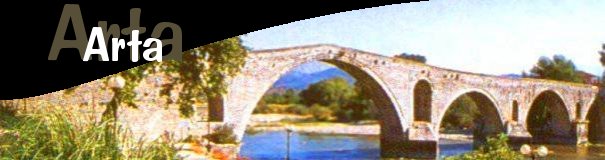
 The most famous landmark of the town is the bridge that lies on the road between Arta and Filipiada - Ioannina. Its reputation derives not only from its architectural elegance but also from the romantic legends associated with it and immortalised in folk songs and novels including "The Bridge of Arta" by Kazantzakis. Legend has it that the master builder had difficulty in preventing the bridge from being washed away every time he tried to complete it and was advised to entomb his wife in the stonework of the central arch. Six plays have been based on the legend of the bridge, two operas and several folk studies. The earliest structure dates as back as the time of Pyrrus but it underwent lots of changes and renovations. The last one took place in 1612.
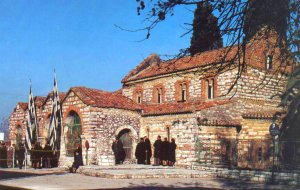
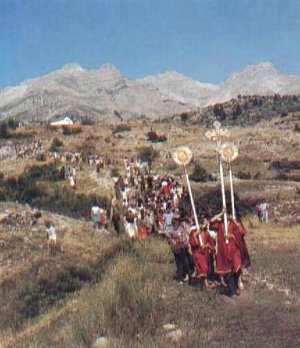 The town of Arta has a number of Byzantine churches. The Panayia Parigoritissa (Old Cathedral 1285-1289) is of enormous architectural interest because of the daring and innovative method used to support its dome, whose interior is covered with 13th century mosaics.The convent of kato Panayia is the only Byzantine monastic community still functioning in Arta. Founded in the 13th century AD, it has a wonderful collection of icons. It maintains a weaving work-shop, which produces fine tapestries.