On To France

The 17th Engineers (Ry),
along with other units, traveled by rail to Jersey
City, New Jersey and were ferried across the harbor to
New York where they boarded the H.M.S. CARMANIA on July 28th
1917 along with the 12th Engineers, a total of about 2,500 troops,
and sailed to Halifax. After two days four additional ships,
the Adriatic, the Ordena, the Burmudian and a cruiser, were
assembled and the convoy started across the Atlantic zigzagging
all the way as a defense against German submarines.
Eventually six British
Destroyers met them in route to escort them
to Liverpool. They arrived on August 12, 1917, 11 days out of Halifax.
The men were taken by train to Borden, England and then marched
at night to Oxney Camp accompanied by a British band.
The unit later went to London for a
grand parade
. Being the first troops of the AEF to arrive in
England, as well as the first American troops ever to march in the
British capital, the parade route was lined by enthusiastic
crowds as well as King George, his mother, Queen Alexandria,
and Field Marshal Sir John French. There were four Railway
Engineer Regiments in the parade; the 12th, 13th, 14th and 17th,
a total of about 4,500 men, with the 17th being the fourth in line.
Each regiment was accompanied by a British marching band.
The very next day the unit boarded the ship Northwestern
Miller except Company E which boarded the Londonderry and they departed
from Southampton. Both ships were cattle ships and the men
were put into the cow stalls and the officers into a room on the
upper deck. Many troops entertained themselves and others
by imitating cow "mooing" as they crossed the channel 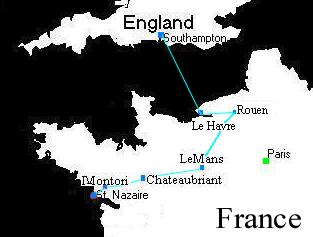 to Le Havre, France. The unit continued by train to the American
camp at St. Nazaire arriving in the evening of August 19th following
the route via Rouen, Le Mans, Chateaubriant and Montoir. The
camp was located about 2 miles from the docks. The 17th Engineers
were now ready to begin the important construction work needed
to support the arrival of combat troops and supplies.
to Le Havre, France. The unit continued by train to the American
camp at St. Nazaire arriving in the evening of August 19th following
the route via Rouen, Le Mans, Chateaubriant and Montoir. The
camp was located about 2 miles from the docks. The 17th Engineers
were now ready to begin the important construction work needed
to support the arrival of combat troops and supplies.
H.M.S. CARMANIA In the
early years of the First World War the British requisitioned merchant
ships and converted them to armed merchant cruisers. One of these
ships was the HMS Carmania of the Cunard steamship line. Although
the idea of an armed merchant ship was soon considered impractical
the HMS Carmania did have success in war by sinking a German armed merchant
ship the Cap Trafalgar of the Hamburg-Amerrika Line
in 1914. In 1916 after other war duties she was returned to the
Cunard Line and used as a troop transport between Halifax and
Liverpool. After the war she returned to civilian service and
was scrapped in 1932.
To see views of the Carmania visit the
Great Ships
web site and
scroll down to Cunard and select Carmania 1.