Chapter 5
Week 19
 This week has had its ups
and downs. I am still fairly housebound and physically inactive. I don’t have
the energy for much or an interest in much more than working at the computer,
surfing the internet, etc. because it is here that I am distracted. I am
currently in the process of tapering down from Ativan, which I have taken off
and on for 18 months. My body had reached the tolerance stage and, instead of
upping the dose from the miniscule amount I was taking, I decided to move
towards freedom from its potential addictive effects. I am also now free of the
Neurontin and Zanaflex, although a muscle relaxer prn at night is necessary to
sleep through the spinal stiffness and slight shoulder spasms that I still have.
So I feel more like me than I have for a long time. I want to be as drug-free as
possible if I go into surgery and during my recovery and rehabilitation.
This week has had its ups
and downs. I am still fairly housebound and physically inactive. I don’t have
the energy for much or an interest in much more than working at the computer,
surfing the internet, etc. because it is here that I am distracted. I am
currently in the process of tapering down from Ativan, which I have taken off
and on for 18 months. My body had reached the tolerance stage and, instead of
upping the dose from the miniscule amount I was taking, I decided to move
towards freedom from its potential addictive effects. I am also now free of the
Neurontin and Zanaflex, although a muscle relaxer prn at night is necessary to
sleep through the spinal stiffness and slight shoulder spasms that I still have.
So I feel more like me than I have for a long time. I want to be as drug-free as
possible if I go into surgery and during my recovery and rehabilitation.
Physically….I have had soreness in my scapula and shoulders every day.
After doing neck exercises for the first time in a few months, I was sore. If I
sleep the wrong way on my neck, I am sore. I am tired of physical discomfort and
pain. I cannot get comfortable. I will be so disappointed if the neurosurgeon
reports again that there is a 50-60% chance that I will feel better after
surgery. But if that is the verdict, I am thinking that it is worth the risk. If
I am not recovered after that, then I will put an assertive rehab plan into
place.
I have not felt consistently well now for 18 months….and in pain off and on
for 5 months. But, oddly enough, I am getting used to not feeling very well. I
guess this is a natural progression and, if I have to learn to live with my
disability, then I will need to develop a whole new outlook on life that
involves keeping pain, symptoms, and discomfort in some kind of compartment so
that I can increase and maintain some kind of quality of life.
Week 20
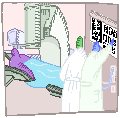
This week I had a myelogram to provide a clearer picture of my cervical
spinal structure and to confirm or dispute that bone spurs and disc degeneration
were likely causing the pain in my right shoulder. The procedure itself was not
difficult. I was admitted to outpatient surgery at the hospital, put in a gown,
and wheeled to the x-ray room. Then I was given a mild painkiller for the
needle insertion to inject dye into my spine. The whole procedure took about 30
minutes, ending with a CT scan. The worst part of the ordeal was having to lay
prone in recovery for 3 hours with my head elevated 30 degrees so that the dye
would not migrate to my brain and then having to maintain this posture for the
rest of the day and through the night.
A week later I met my husband at the neurosurgeon’s office to make a
final decision about surgery. Oddly enough, I have had no pain for 3 weeks with
little soreness or muscle spasms. In fact, I am almost symptom free at this
point. I feel better, too, because I am also almost medication free for the
first time in 18 months. But I have also been almost completely inactive and on
bed and chair rest for months. No exercise, no walking, no lifting, no major
housework, an intricate pillow arrangement in bed so that I don’t put pressure
on my shoulder and upper spine, no
leisure travel, and no major work commitments.
 The myelogram confirms
that I have pressure on the nerve root that radiates into my right shoulder and
down my right arm, likely the cause of my symptoms. The surgeon seems more
enthusiastic about the surgery with this evidence in front of him. He explains
that he will shave off the bone spurs and do a fusion of C5-C6 vertebrae,
eliminating the motion at the joint which is causing the inflammation. The
procedure takes about 2 hours. I
will stay overnight at the hospital and wear a soft collar for 4 weeks. I can
sleep normally and not in a recliner. I ask him about the 50 to 60% odds that he
gave me last month for resolution of symptoms. He replies that there just
hasn’t been enough research on this particular symptomology to give any real
definitive numbers or guarantees, noting that pain is a subjective state and not
amenable to measurement. However, many
patients are pleased with their decision to have the procedure. Mostly, I watch
his affect. He is less cautionary, more supportive and assertive during this
visit.
The myelogram confirms
that I have pressure on the nerve root that radiates into my right shoulder and
down my right arm, likely the cause of my symptoms. The surgeon seems more
enthusiastic about the surgery with this evidence in front of him. He explains
that he will shave off the bone spurs and do a fusion of C5-C6 vertebrae,
eliminating the motion at the joint which is causing the inflammation. The
procedure takes about 2 hours. I
will stay overnight at the hospital and wear a soft collar for 4 weeks. I can
sleep normally and not in a recliner. I ask him about the 50 to 60% odds that he
gave me last month for resolution of symptoms. He replies that there just
hasn’t been enough research on this particular symptomology to give any real
definitive numbers or guarantees, noting that pain is a subjective state and not
amenable to measurement. However, many
patients are pleased with their decision to have the procedure. Mostly, I watch
his affect. He is less cautionary, more supportive and assertive during this
visit.
Because I am feeling better now and without the tranquilizing effects of
the medication I have been taking off and on for 18 months, I think about
whether this is the right decision. For the first time in weeks, I have the
energy to clean a few closets. I am not feeling anxious at the grocery store.
Memories of the hospital emergency room and acute pain are fading. But I don’t
believe that I have healed and that the hand grenade of inflammation could
explode again at any time. We want to travel.
I want to be able to take a brisk 2-mile walk without feeling shoulder
soreness. I’d like to return to yoga, no head or shoulder stands please!
I want to fix the structural problem that has and will likely again
undermine my health, confidence, and quality of life. I want to be released from
worry and obsession about every little ache and pain. I want to return to work.
I want to experience the freedom of an empty nest and not the chains,
loneliness, and worry that comes with a chronic disability. I will have the
surgery.
Week 24
I write this 30 hours post-op at home! After a couple of weeks of feeling
pretty good, I really wondered
whether I should be having this surgery. But I was having occasional soreness
around my right scapula and still unable to lie comfortably on that side in bed
at night. Too much activity would leave me with some spasm/tightness in both
shoulders. For the last few days before surgery, I was particularly sore…so I
decided not to cancel, deciding that peace of mind that I was not going to
further deteriorate due to increasing bone spur growth was a good enough reason
to have the surgery. While most people would be happy with the level of
improvement I have been having for the last month, I am a fix-it, prepare for
the future kind of person. I don’t like mystery. At a doctor’s appointment
for a routine thyroid check, the MD said to me, “Are you sure it’s the right
thing to do?” Yes. For me, doing the surgery is the right thing. I am tired of
worrying.
 We checked in at
6am
to the surgery waiting room. I was in a gown in
prep by
7am
. The nurse gave me some
circulation hosiery and a pair of blow-up leggings that would deter blood clots.
The anesthesiologist came in to explain his role and the surgery in general. The
anesthesia would be delivered through an iv, to which I was now hooked up. The
nurse rolled me into the elevator and down to the surgery floor and into the
sterile surgery room. By the time they transferred me to the surgery platform, I
looked up at the lights above my head and remember nothing after that! The
procedure took about 2 hours with another hour in recovery.
We checked in at
6am
to the surgery waiting room. I was in a gown in
prep by
7am
. The nurse gave me some
circulation hosiery and a pair of blow-up leggings that would deter blood clots.
The anesthesiologist came in to explain his role and the surgery in general. The
anesthesia would be delivered through an iv, to which I was now hooked up. The
nurse rolled me into the elevator and down to the surgery floor and into the
sterile surgery room. By the time they transferred me to the surgery platform, I
looked up at the lights above my head and remember nothing after that! The
procedure took about 2 hours with another hour in recovery.
Once in my room, I became aware of my husband sitting next to the bed,
reading a mystery. I awoke slowly, feeling no pain and in a soft cervical
collar. For the rest of the day I dozed off and on. Ate lunch and dinner.
Had some soreness in both shoulders and a
slight sore throat from a breathing tube inserted during the surgery.
Morphine drip through an iv.
Then Vicodan by mouth and a Medrol pack to cut down on the inflammation.
I have a 3-inch incision on my throat a bit to the left. There are no external
stitches, the incision held together by clear butterfly bandages which will
dissolve in the next few weeks.
The surgeon visited early this morning and reported that, technically,
the surgery went well and without a hitch. He told me to expect some shoulder
soreness over the next few weeks. I could take the collar off for showering and
at night while sleeping. “It really serves as a reminder not to jerk your head
around quickly…” I was discharged after only a 24-hour stay. I go back to
see him in 3 weeks for him to check the incision and in 6 weeks for an x-ray to
see that the fusion is proceeding well. I cannot drive for 7 days or lift
anything over 10 pounds for several weeks.
Today I have a lot of energy but I know that it is likely a post-surgery
high due to adrenalin, corticosteroids, and Vicodan. I have a little discomfort
when I swallow and some shoulder
soreness but I have had periods of relaxation and no tightness of soreness in my
right scapula. I doubt that I’ll know for sure any time soon whether the
surgery has relieved all of my symptoms. Mostly, I am relieved not to have to
worry about unexpected pain. I am relieved that I am on the other side of a
surgery I have been thinking about for 6 months. I am looking forward to
starting to exercise again and about the prospect of returning to work
full-time. Lots of well wishes, flowers, food, and visits from friends and
family have buoyed my spirits. It has been a long, arduous ordeal. Time to rest.
I had a call from a friend of ours who had a triple anterior cervical fusion a
few years ago, performed by this surgeon. “It was a piece of cake, wasn’t
it?”. Yes, it was a piece of cake.
Week 25
 Six days post-op at home,
and things are not too bad. For the first few days at home, I had a lot of
energy and was pain-free. I finished up the kids’ scrapbooks for Christmas,
did a little house cleaning, entertained visitors, and even walked the dog a few
times. My appetite has been fine. The doctor said that I don’t need to wear
the cervical collar in bed, thank goodness. But sleep is still a challenge
because I am trying to be careful about turning over suddenly, lifting my neck
off the pillow, etc. Also, my lower back muscles are pretty weak, I think,
because I have been sitting so much, and I can have some soreness there during
the night. So, overall, I am not waking in the morning yet with a feeling of
having rested deeply. I have opted not to take any sleeping pills, however, and
would prefer not to get into that habit again.
Six days post-op at home,
and things are not too bad. For the first few days at home, I had a lot of
energy and was pain-free. I finished up the kids’ scrapbooks for Christmas,
did a little house cleaning, entertained visitors, and even walked the dog a few
times. My appetite has been fine. The doctor said that I don’t need to wear
the cervical collar in bed, thank goodness. But sleep is still a challenge
because I am trying to be careful about turning over suddenly, lifting my neck
off the pillow, etc. Also, my lower back muscles are pretty weak, I think,
because I have been sitting so much, and I can have some soreness there during
the night. So, overall, I am not waking in the morning yet with a feeling of
having rested deeply. I have opted not to take any sleeping pills, however, and
would prefer not to get into that habit again.
At day 5, I began to descend from the post-op high, likely due to
finishing up the corticosteroids and the elation of completing the surgery
started to wear off. I had quite a bit of soreness in my shoulders last night,
which lasted a few hours and then disappeared. Probably overdid it by trying to
sit in a regular desk chair at the computer for a few hours. This morning, I was
so fatigued after tossing and turning all night that I went back to bed and
stayed there until
1pm
!
Kind of like hitting the wall. Took a Vicodan this morning because of
soreness up and down my spine. This afternoon, I decided to stick with ibuproden
and seem to be doing fine. I have some sweating occasionally, but temperature is
normal. No discomfort at all around the incision or in my neck. And, most
importantly, my shoulders are relaxed. Any tightness on the right side is
temporary and generally resolves quickly.
As I get ready for next semester, upcoming meetings and conferences, and
a few job interviews in the spring, I wonder whether I will be rehabilitated by
then….or will I still feel vulnerable, have difficulty sleeping, and out of
shape? Not that I want to run a marathon again. But I do want to be able to go
power-walking or hiking again and I want to be able to take trips without
suffering for sitting on a plane or in a car for more than an hour. A few
surgical internet sites suggest that I should expect 4-6 months of healing time
for the bone graft. I guess it is not unlike breaking an arm or a leg. The body
needs time to heal, and many systems are affected.
Table
of Contents Next Chapter