
4.6 Billion Years Ago to Present Day
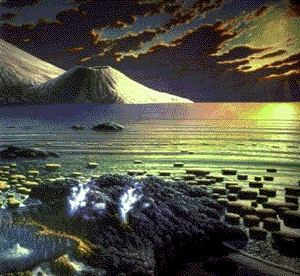
It's hard to imagine exactly how long 4.6 billion years is. Just like we use calendars to help us define days, weeks, months, and years, scientists use a type of calendar that helps them define important events in Earth's history. This type of calendar is called the Geologic Timetable.
The Geologic Timetable divides the Earth's history into units of time. The largest units of time are called eras. Eras are divided into smaller units of time called periods and periods are then divided into even smaller units called epochs. Major changes in the fossil record usually mark the beginning and the end of each time unit.
The names of the eras refer to the kinds of life that scientists believe existed during that time period. There are four major eras in Earth's history. To learn more about the Precambrian Era, the Paleozoic Era, the Mesozoic Era, and the Cenozoic Era just click on the words to take a journey backwards into
Earth's fascinating history!!
*Google Images
www.google.com/imghp.?hl=en&tab=wi&ie=UTF-8&q=
*"Earth Science: The Challenge of Discovery"; Snyder, et.al.;D.C. Heath & Company (1991)
*"Life Science: The Challenge of Discovery"; Bierer ,et.al.; D.C. Heath & Company (1991)