PRECAMBRIAN EARTH

4.6 Billion Years to 570 Million Years Ago
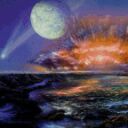
The Earth during the Precambrian Era was very different from the Earth you know today.  This young Earth was very hot.  The gases escaping from volcanoes formed the early atmosphere.  The ancient atmosphere contained gases such as carbon dioxide, carbon monoxide, sulfur dioxide, water vapor, hydrogen, and nitrogen.  Believe it or not, scientists have evidence that this ancient atmosphere contained NO oxygen at all!  The water vapor in the atmosphere condensed to form rain.  Because the Earth was still very hot, the rain was then evaporated back into the atmosphere and condensed to form more clouds.  As the Earth cooled, the rain that fell remained on the land in the form of liquid water.

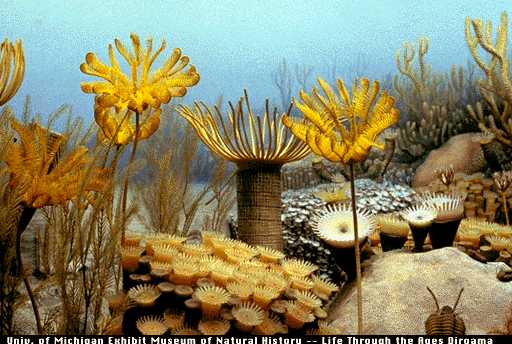
During the middle of the Precambrian Era, the first life forms appeared - BACTERIA!  Bacteria are very tiny single celled organisms.  The first plant-like cells also formed during this period - ALGAE.   As liquid water accumulated to form the oceans more and more simple forms of life appeared.  By the end of the Precambrian Era, the ancient oceans contained animals such as coral, sponges, arthropods, worms, mollusks, starfish (echinoderms), and brachiopods which are clam-like animals.  Early vertebrates also appeared near the end of this time period.

Click here to learn about the exciting events that take place in the next major time unit - the

Paleozoic Era!
Go to:

Home page - Earth's history
Paleozoic Era
Mesozoic Era
Cenozoic Era
**Images courtesy of Google Images**
Hosted by www.Geocities.ws

1