
Audi
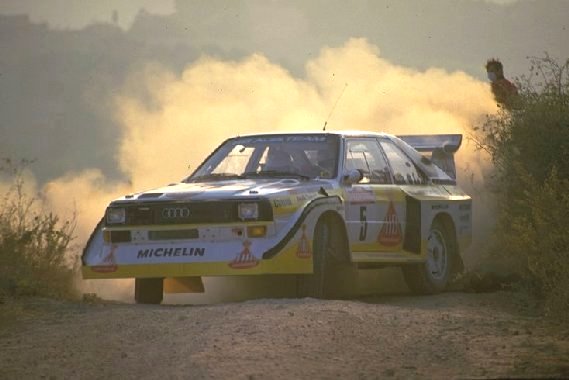
One of the most significant rally cars of all time made its introduction to the world in 1980, with the unveiling of Audi's rally contender, the Quattro. The Quattro was the first rally car to take advantage of the new rules permitting four-wheel-drive for rally competition, but there were some initial doubts about four-wheel-drive's suitability to rallying. Some thought it would be too complex and heavy to be competitive. The critics were quickly proven wrong.The Quattro won its first rally on its first outing, the Austrian round of the European championship in 1981: the four-wheel-drive experiment was an instant success. The Quattro went on to win a couple rounds of the world rally championship, and Audi gained additional exposure when Michèle Mouton won the 1981 San Remo rally, the first woman to win at the international level. The 1982 season looked set to be an Audi tour de force.
While the Audi was clearly the fastest and one of the most revolutionary rally cars in some time, it did have a number of shortcomings. The Quattro was rather heavy, its front-engine, monocoque chassis gave the car clumsy and unwieldy handling characteristics, and the car had problems with mechanical reliability. The car did win the 1982 championship for constructors, but Walter Röhrl took his first win of the year and the championship on the final event, the Ivory Coast rally, after Michèle Mouton's Quattro suffered a broken transmission.
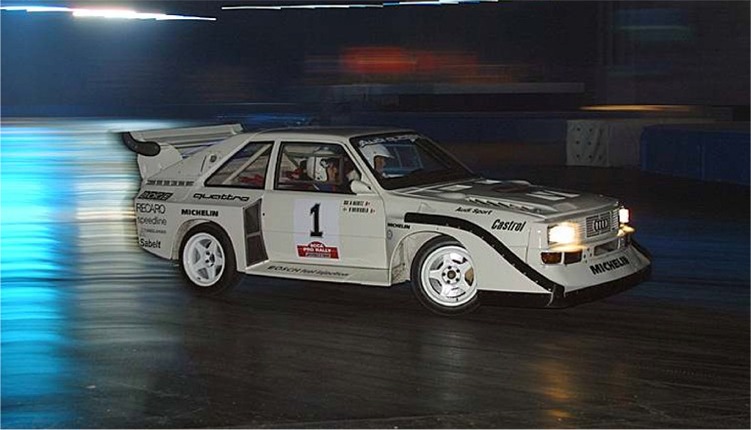
The 1983 season was another bittersweet season for Audi; the introduction of the Lancia 037 promised fiercer competition (despite the 037 still being rear-wheel-drive), and the 037 delivered. Audi's #1 driver, Hannu Mikkola, won the 1983 driver's championship, but Lancia pilots Markku Alen and Walter Röhrl finished in the points frequently enough to give Lancia the constructor's title. The 1984 season was Audi's most successful year in rallying. Stig Blomqvist's sideways driving style plus the introduction of the short-wheelbase, more powerful (450+ hp) and more advanced (six-speed transmission, kevlar bodiwork) Sport Quattro combined to take both titles for the 1984 season.However, the 1984 season saw a new challenger to Audi's crown: Peugeot launched their brand new 205 T16 in Corsica for the 1984 Tour de Corse rally. The new 205 differed from the Quattro in several key respects: it was rear-engined, it had a space frame, and it was a generally smaller car with less weight. Peugeot driver Ari Vatanen nearly won the 205's first rally, except a crash prematurely ended his rally. The Peugeot caused enough concern that the Audi team managers sent messages back to the engineers in Ingolstadt, reminding the engineers to keep up development, and not to be complacent with the current success.The title of "king of the hill" was transferred to Peugeot at the start of the 1985 season. The Sport Quattro was simply unable to keep up; its handling and reliability was poor compared with the 205 T16. Audi never ceased development despite losing its crown, and the radical Sport Quattro S1, introduced at the 1000 Lakes rally in 1985, proved to the rally community that Audi was very serious in its attempt to regain its previous form. The S1 had more power than any other rally car in history, reaching over 600 horsepower in 1986, and it had huge wings to aid with traction on faster stages. Faced with ever-increasing competition, the S1 only managed a single victory, on the San Remo rally in 1985.
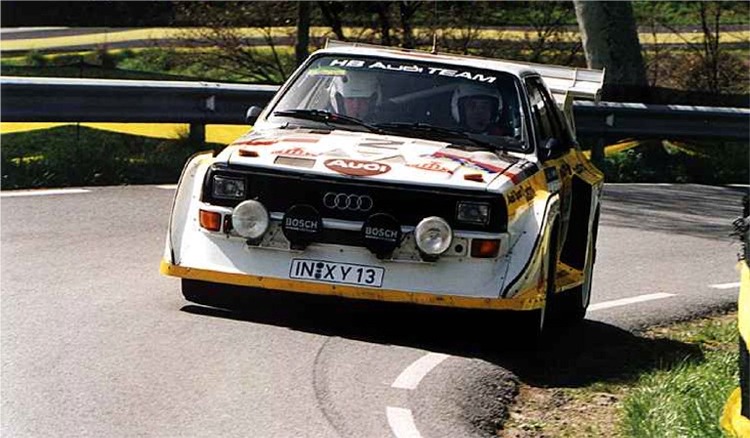
The curtain call for Audi's Group B program came with the death of Henri Toivonen on the Tour de Corse 1986; following Toivonen's death, Audi, along with Ford, immediately pulled the plug on its Group B rally program. The Quattro in its various iterations competed for four and a half years, winning four championships, and changing the face of rallying forever.