|
Flight
as Power
By Jose Wendell P. Capili
Angels
Directed by Ellen Ongkeko
Produced by Star Cinema
85 minutes
The
University of the Philippines Film Center should be commended
for resurrecting Ellen Ongkeko's Angels, a pioneering
digital, but-not-yet-released masterpiece, produced by Star
Cinema. Completed almost two years ago, Ongkeko's full-length
debut fits perfectly into this year's celebration of the 14th
International Women's Film Festival because the film constitutes
the urgency that the imprecise boundaries of identities, both
male and female, seem to provoke.
Ongkeko's
film weaves poverty, blindness and social mismanagement by
interrogating relationships encountered by physically-challenged
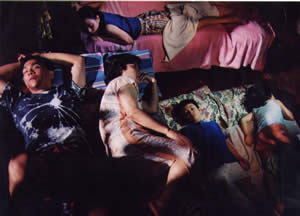
identities. Torn between freedom and responsibility, Jonathan
(Angelo Caangay) often dreams of an angel who takes him to
fly with the latter. But sometimes, Jonathan and his angel
plunge often into the ground because the angel is blind. Outside
his dreamland, Jonathan has a bigger problem: his parents
(Gina Alajar and Noni Buencamino) are blind. The ten-year
old boy is compelled by circumstances to guide his parents
through the streets of postcolonial Manila in search of a
normal family life.
Ongkeko
raises many questions as the plotless narrative unfolds: Is
it Jonathan's duty to take care of his blind parents and mentally
retarded sister (Wena Basco)? Should corruption-infested government
agencies claim custody of Jonathan? Are blind parents capable
of raising a family?
Ongkeko's
efforts are pathbreaking. She retells the true-to-life story
by doing away with a formula plot, cinema-verite style. Instead,
Ongkeko allows her material to take its own form, based on
scenes shared and encountered by different members of Jonathan's
family, reenacted and framed within Manila's lightning rallies
and uncollected garbage. Eventually, Ongkeko resolves Jonathan's
dilemma by way of transcendence: the boy remains guided by
an angel. The boy's unwavering faith, though initially aimed
at achieving social assimilation, can lead to his strength
and salvation.
Michael
Angelo Caangay stands out as Jonathan. It is nearly unimaginable
for a boy about Caangay's age to render a character both spiritually
and materially orphaned with so much clarity. Caangay delivers
and quite possibly, he has achieved one of the best lead performances
in recent local cinematic history. Gina Alajar, Nonie Buencamino
and Wena Basco gleamingly construct a family's ambiguous relationship
to male privilege and power. When Buencamino's character inflicts
both corporal and emotional punishment on Jonathan when the
latter ran away from home, Ongkeko suggests that even in the
most dysfunctional of Filipino families, women are mostly
subordinated.
Fortunately,
Alajar's character breaks away from the usual gender role
system by consistently portraying how mothers are capable
of reorganizing their family lives in a manner so predominant
such that in the end, dysfunctional families may reconcile
in spite of the individual members' basic distortions.
Likewise,
the ensemble acting of Angel Aquino, Soxie Topacio, Jackie
Castillejo, Giselle Sanchez, Sylvia Sanchez, Connie Lauigan
Chua, Mel Kimura and PETA members bears witness to the primacy
of struggle in Jonathan's situation. They led the focal character
(Jonathan) and his family members into finding strength and
power from sustained defiance of a society that has become
so largely dehumanized and anguished.
Ricardo
Lee's screenplay takes the audience to a wilderness where
individuals from dysfunctional backgrounds engage in a treacherous
system of cultural identities, institutions and representations.
Eventually, Lee implicates not only Jonathan but everyone
in these systems. The script clearly designates the necessary
acceptance of distortion and rupture on the part of the film's
focal character. And Ongkeko successfully translates this
element of the powerful script, as well as the consequential
harmonic resolution of Jonathan with his family, on the big
screen.
Larry
Matic's production design grasps simultaneously Manila's diversity
and emerging uniformity. Tagalog hegemony appears degraded
and self-destructing against shreds of other Philippine regional
cultures and societies contained within Ongkeko's vision of
a bourgeoning metropolis. Matic rescues a dysfunctional, multiethnic
neighborhood as sublimated art reminiscent of Brocka's Maynila
sa mga Kuko ng Liwanag, Bernal's Manila by Night, O'Hara's
Bagong Hari and Jeffrey Jeturian's Pila-Balde.
Vincent
de Jesus' musical direction brings cultural analysis to the
film. His choice of accompaniment pieces is neither too distracting
nor too self-indulgent. By being subtle and subliminal, de
Jesus truly enhanced the flow of the narrative.
It
is certain that Regieben Romana (animation), Chito Almacen
(sound), Alma de la Pena (director of photography) and Christine
Valenciano (editor) worked very closely with Ongkeko. In spite
of the film's shoe-string budget, all four artists communicate
the director's certitude of vision and ceaseless advocacy.
Their technical feat (especially in juxtaposing Jonathan's
dream world through animation vis-à-vis the boy's lingering
saga) supports Ongkeko's allegory about coming alive out of
disintegration and near-decay.
From
the SRO crowd at the UP Film Center last 11 March that enthusiastically
welcomed the film, many wondered why Angels had been
left out in cold, subsumed by Star Cinema's commodified, less
enduring cinematic productions. Ongkeko's vision and incessant
innovation to move away from formula should not be washed
out in one vertiginous freezer. Was it because Star Cinema's
bigwigs believed that the film was too ethnographic and therefore,
too pedantic for mass audiences? Was it because the film had
non-box office stars performing in it? Was it because the
film was too feminist (both in style and perspective) and
therefore, too ivory towerish to be released commercially?
Or was it because the film director had moved to a thriving
career as an executive producer in a rival broadcasting network?
Whatever
their reasons are, the film's producers should realize by
now that the film is a major cinematic gem. More importantly,
Ongkeko is Philippine cinema's bravest new find after Jeffrey
Jeturian and Lav Diaz made their respective impressive debuts
nearly five years ago. There seems to be a dearth of local
film artists who are in clear possession of both technical
dexterity and substantive advocacy. Nowadays, a gifted filmmaker
must also be selective of his/her choice of a pathbreaking
script. In addition, he/she must translate the script into
a narrative with great emotional power. The film director
must also transport his/her audience to a magical place and
time. Finally, the film director must be a visionary: he/she
should make an effort to state a metaphysical point hopefully
in a manner no other film director has done before.
Angels
deserves to be released commercially. With an additional cost
of 800,000 pesos or even less, a digi-movie translates perfectly
on any theater screen. In the movie, Ongkeko has elevated
Ricky Lee's material to a new level rather than merely delineating
the usually clumsy and mechanically melodramatic rendition
to the world of the physically challenged. Ongkeko's masterstroke
bears witness to the primacy of struggle against the backdrop
of a harsh, largely unproductive universe that revolves around
oppression or colonization.
***
This
article first appeared in the Lifestyle Section of the Philippine
Daily Inquirer on May 12, 2003.
Jose
Wendell P. Capili graduated from UST, UP. The University of
Tokyo (Japan) and the University of Cambridge (UK). He received
Palanca, CCP and UP awards for his poems and essays as well
as scholarships/fellowships from the Japan Ministry of Education,
Korea Foundation, Cambridge Overseas Trust, Standard Chartered
Bank (Hong Kong) and the British Council. He is the author
of A MADNESS OF BIRDS (poetry, UP Press, 1998), BLOOM AND
MEMORY (essays, UST, 2002), MABUHAY TO BEAUTY! (pop culture,
Miflores Publishing, 2003) and SAMPALOC BOYHOOD: PASSAGES
AND PREDILECTIONS (creative nonfiction, forthcoming). He is
currently Asst. Professor and Associate Dean for Administration
at the UP College of Arts and Letters.
|