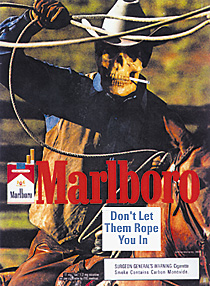
Follow the money! See our nation's leaders framed and discredited! Don't let tobacco rope you in!
Tobacco spies infiltrate anti-smoking groups and bankroll supposedly grassroots campaigns against smoking bans, say 33 million pages of declassified documents during Minnesota's antitobacco lawsuit seeking compensation for public funds spent treating smokers and settling for over $6 billion. Hiring Kenneth Starr to frame President Clinton is a minor expense to a large, money-making tobacco industry, employing millions to protect its interests from President Clinton's laws taxing tobacco to pay for tobacco-related illnesses, prohibiting advertising aimed at youths their largest market, and creating more non-smoking areas. Tobacco endangers your health and that of those around you breathing 2nd hand smoke.
Negotiators for tobacco companies and 8 states announced a massive antismoking settlement initiative, the largest civil settlement ever, that could cost the tobacco industry $206 billion over 25 years and includes measures to cut teen smoking and sweeping curbs on advertising. Tobacco companies must make payments to 46 states and finance anti-smoking programs in exchange for having remaining state claims for costs of treating sick smokers dropped. Critics call the deal too easy on tobacco, leaving too many loopholes. Proponents say it not only levels tough penalties but severely limits tobacco ads and lobbying. The agreement can be finalized only after a "critical mass" of states other than those negotiating it accept the proposal. It requires support of several more states to take effect. President Clinton greeted the proposal as an important first step but said Congress must pass broad tobacco legislation. Clinton also asked the Supreme Court to decide if the Food and Drug Administration has authority to regulate tobacco. The agreement expects to drive up cigarette prices.
Punch-Drunk From Litigation: Brown & Williamson Tobacco's toll-free phone message: a male choir sings "Oooh tobacco plants are lovely plants / With leaves so broad and green / You shouldn't think of tobacco plants / If you're still a teen."
The American Cancer Society's annual Great American Smokeout urges smokers to quit that day as a first step toward quitting permanently. The day ranges from presidential proclamations to free aerobics classes to antismoking programs to christening smoke-free cruise liners to reducing youth smoking, including $142 million in new federal research funds over 5 years. Reports highlight cross-spectrum increased smoking.
Another friend, on oxygen, still smokes. Another friend - his wife already dead of cancer - had a tracheotomy and a laryngectomy. Others died of lung cancer. My neighbor quit smoking, clearing the air for his family.
I miss my lung, Bob! Smokers exhale dark yellow. Smoking machines, not inhaling, exhale pitch black. Marijuana contains 25 times as much tar and nicotine as tobacco.
TOBACCO KILLED: Walt Disney, Yul Brynner, Humphrey Bogart, Audrey Hepburn, Stephen Ambrose, and astronomer Edwin Hubble, who brought pipe-smoking home with him from Queen's College, Oxford, England, where he studied astronomy on a Rhodes scholarship in days before second hand smoke was discovered to be harmful. Think of what more he'd have discovered had smoking not shortened his life. I feel cheated, losing him.
Quitnet American Lung Association
Preschool children think smoking is cool if their parents smoke and will smoke when they grow up. It's important to start anti-smoking campaigns aimed even at the youngest children and to get parents to quit. Children seeing movies in which people smoke and teenagers seeing their favorite actors smoke are more likely to smoke. Make them ineligible for awards unless the story is about smoking. Living with a smoker, especially a mother, greatly increases chances a child will smoke when older. Long before college students flip their tassels, many are already addicted. Previously college students were considered far less likely to smoke than people less educated. Most smokers begin before age 18.
In China, smoking kills 3 million men each year. 1/3 of China's young men die from tobacco effects, many under 70. 2/3 of China's people think smoking causes little or no harm. Asia has 300 million smokers. Tobacco kills half of Asia's young people.
Smoking makes you less popular. It gives you bad breath, stained teeth and clothes that smell bad. People rather be friends with and date nonsmokers. Non-smoking areas are off limits to smokers. Tobacco users are less physically fit, finding it harder to exercise. Physical fitness is In. The only crowd smokers can join is other smokers.
Antismoking ads: Bin Laden urges people to smoke in the name of Jihad; also reading the list of carcinogins in cigarettes pondering which to use in a chemical attack. Smoking kills as many people in 5 days as died at the World Trade Center.
Wildfire started by a careless smoker's cigarette tossed from a car destroyed homes and forced evacuations. 10,500 tinder-dry acres, at least 4 homes burned and chased 650 people from the area, rousting 2,000 firefighters and residents from their beds before dawn. Gusts up to 65 mph fanned the fire, closing 2 casinos and 12 miles of the highway for 11 hours. 2 people suffered minor injuries.
Archaeologists found 2500-year-old Mayan stone carvings of tobacco users. Native to the East Coast, tobacco gained widespread use due to folk belief in its healing qualities. 1492 Columbus saw natives using and placing high value on tobacco. Spanish explorers and soldiers brought tobacco to Europe in the 1500s. Smoking tobacco, they couldn't stop, our first accounts of nicotine addiction. Spanish colonists grew and shipped tobacco, filling Old World nicotine needs. Portuguese sailors sent tobacco home from Brazil. People complained that tobacco use was unhealthy. Nicotine is named for Jean Nicot, France's Ambassador to Portugal, who in 1560 sent tobacco home to his queen for her herb garden. Russia's church and government forbade tobacco use. 1600s China decapitated tobacco sellers.
Jamestown settlers barely survived until 1602 when John Rolfe, later marrying Pocahontas, introduced to colonial farmers a new, flavorful plant from seeds acquired from Spanish colonists in Trinidad. Tobacco, first shipped to England in 1613, became an important income source for American colonists. Sir Walter Raleigh and John Rolfe grew tobacco in Virginia. King James, believing tobacco use was a passing fancy, was not convinced tobacco was a dependable colonial cash crop. To encourage colonists to grow other crops he taxed tobacco heavily to make it less profitable to grow and more expensive for users to buy. Tariffs did not slow tobacco production or demand. Tobacco use was already established and spreading. In the 1600s and 1700s tobacco was one of Colonial America's largest industries. Making large profits, tobacco was grown everywhere, even in streets. Tobacco farmers knew little about soil fertilization. When soil wore out farmers moved westward and along the Atlantic Coast seeking new tobacco farmland. Slaves planted and harvested huge tobacco crops. Tobacco was at first shipped raw to England, returning as finished products. Tobacco was later sold directly to American factories, at last a completely American product.
Snuff, safer and more available and not requiring lighting equipment like tinderboxes, candles or hot coals, was widely used in the 1700s by the upper class, adopting snuff dipping from the French court. Elaborate ritual revolved around its use. People collected and displayed fancy jeweled snuffboxes, handed down from generation to generation and often stolen. In the early to mid 1800s cigars and chewing tobacco became popular. In the mid 1800s pipes were the most common form of tobacco use.
Cigarettes were first made in Spain from tobacco scraps left over from cigar rolling. They traveled to England, then came to the U S via pre-Civil War English tourists. Cigarettes, easy to use and conceal, replaced snuff and chewing tobacco. Cigarettes, made from tobacco leftovers, were considered a poor man's smoke, cheaper to roll tobacco bits in paper than to buy handmade cigars. Cigarettes soon became big business. London merchant Philip Morris manufactured cigarettes from Turkish-grown tobacco. Glamorous actresses and playful boys advertised cigarettes as cheaper and milder than cigars and without the effects.
Tobacco smoking became a worldwide habit by 1876. Cigarette coupons and trading cards were introduced in 1878. The best workers rolled 4 cigarettes a minute. The cigarette machine, invented in 1881, made 120,000 cigarettes a day, lowering their price by mass production. In the late 1880s cigarettes, at first thought a passing fad, soon became the most popular use of tobacco. The 1900s birthed the modern tobacco industry. Machines turned out more cigarettes and cigars. 1913 - 1914 media ads brought a turning point in cigarette industry growth. Cigarettes were distributed to World War I soldiers as part of their food ration. During World War II President Roosevelt, considering tobacco an essential crop, exempted growers from military service. Postwar cigarette ads were aimed at women and children.
The first antismoking movement, arising in 1890 with ads showing young boys dying from tobacco use, had no hard evidence of tobacco's adverse effects on health. By World War I negative public attitudes towards tobacco faded as people grew tired of antismoking cusades. Cigarettes were distributed to American soldiers overseas. Returning veterans with lives to establish ignored tobacco's moral and health issues. During the antismoking movement's decline researchers' interest in tobacco studies grew, taking years to confirm nicotine as tobacco's habit-forming ingredient.
1950s new evidence showed tobacco as a cause of lung cancer. Cigarette sales increased when tobacco growers responded with filtered cigarettes. Ads showing pastoral scenes, sports, and youthful, healthy models downplayed tobacco's harmful effects. Movies, TV and theater presented smoking as glamorous and sophisticated. Tobacco growers sponsored concerts and sporting events. Tobacco advertising with its hefty income pressured editors not to print articles criticizing its use. Scientists observed that smokers have more heart and lung disease and a higher death rate. Serious studies began in 1961 when the Surgeon General declared tobacco a health problem. In 1963 the tobacco epidemic peaked. In 1964 U S Surgeon General C Everett Koop presented his report that tobacco causes emphysema.
1986 passive smoking effects report makes second-hand smoke a political issue. Anti-tobacco advertising laws were passed and warning labels mandated.
1980s - Nonsmokers insisting on their right to breathe smoke-free air passed more anti-smoking laws. No Smoking signs appeared in more and more places. Smokeless tobacco became more popular. In 1988 a nicotine addiction report was published. Tobacco use decreased with antitobacco education.
Tobacco wears out agricultural soil quickly but earns over $3000 per acre, much more than cotton, wheat or vegetables. It grows 2 - 8 feet tall.
Cigars, designer suits are in with 'action' man in capital
SACRAMENTO - Suddenly, smoke-filled rooms are in vogue - or at least smoke-filled patios like the one outside the cigar-loving governor's office.
In: Cigars. The governor hands them out to pols the way Ronald Reagan passed out jelly beans to schoolchildren.
Out: Anti-smoking campaigns. The American Lung Association's plea to Schwarzenegger to stop puffing on cigars may be a hard sell.