It is one of the most isolated islands in the world but 1200 years ago a double-hulled canoe filled with seafarers from a distant culture landed upon its shores. Over the centuries that followed a remarkable society developed in isolation on the island. For reasons still unknown they began carving giant statues out of volcanic rock. These monuments, known, as "moai" are some of the most incredible ancient relics ever discovered. The people of Easter Island called themselves the Rapa Nui. Where did they come from and why did they disappear? Science has learned much about the enigma of Easter Island and has put to rest some of the more bizarre theories, but questions and controversies remain. Explore this site to get the latest information on the island's history and current research.
One of the world's most famous yet least visited archaeological sites, Easter Island is a small, hilly, now treeless island of volcanic origin. Located in the Pacific Ocean at 27 degrees south of the equator, some 2200 miles (3600 kilometers)
 off the coast of Chile, the island is 63 square miles in size and has extinct volcanoes rising to 1500 feet. In the early 1950s, the Norwegian explorer Thor Heyerdahl (famous for his Kon-Tiki raft voyages across the oceans) popularized the idea that the island, called Rapa Nui by the natives, had been originally settled by advanced societies of Indians from the coast of South America. Extensive archaeological, ethnographic, and linguistic research has conclusively shown this hypothesis to be inaccurate. It is now recognized that the original inhabitants of Easter Island are of Polynesian stock (DNA extracts from skeletons have recently confirmed this), that they most probably came from the Marquesas or Society islands, and that they arrived around AD 380 to 400. At the time of their arrival, the island was entirely covered in thick forests and was teeming with land birds. It was the richest seabird breeding site in Polynesia and probably in the whole Pacific. Within a matter of centuries this profusion of wildlife was entirely destroyed by the islanders' way of life. The reasons are today eminently clear.
It is estimated that the original colonists, who were quite probably lost at sea, arrived in just a few canoes and numbered fewer than 100. Because of the plentiful bird, fish, and plant food sources, the population grew rapidly and gave rise to a rich religious and artistic culture. However, the resource needs of the growing population inevitably outpaced the island's capacity to renew itself ecologically and the ensuing environmental degradation triggered a social and cultural collapse. Pollen records show that
 the destruction of the forests was well under way by the year 800, just a few centuries after the start of the first settlement. These forest trees were extremely important to the islanders, being used for fuel, for the construction of houses and ocean-fishing canoes, and as rollers for transporting the great stone statues. By the 1400s the forests had been entirely cut, the rich ground cover had eroded away, the springs had dried up, and the vast flocks of birds coming to roost on the island had long since disappeared. With no logs to build canoes for offshore fishing, with depleted bird and wildlife food sources, and with declining crop yields because of the erosion of good soil, the nutritional intake of the people plummeted. First famine, then cannibalism, set in. Because the island could no longer feed the chiefs, bureaucrats, and priests who kept the complex society running, chaos resulted, and by 1700 the population dropped to between one-quarter and one-tenth of its former number. During the mid 1700s rival clans began to topple each other's stone statues. By 1864 the last of the statues was thrown down and desecrated.
Easter Island was unknown to Europeans until 1722 when it was accidentally sailed upon by the Dutch admiral, Jacob Roggeveen, on Easter Day. The barren lands and social strife that Roggeveen first recorded make it difficult to imagine the extraordinary culture that had flowered on the island during
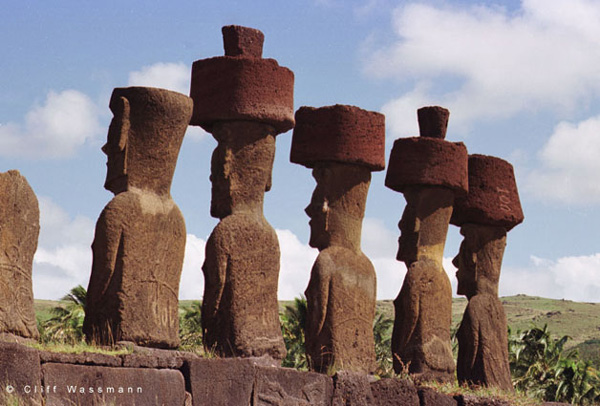
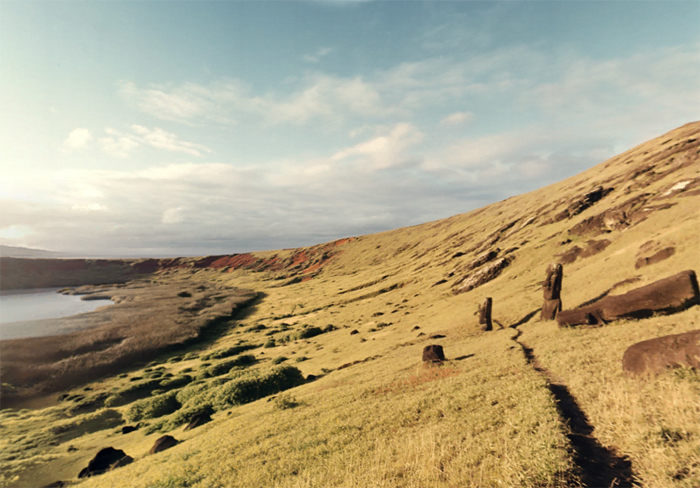
 the previous 1400 years. That culture's most famous features are its enormous stone statues called moai, more than 200 of which once stood upon massive stone platforms called ahu. At least 700 more moai statues, in various stages of completion, are scattered around the island, either in quarries or along ancient roads between the quarries and the coastal areas where the statues were most often erected. Nearly all the moai are carved from the tough stone of the Rano Raraku volcano. The average statue is 14 feet, 6 inches tall and weighs 14 tons; some moai were as large as 33 feet and weighed more than 80 tons (one statue only partially quarried from the bedrock was 65 feet long and would have weighed an estimated 270 tons). The moai and ahu were in use as early as AD 700, but the great majority were carved and erected between AD 1000 and 1500. Depending upon the size of the statue, between 50 and 150 people were needed to drag it across the countryside on sleds and rollers made from the island's trees. While many of the statues were toppled during the clan wars of the 1600 and 1700s, other statues fell over and cracked while being transported across the island. Recent research has shown that certain statue sites, particularly the most important ones with great ahu platforms, were periodically ritually dismantled and reassembled with ever larger statues. A small number of the moai were once capped with "crowns" or "hats" of red volcanic stone.