The tree thrives on abundant and steady
rainfall- at least 50 inches per year-and high humidity. It grows
best in loose soil in areas where there is little wind. Wild cacao
trees in the South and Central American forests, and cultivated trees do
best in screened sunlight.
Cacao trees were being cultivated by Indian
farmers in the Yucatán Peninsula in Mexico long before the arrival
of Cortés. When the Spanish took over the rule of Central
America, they also took over its agriculture and trade and went on to establish
many more cacao plantations, first in Mexico and Venezuela, and later in
Fernando Póo (an island off the coast of West Africa) and the Philippines.
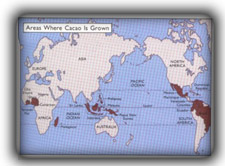
For almost a century, the Spanish had a monopoly
on cacao production. But as the demand for chocolate increased across
Europe, other nations began to establish cacao plantations. The Dutch
started operations in Ceylon (now Sri Lanka), Java, and Sumatra; the Belgians
in the Congo and central Africa; the English in the West Indies; the Germans
in Cameroon; and the French in the Martinique and Madagascar. The
countries of West Africa, including Ghana, Côte d’Ivoire, Nigeria,
and Cameroon, have been leading the world in cacao production.
South Americans countries such as Brazil, Colombia,
Venezuela, the Dominican Republic, and Ecuador harvest the second largest
crop. Malaysia, Indonesia, and Papua New Guinea are also significant
producers. Mexico, the plant’s largest origin, contributes only about
2 percent of the total world crop.
|










 page
3
page
3