
Welcome to "ALEXANDRIA"
it was just like Golden age to Alexandria,the capital of Hellenistic civilization,centre of Arts,
Science& school of phyilosophy,Alexandria was capital of the Ptolemies, with numerous monuments to
the greatness of the era. It was the site of the Lighthouse, one of the Seven Wonders of the Ancient World, as well as the Great Library.
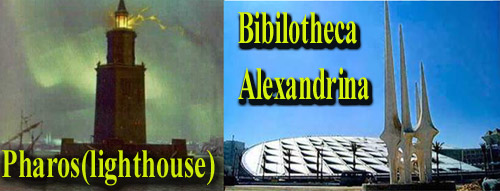
Of the Seven Wonders of the Ancient World, only one had a practical use in addition to its architectural elegance: The Lighthouse of Alexandria,For sailors, it ensured a safe return to the Great Harbor.
For architects, it meant even more: it was the tallest building on Earth.
And for scientists, it was the mysterious mirror that fascinated them most ,The mirror which reflection could be seen more than 50 km (35 miles) off-shore.
Location
On the ancient island of Pharos,there are various opinions about where was pharos locating?
pharos lighthouse was located on an island had the same name" pharos" ,so archeologists not sure yet if this lighthouse got its name from its island name or inversion has happened,but there are so many ancient descriptions about pharos location has helped archeologists to conclude that old pharos of Alexandria was locating in the same place where Fort of Qait bey exists now, and recent excavation has proved all those conclusions.
here is some reviews of those Descriptions:-
1-Julius Caesar's description :
*when Julius Caesar took over Alexandria city after great victory over Ptolemaics in naval battle and ended their rule in Egypt, he described what he saw in Alexandria as follows:
"Pharos of Alexandria is Giant tower with excellent structure ,it located on Pharos island which facing Alexandria shore, linked with shore through so narrow road (this road was called Heptastadium in Greek and in Latin, Hepta means seven, stadium is Greek measurement union ),this narrow road was built of rocks in sea (Mediterranean sea)."continued saying" entrance of this harbour becoming narrow
and tight when you go through it "
from this last paragraph ,we can conclude that Caesar was knowing what danger he would face if that light house & harbor fallen in other hands ,that'll prevent his provision ships entered safely Alexandria's shore , so at once he took possession of island pharos to secure the main entrance of Alexandria.
2- Strabo's (ancient roman historian) description :
"the eastern side of island Pharos consists of rocks, surrounded this side by water from all its corner, on that island there is tower contains several floors ,built of white marble in marvelous structural shape"
**How archeologists succeeded to imagine the final structural shape of pharos?
left samples of Minor arts have helped archeologists to imagine and draw final picture of Pharos ,for example Coins (related back to Roman Imperial age) existing now in Greco-roman museum in Alexandria, those coins bearing drawings and shapes of pharos lighthouse, Greek &Roman Lamps were decorated with the same drawings and relieves ,besides little help from ancient historians' descriptions.
** Now important question comes to our mind, How they built pharos lighthouse ? what kind of building materials they've used?
let's talk about the general facts:
1-building's costs: 800 talent = about 2000 � nowadays .
2-large numbers of slaves & servants (unknown their nationalities) were used in brickwork process.
3-Building materials:Ashlar,&rocks was brought from MAX mine in Alexandria,marble slabs, &Alabaster were used in ornamentation works,bronze was used for sculpture issues and statues,Granite w used for Columns and was brought from Aswan's mines and still some remains & ruins of those columns around Qait bay fort in Alexandria but underwater.
Construction of the Lighthouse :
was most probably begun under Ptolemy Soter, a general in Alexander's army who took control of Egypt after the wars of succession, and it was inaugurated by his son, Ptolemy Philadelphus, around 285 BC. the Lighthouse was a tower over 100 metres tall standing on the eastern tip of Pharos island and that it was constructed in three stages:
- the first was square
- the second octagonal
- and the last circular.
Access to the entrance was up a long vaulted ramp. From there, a spiral staircase led up to the many chambers and it was perhaps used by beasts of burden to carry fuel to he third storey where the fire burned on the summit.
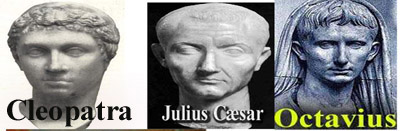
throw fires on the city...and the fire spreaded out along the city and of course the Library was the vicitimand
Octavian (later Augustus) entered it (30 B.C.) .
after the suicide of Antony and Cleopatra. Alexandria formally became part of the Roman Empire in 30 B.C.
It was the greatest of the Roman provincial capitals, with a population of about 300,000 free persons and
numerous slaves. In the later centuries of Roman rule and under the Byzantine Empire, Alexandria rivaled Rome and Constantinople as a center of Christian learning. It was (and remains today)the seat of a patriarch of the Eastern Orthodox Church.
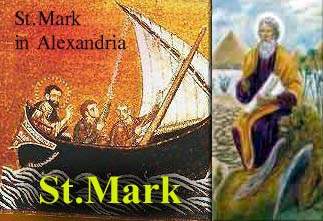
The first conflict that split the early church was between two Alexandrian prelates, Athanasius and Arius, over the nature of Christ's divinity. It was settled in 325 by the adoption of the Creed of Nicaea, which affirmed Christ's spiritual divinity and branded Arianism--the belief that Christ was lower than God-- and this sharpened the conflict between the Alexandrian church and the state. In 391 Christians destroyed the Sarapeum, sanctum of the Ptolemaic cult and what Cleopatra had saved of the great Mouseion library. In 415 Greek culture in Alexandria quickly declined.

