

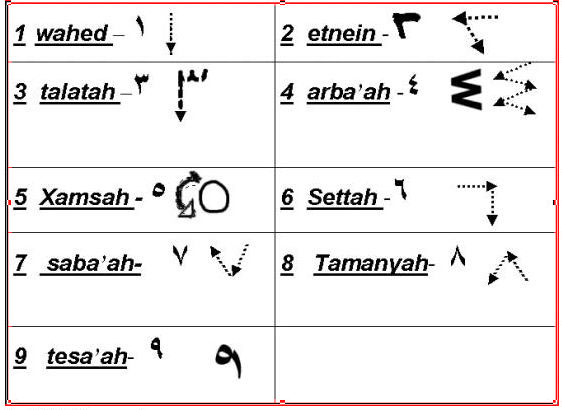
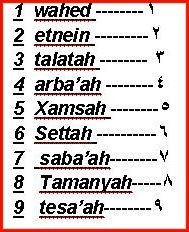
1-the numbering system in Arabic is different, It is derived from Indian numerals, The Indian numerals form the basis of the European number systems which are now widely used. However they were not transmitted directly from India to Europe but rather came first to the Arabic/Islamic people and from them to Europe. The story of this transmission is not a simple one�The eastern & western parts of the Arabic world both saw separate developments of Indian numerals with relatively little interaction between the two. By the western part of the Arabic world we mean the regions comprising mainly North Africa and Spain. Transmission to Europe came through this western Arabic route, coming into Europe first through Spain.
2- All Arabic numbers we use today are ideograms created by Abu Ja' far Muhammad ibn Musa al-Khowarizmi (c.778 - c.850).
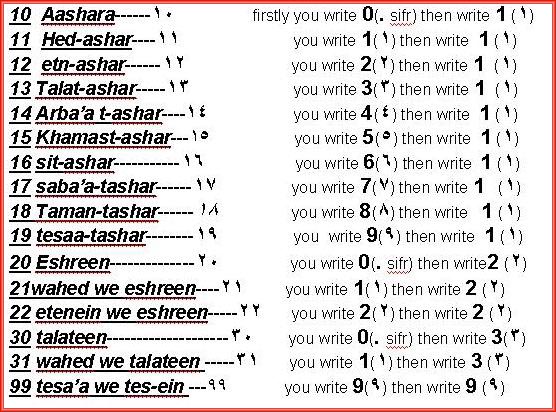
*nouns coming after numbers falling between one and eleven are in plural ,and nouns following after all other numbers are in the singular .
ex:
etn-ashar Kitab(book-singular) =12 books
Xamas Koutob(books-plural) = 5 books
==============================================
* there are three numbers in Arabic: The singular ,The Dual and The plural.
*the dual is formed by adding (-ein) to the singular ,as :-
(Kitab=one book)
(kitabeen=2 books).
-and (-ten) to the feminine which ends with (a),as:-
(genena=one garden)
(genenaten= 2 gardens).
==============================================
* feminine plural is formed by adding (-at) to the singular ;as:
(Bent=one girl )
(Banat= girls)
*and most of the masculine singular that ending in a consonant preceded by (a) form their plural by adding (-in) to the singular , as:-
(shayyalin=porters).