

A- Classical Arabic - the language of the Qur'an and classical literature.
It differs from Modern Standard Arabic mainly in style and vocabulary,
much of which is archaic. All Muslims are expected to read the Qur'an in the original language.
B- Modern Standard Arabic - the universal language of the Arabic-speaking world which is understood by all Arabic speakers. Using it in writing material, books,newspapers, lectures ,speeches formal letters and in formal TV shows, also in radio,in the mosques, and in conversation between educated Arabs from different countries.
C- Colloquial Arabic (local dialects):
using it in our daily life conversation ,and you can find out that every Arabian
country has a sort of special dialect, These colloquial varieties of Arabic appear
in written form in some poetry, cartoons and comics, plays and personal letters,
but you�ll be understood by any other Arabians�no matter the Arabic dialect you speak .

*Note:in this lesson you'll be taught the Arabic alphabet but with noting the letter name will be in Egyptian Arabic ,although there is no such big difference between the sounds of letter in Standard Arabic and Egyptian Arabic but i prefer to write the Egyptian sound of those letters purposely to let your tongue get used to Egyptian dialect.
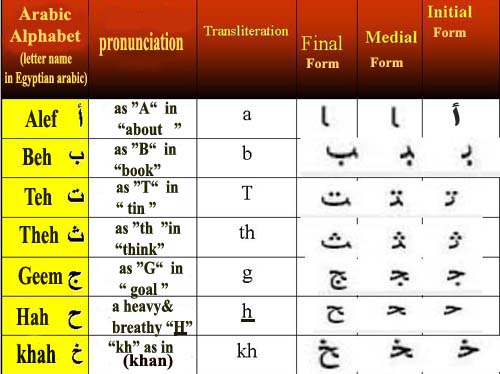
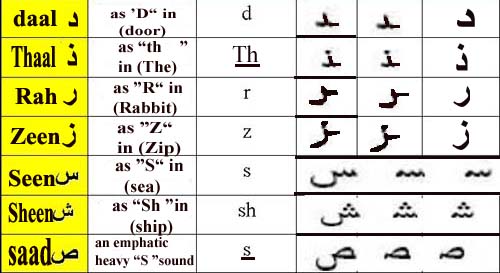
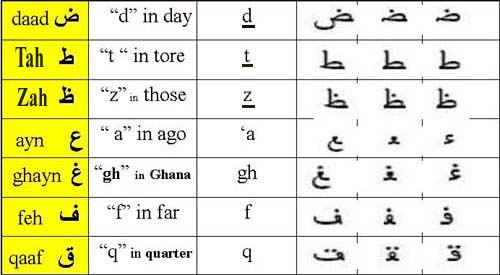
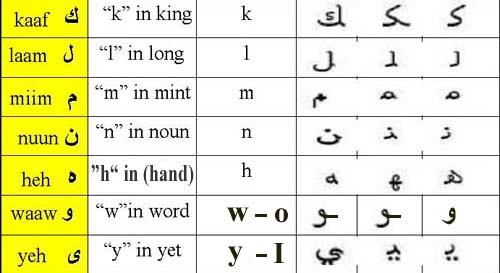
1-the classical Arabic alphabet contained 22 letters but The Modern Arabic alphabet contains 28 letters, Some additional letters are used in Arabic when writing places names or foreign words containing sounds which do not occur in Standard Arabic, such as :/p/ or /g/.
and additional letters are used for writing languages other than Arabic ,such as Urdu and Persian (Farsi),these additional letters are generally formed by addinf extra dots,lines or other squiggles to existing letters or by combining two letters together.
2- Arabic Words are written in horizontal lines from right to left, Arabic is written with its own alphabet ,the shape and structure of the letters makes it�s natural to write Arabic in this direction.
3-to understand how to write in Arabic ,all what you have to do is knowing its handwriting system and realize it well, just like you connect letters together when you write ,so you will joint letters when you write Arabic.
4-Most of letters change its form depending on whether they appear at the beginning, middle or end of a word, or on their own.
5-in Arabic language there are just 3 vowels and they are all with long sound :
alif,= /a:/ ------- like �a� in �cat�
yaa= /i:/ -------- like �ee� in �been�
waaw =/u:/ ----------- like �oo� in �moon�
6- these letters have no English equal and may be a problem specially in pronouncing:
Ha / Kha/ Ain / Ghain / Qaph /Hamza
7-the following letters should always be given the correct stress:
Saad,Daad,Tah,Zah
8- the English following sounds have no equivalent in Arabic:V & P.
9-�ain� is articulated by making a sound as far back in the throat as possible,
�Ghain� is preceded by a sound similar to that made in gargling or like the third letter
of the Greek alphabet.