 |
|
|
|
|
|
|
|
|
|
|
|
|
|
|
|
|
|
|
|
|
|
|
|
|
|
|
|
|
|
|
|
|
|
|
|
|
|
|
|
|
|
|
|
|
|
|
|
|
|
 |
|
|
 |
|
|
|
|
|
 |
 |
 |
 |
 |
 |
|
|
|
Program |
|
|
Part I |
|
|
Part II |
|
|
|
|
|
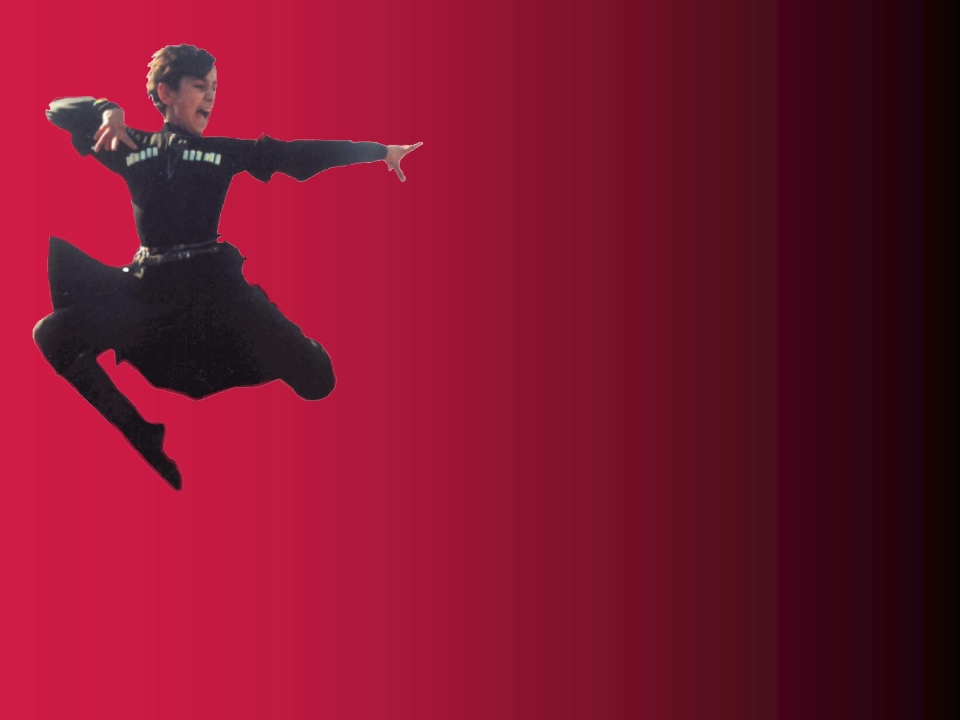
We would like to introduce to you the art of Georgian Folk dancing. These breathtaking and absolutely awesome dances represent a live history book expressing the centuries of Georgian art, culture, and tradition. The beautiful costumes blend history and art in one single harmony. This, coupled with at times rough and technical movements, leaves the audience in total awe. Each dance portrays the life of the region in which it originated, and thus is diverse and unique. The mountain dances, such as Khevsuruli, Kazbeguri, or Mtiuluri, are sharply different from some valley dances - e.g. Adjaruli and Samaia. The costumes are different for every dance and resemble the clothing of the past in different regions of Georgia. |
|
|
|
 |
|
|
Partsa |
|
|
|
|
|
Dances from Guria and neighboring regions in south-western Georgia, along the Turkish border. This group of dances is a snapshot of Georgian history and spirit. Partsa is an ancient dance, popular at village festivities. It is a vibrant dance which brings joy into the town. This circular or round dance is one of the oldest dances in Georgia. It is danced by the complete company. |
|
|
|
|
|
Kartuli |
|
|
|
|
|
|
 |
|
|
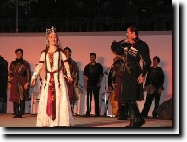
Kartuli is the quintessential Georgian dance. It is the one dance which has not been choreographed for the stage but is danced according to very definite rules of sequence and relation between the man and the woman. It consists of 5 sections where the man invites the woman to join him, the dance together, the solo dance of the man, the solo dance of the woman and the conclusion as they move together. The dance expresses chivalry between Georgian men and women. The man shows a most respectful attitude towards the woman. It is characterized by keeping the upper body very still. Kartuli is governed by very strict rules the man must not touch the woman, not even with his coat. |
|
|
|
|
|
|
Khorumi |
|
|
|
 |
|
|
|
|
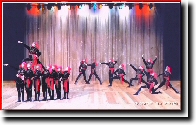
One of the most popular an ancient war dances from the Georgia. It dates back to the period of the heroic war against the conquering armies of the Turks, Mongolians, Arabs and other nations. It is composed of four parts: the search for a suitable spot for the fighter of the underground army, the approach of the enemy, the battle and the victory. Khorumi expresses the infinite strength of character of the Georgian people. |
|
|
|
|
|
Adjarian suite |
|
|
|
|
|
|
*Lazuri - a fisherman's dance |
|
|
|
 |
|
|
|
|
*Gandagan - a fiery dance for the whole ensemble |
|
|
|
|
|
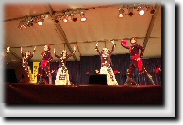
Typical dances from the Adjaria region, they are done at festive occasions, and always with both men and women. The Gandagan is a couple?s dance which is central to the performance. The dance is striking in the contrast of the strong active movements of the men against the light undulating movements of the women. The interaction is free and open, even frivolous and flirtatious. |
|
|
|
|
Kazbeg dance |
|
|
|
A traditional folk dance of the shepherds from the mountain region of Kazbegi. It is powerful dance, where each dancer shows his best... |
|
|
|
Samaya |
|
|
|
 |
|
|
|
|
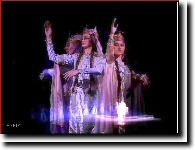
A dance for three women, originally considered to be from the pre-Christian era, celebrates a wedding feast. The dance honors King Tamar, the woman king of Georgia's golden age in the 12th-13th Centuries. The women are thought to represent the three muses of Art, Poetry and Music as shown in an ancient fresco in a famous cathedral in Mtskheta, the former capital of Georgia. The choreography is both monumental and subdued. The dancers' hands silently express the ultimate fluidity found in the three faces |
|
|
|
|
|
Svanuri |
|
|
|
|
|
|
The mountain region of Svaneti has its own language and is culturally separate from the other regions to the east. Common to the mountain regions the men dance with vigor, with special techniques on the toes. |
|
|
|
Khevsur suite |
|
|
|
*Tskarostan |
|
|
|
A women's dance with water jugs (kokebi) - the women goes to the stream to carry water. |
|
|
|
*Kalta |
|
|
|
A dance of the young women, danced at festive gatherings. The women in the high mountain regions dance with a much more active style than in the other regions of Georgia. With grace and vigor each dancer shows her skill. |
|
|
|
*Parikaoba |
|
|
|
This dance commences with the entrance on stage of a young couple in love. When the second young man enters, a quarrel begins and the stage is set for a sabers fight. The young girl, worried about the fate of her lover, calls for help and the dance ends with a general melee. When the battle reaches its peak, the girl takes off her headdress and throws it between the warriors. According to tradition the duelers have to stop immediately. |
|
|
|
INTERVAL |
|
|
|
Part II |
|
|
|
[Home][History][Leaders][Program][Photo Gallery][Video][Contact Us] |
|
|
|
|
|
|
Copyright (c) 2007 Egrisi. All rights reserved. |
|
|
|
[email protected] |
|