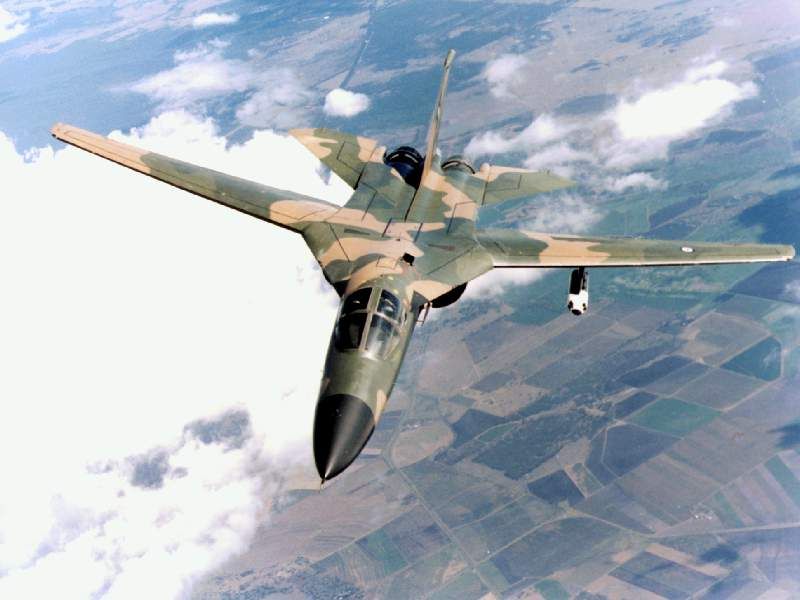
General Dynamics F-111 Aardvark Nicknames: Flying Pig, Whispering Death, Swinger, Switchblade, SparkVark. |
| The F-111 first flew in
December 1964 under the TFX (tactical fighter, experimental) designation. It was developed
to meet a joint service requirement for a long range interceptor and deep-strike
interdictor. Entering the US Air Force service in 1967, it saw action in the Vietnam war,
where structural defects and problems with the terrain-following radar caused the loss of
several aircrafts. Withdrawn for modifications, the F-111 was reintroduced with
considerable success in 1972, earning the nickname "Whispering Death" from the
Vietcong. Dubbed Aardvark which is
Afrikaans for "Earth Pig" ( because of its long snout), the F-111 fighter-bomber
was favored by Tactical Air Command ( TAC ) units for use on long range, deep interdiction
attacks against targets within enemy territory. The FB-111A was used by the Strategic Air
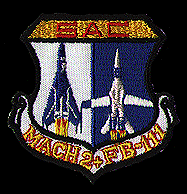
Command ( SAC ) as a medium bomber (See patch below). The Aardvark has side-by-side
seating for the pilot and weapons systems operator. The two crew members sat in a pressurized capsule which served as an emergency escape module. This module was designed to permit safe escape throughout the entire flight and could serve as a survival shelter on the ground or in the sea.� A Pave Tack laser designator system
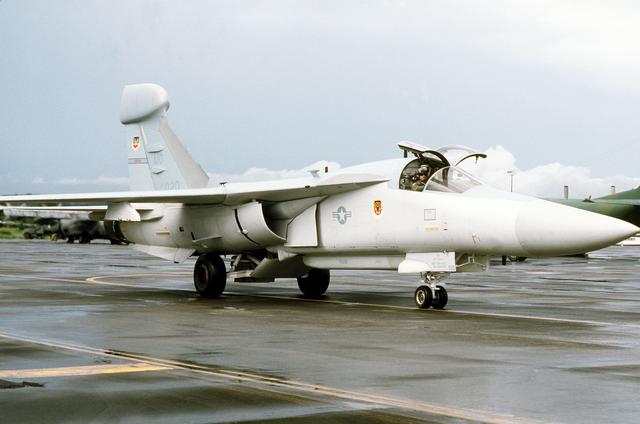
enables pinpoint delivery of In 1975, the F-111A underwent modifications by Grumman Aerospace resulting in the EF-111A, which was the electronic warfare derivative of the Aardvark, so it was hardly surprising that its crews quickly adopted the unofficial name "Spark Vark" for their mount. When the modifications were completed, the airframes had been totally re-wired, the weapons bay had been modified and the aircraft was outfitted with the AN/ALQ-99E jamming system which jams enemy radar signals and provide a protective electronic shield for attacking aircrafts. Initial operational capability (IOC) was achieved in November 1983, and the EF-111A was named the "Raven". Prior to the official designation, Grumman referred to the EF-111A as the "Electronic Fox". As mentioned earlier, the EF-111A community commonly referred to it as the "Spark Vark". The Raven has no armament capability and is therefore forced to rely on high-speed evasion in the event of running into fighters. However, a dwindling US Defence budget and the drive to consolidate forces, led to the decision to withdraw the Raven from service. The last unit to operate the much-loved and highly effective EF-111A Raven was the 429th Electronic Combat Squadron ( ECS ) at Cannon AFB, New Mexico. The official retirement ceremony was hosted by the 27th Fighter Wing at Cannon AFB, over 1 ~ 3 May 1998, with the final deactivation on 19 June. The Ravens now reside among other classic types in the dusty rows of Aerospace Maintenance and Regeneration Center (AMARC) formerly known as Military Aircraft and Storage Disposition Center (MASDC). AMARC is located in the Davis-Monthan AFB way out in the Arizona desert and is the "mecca" for literally thousands of surplus aircrafts. Another era in aviation history has been
drawn to a close with the retirement of the EF-111A Raven from US Service. |
| �Click on the thumbnails below to view a larger image. |
 |
 |
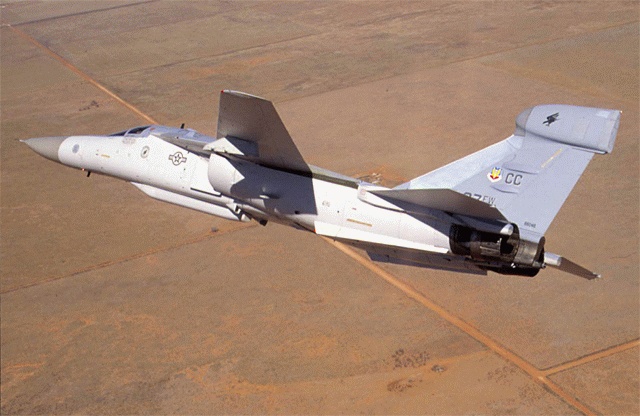 |
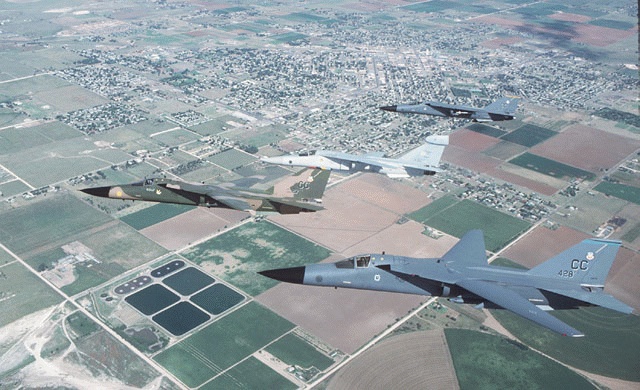
| EF-111 Raven | 4 ships formation | right bank |
Aardvark� F-111F� Specifications |
|
| Length: | 22.40 m |
| Height: | 5.22 m |
| Wing span: | �19.20 m -
spread full forward. �9.74 m - swept full aft. |
| Wing area: | 48.77 sq m |
| Performance | |
| Maximum speed: | �Mach 1.2 at sea
level. �Mach 2.5 at 18,200 m. |
| Weight: (empty): | 21,537 kg |
| Weight: (take-off): | 45,360 kg |
| Range: | more than 2,540 nm with internal fuel, & 3,100 nm with external fuel tanks. |
| Service ceiling: | 18,200 m |
| Propulsion | |
| Powerplant: | Two Pratt & Whitney TF30-P-100 turbofans, each rated at 111.65kN. |
| Armament | |
|
Two AIM-9P-3 AAMs for self-defence, and up to 14,228 kg of primary weapons and� "dumb" ordnance, which includes :-
Dumb Ordnance :
|
|
Go to top 
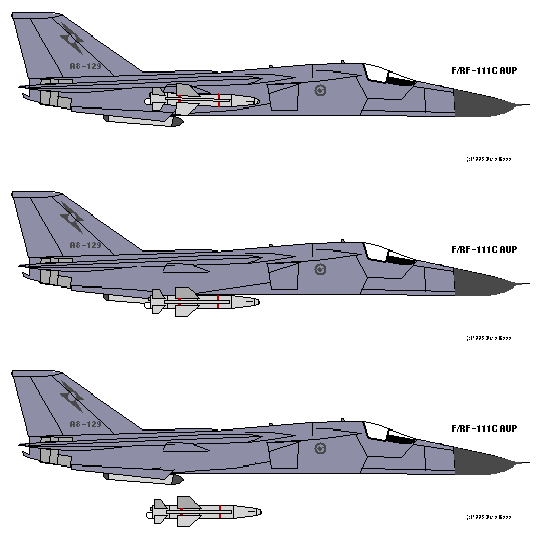
An Australian Aardvark armed with
Raphael/Lockheed-Martin AGM-142
Raptor stand-off weapon.
| F- 111� Aardvark� Variants | |
| F-111 | Pre-production variant, first flew in December 1964. |
| F-111A | Production variant. |
| F-111B | Developed for the US Navy, but was cancelled before its production due to severe weight problems. |
| F-111C | Flown mainly by the Royal Australian Air Force. |
| F-111D | Has improved avionics with better navigation, air-to-air delivery systems and newer turbofan engines. The D proved to be maintenance intensive and was retired in late 1992. |
| F-111E | Has modified air intakes to improve the engine performance at speeds above 2.2 Mach. Most F-111Es served with the 20th Fighter Wing RAF Station, Upper Heyford, England to support NATO. |
| F-111F | Last of the production variants. Modified to carry the Pave Tack system in their weapon bays. |
| F-111G | The FB-111As were reworked as F-111Gs, and these served in a training role until 1993. |
| FB-111A | Used by Strategic Air Command (SAC) as a medium bomber, the FB-111A has longer-span wings. |
| EF-111 | Dubbed as the Raven. This model is the modified version of the F-111A and is equipped with the AN/ALQ-99E jamming sub-system. |
�Go to top
Aardvark's 
F-111 Aardvark� - The Number One site on all versions of the F-111.
The FB-111A "Switchblade"�� - A good "FB" site by Phillipe Colin.


Fly back�  � to Hangar.
This page was edited on Monday, 10 September 2001.
�
 ordnance. The F-111's wings can be changed in flight from a straight
to swept-back delta configuration, hence sometimes they are referred to by their nicknames
"Swinger" and "Switchblade".
ordnance. The F-111's wings can be changed in flight from a straight
to swept-back delta configuration, hence sometimes they are referred to by their nicknames
"Swinger" and "Switchblade".