Sukhoi
Su-25' Frogfoot' |
|---|
 This comes from the bird's
ability to get the food out of hard to reach spots, which is very similar to
the plane's ability to destroy he hardened
targets in hard to reach locations in the mountains. The Afghanistani Mujahideens called the
Su-25"The German Product" because of their initial
disbelief that something that efficient can be designed by the
Soviets. It was the most feared and respected fixed wing aircraft. The
Soviet infantry called the Su-25"Rascheska" ( The Comb ),
because loaded Su-25 with its ten pylons
occupied with the payload, resembled the comb if viewed from below . The VVS (Soviet Air
Force) staff called the Su-25"Konyok-Gorbunok" which is a
fictional animal from one of the fairytales by Bazhenov. This character is more like a
pony or some sort of a miniature horse, which looks ugly and small, but can outperform the
bigger (and faster) stablemates. Czechoslovak's Su-25s were nicknamed"Steam
Locomotives".
This comes from the bird's
ability to get the food out of hard to reach spots, which is very similar to
the plane's ability to destroy he hardened
targets in hard to reach locations in the mountains. The Afghanistani Mujahideens called the
Su-25"The German Product" because of their initial
disbelief that something that efficient can be designed by the
Soviets. It was the most feared and respected fixed wing aircraft. The
Soviet infantry called the Su-25"Rascheska" ( The Comb ),
because loaded Su-25 with its ten pylons
occupied with the payload, resembled the comb if viewed from below . The VVS (Soviet Air
Force) staff called the Su-25"Konyok-Gorbunok" which is a
fictional animal from one of the fairytales by Bazhenov. This character is more like a
pony or some sort of a miniature horse, which looks ugly and small, but can outperform the
bigger (and faster) stablemates. Czechoslovak's Su-25s were nicknamed"Steam
Locomotives".The SU-25 Frogfoot's main production plant was at Tbilisi,
Georgia, whilst the production of the two-seat SU-25UB was undertaken at the Ulan Ude
Aviation Plant, Russia. When the Soviet Union disintegrated, production at the Tbilisi plant ended in 1989 after
approximately 330 aircraft had been built. It is now
thought that the SU-25/T/TM/TK "Frogfoot" is no longer in production.
The Frogfoot is regarded as a Soviet equivalent of the US Air
Force's Fairchild A-10A Thunderbolt II, and as such it is intended
for deployment in a similar battlefield close-support role, but performance figures show
that the SU-25's higher maximum speed was gained at the cost of reduced weapons load and
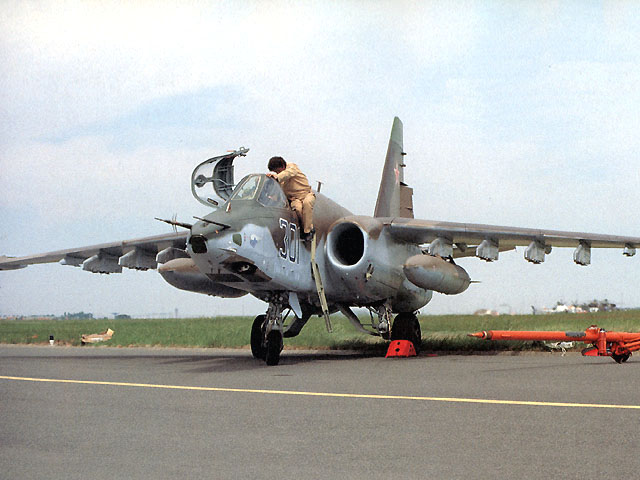
also of lesser range and/or endurance. In configuration, the SU-25 is a shoulder-wing
monoplane, the wing incorporating considerable anhedral and about 20?of sweepback. The
leading edge of the wing has full-span slats, and doftooth at 50 per cent span with
extended chord outboard to the wing tip; the entire trailing edge is occupied by ailerons and double-slotted flaps. At each wing
tip is a fairing of flattened ovoid cross-section that houses (in the lower forward end) a
retractable landing light, and which is formed at the rear by upper lower split spoilers
that can be extended collectively to serve as air brakes or operated differentially to
improve maneuverability in low-level flight. The tail unit is conventional, the landing
gear is of retractable tricycle type with low-pressure tyres and designed specifically for
operation from rough surfaces, and power is provided by two turbojets mounted in long
nacelles at each wing root. The single-seat accommodation for the pilot is protected by
armour which is incorporated in the fuselage side structure and by flat bullet-proof
windscreen. External antennae indicate that avionics include 'Odd Rods' IFF and a Sirena-3
radar-warning system, and the tailcone serves to house a chaff/decoy flare dispenser. A
laser rangefinder and marked-target seeker is mounted within the nose.
The SU-25 was deployed for experimental operational use in Afghanistan, where the Soviet Air Force placed early emphasis on the development of co-ordination techniques to maximize the efficiency of close-support operations in which SU-25 and Mil Mi-24 'Hind' helicopter gunships were collaborating. Attaining full operational capability in 1984, the SU-25 force in CIS service now totals some 700 aircrafts, and this derivative has also been exported to a number of favoured customers in its SU-25K version.
| Sukhoi Su- 25K Specifications | |
| Length : | 15.53 m |
| Height: | 4.80 m |
| Wingspan: | 14.36 m |
| Wing area: | 33.70 sq.m |
| Performance | |
| Weight (empty equipped): | 9,500 kg |
| Normal take off weight: | 14,600 kg |
| Maximum level speed: | 975 km /h |
| Service ceiling: | 7,000 m |
| Combat radius: | 550 km with a 4,000 kg warload and two drop tanks. |
| Propulsion | |
| Two MNPK 'Soyuz' (Tumanskii) R-195 turbo jets each rated at 44.13 kN dry. |
|
| Armament | |
| ��One 30-mm AO-17A cannon in port lower fuselage, with ��250 rounds; maximum ordnance 4,400 kg including :- ������� ����- 57mm to 330mm unguided rockets, ���������� �- various free fall and laser guided bombs, ���������� �- cluster bombs, ����������� - dispenser and incendiary weapons, ����������� - cannon pods, ����������� - Kh-23 ( AS-7 'Kerry' )���ASM ����������� - Kh-25 ( AS-10 'Karen' )�ASM ����������� - Kh-29 ( AS-14 'Kedge' )�ASM ����������� - R-60��( AA-8�'Aphid' )����ASM |
|
Click on the thumbnails below to view a larger image.
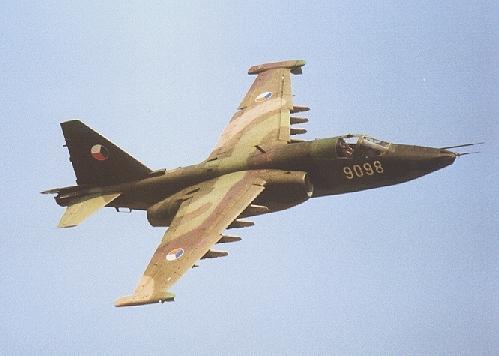
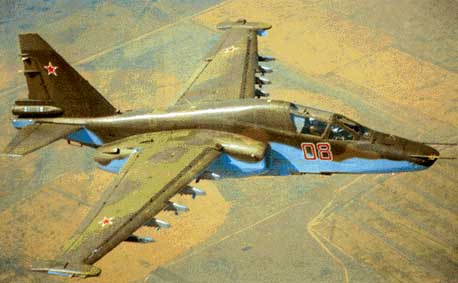
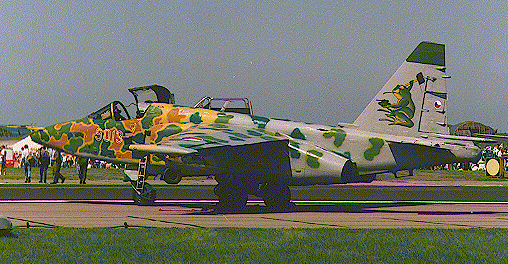
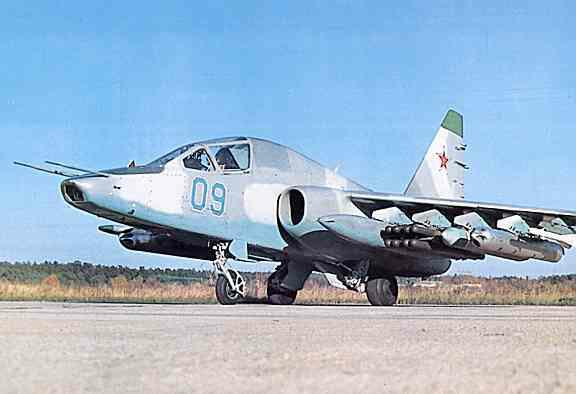
�����Su-25K����������������Su-25UB�����������������������Su-25����������������������Su-25TM
| Sukhoi Su-25�Frogfoot�Variants | |
| Su-25 | (Frogfoot A) basic
single-seat version. Prototype known as T-8-1 was first flown on 22 February 1975. |
| Su-25K | Export variants. |
| Su-25BM | Target tug conversion. |
| Su-25UB | (Frogfoot B) Combat capable two-seat conversion trainer with stepped cockpits. |
| Su-25UBK | Trainer variant for export. |
| Su-25UT | (Frogfoot B) same as Su-25UB but the weaponry has been removed. Used for pilot training with VVS and DOSAAF. ( It was later redesignated Su-28 ) |
| Su-25UTG | (Frogfoot B) same as Su-25UT but an arrester hook has been added for deck landing. Ten of these were built and are now deployed with the carrier Adm. Kuznetsov. |
| Su-25TK | Export variant offered to Abu Dhabi and Bulgaria. |
| Su-25TM | Improved version of the Frogfoot and the most recent variant. The original Su-25UB airframe was used. The second seat was removed and the rear cockpit was used for an additional metric ton of fuel and extra avionics. |
| Su-25TP | Proposed maritime variant. |
| Su-25BM | The Su-25BM is a standard Su-25 but has additional underwing pylons for the attachment of rocket powered drones. |
| Su-34 | Originally the Su-25T, the Su-34 is an extensively modernised Su-25UB derivative, |
Go to top�
| Frogfoot� Operators | ||
|---|---|---|
| Angola | Azerbaijan | Belarus |
| Bulgaria | Czechoslovakia | Georgia |
| Iran | North Korea | Russia |
| Slovak Republic | Ukraine | |
Frogfoot's 
Frogfoot - Coming up soon.
Su-25�-�We are searching for some good links. Do you know any ?
Fly back |
This page was updated on Friday, 17 January 2003.