County Kilkenny, Ireland
~ ©1999 by Ed Marsh, written Sunday, April 04, 1999, revised Thursday, September 23, 1999|
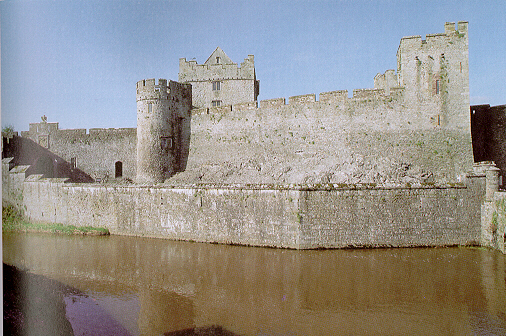
Cahir (pr. "care"): the great Butler castle, County Tipperary, Ireland |
In the following article, I indulge the fantasy of Candlers and Castles. At the bottom of the page, there are some more pictures and fun stuff. According to legend, Daniel Candler immigrated to America from Ireland after he was disowned for marrying an Irish Catholic woman (Hannah). Legend holds that the Candlers (Daniel, Hannah, and possibly John and Elizabeth) arrived in Charleston, SC, in c1735 and proceeded almost immediately to North Carolina. Their destination in Carolina is never part of the tale. |
Quoting Doug Tucker (informally from the Candler GenForum), "Ann Villiers Candler was well-connected to the Court of St. James and it was probably her connections that led to William Candler being granted crown lands at Callan in County Kilkenny in 1670. These lands included the ruins of an old mote and bailey castle built by William Marshall in the 13th century. In fact, a mote and bailey castle was more of a rudimentary fort than a castle, consisting of a single fortified tower on a hill (the mote), surrounded by a fenced in common yard (the bailey). Originally built of wood, the walls and tower at Callan had been rebuilt with rough stone. It was a defensive fortification and was never used as a residence -- before or after the Candlers. In 1670 when the Candlers arrived in Callan, the Marshall Castle was a total ruin and the bailey had been used as a grave yard for those who died during Cromwell's seige of the town in 1650.
William Candler built a manor house on his Callan property and named his property "Callan Castle". It is pleasant to imagine that William Candler lived in an pictuesque Irish castle, but that just isn't the case."
What A. D. Candler Thought
In Allan Daniel Candler's book Colonel William Candler of Georgia, His Ancestry and Progeny, 1896, Foote and Davis Pub, Atlanta, GA, the author states that the Candlers came to North Carolina and that this was where William was born, raised, and married. This is not correct.
What The Facts Tell Us
William Candler was at the South River area (present-day Bedford & Campbell Co, Virginia) at age nineteen (he joined the Quakers in 1755) and he was still in Virginia at age 25 (in 1761 when he married Elizabeth Anthony).
Quakers were very rigid in their comings and goings. They were often required to get certificates of good standing before visiting another Quaker meeting. We see marriage certifcates, traveling certificates, etc. To move away from a meeting in good standing one had to prove that he was leaving with no debt or pending legal issues. William Candler asked the South River Quakers to settle his business with them in 1766 and left the area about 1767-68. He was in Georgia by 1769.
Furthermore, William's brother, John Candler, Sr. (c1730-1802) was married c1750 to Elizabeth Gibson whose parents, James and Eleanor Gibson, had lived in the area since the mid-1740's (as shown in land records of Lunenburg County -- became Bedford in 1753). John's son William was born there in 1751. Considering John's age at the time of his marriage, it seems likely that Daniel and Hannah were already living in the area. Why?
Daniel stated in his will of 1765 that if Zedikiah did not remain at home till age twenty (or till married), that he would be disowned. Considering these feelings, it is likely that John (about 20 at the time of his marriage) had not left home, met a girl and decided to marry. Reasoning thus, I assume that Daniel and Hannah Candler reached South River Settlement no later than 1747-48 -- about the time that Zedikiah was born and a few years before John was married.
Daniel and Hannah Marry
According to legend, Daniel was the son of Thomas Candler, Esq. of Callan, County Kilkenny, Ireland; and the grandson of Lieutenant Colonel William Candler, Esq. Thomas Candler's will was probated in 1719 (although I've heard that he died in 1716). Assuming the 1719 date, let's examine this time-line.
|
c1700 -- Daniel is born in County Kilkenny |
c1736 -- William Candler is born |
|
c1718 -- Daniel marries Hannah and is disowned |
c1740 -- Elloner Candler is born |
|
c1730 -- John Candler is born |
c1747 -- Zedikiah Candler is born |
|
c1733 -- Elizabeth Candler is born |
c1748 -- Daniel, Hannah, John, Elizabeth, William, Elloner, and Zedikiah are living at South River |
|
c1735 -- Daniel immigrates to America |
c1750 -- John Candler marries Elizabeth Gibson |
This schedule would have Daniel and Hannah married for twelve years prior to the birth of their son John (15 years if Thomas died in 1716). Additionally, Hannah would have been about fifty when Zedikiah came along. It is not impossible that circumstances created this scenario, but it seems a bit unlikely.
I have read that there was a Daniel Candler on a County Down tax list in about 1730. This is consistent with the oft-repeated tale that William Candler was born in Dublin, Ireland. His grandson, Ignatius Few, said he was born in America, but this residency near Dublin may account for the story.
There is also another 12 year period between c1735-c1747 when no accounting for Daniel's whereabouts has been made. This is the time when he was supposed to have been in North Carolina.
Back to Ireland
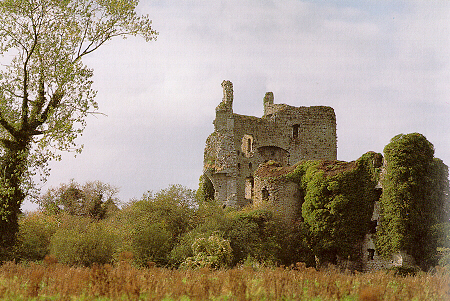
Castle building in Ireland began after the Norman Conquest of England in 1066. "William the Conqueror and his Norman lords and knights built the first castles in Britain expressly as military stronghold-cum-residences from which to police their newly conquered lands." -- P.S. Fry, Castles of Britain & Ireland, Abbeville Press.
There passed a period of neglect before the land-grabbing class of England could turn their ambitions toward the Emerald Isle. Between 1170 and 1700, approximately 3000 castles were constructed, the great majority built by people other than the Irish. Thus the castle itself came to be a symbol of foreign aggression. In time, the early English descendants became intermixed with the Irish. Oliver Cromwell's campaign of the 1650's found many one-time Englishmen fighting to repel the newcomers.
Lieutenant Colonel William Candler, Esq. took up residency in Callan, County Kilkenny, Ireland. Legend holds that he lived in a castle: "... for there were castles available at that time" stated one writer. Callan lies at the southwest edge of the County near the Kilkenny/Tipperary county line. This area was occupied by the Butler family prior to the confiscations of 1653. There is much speculation on just which castle at Callan was the home of the Candlers. I am completely unqualified to comment on this question.
What Was A Castle Like
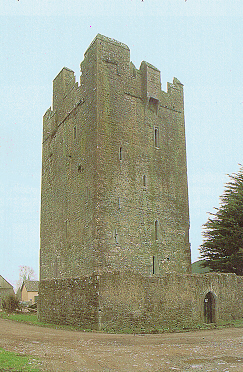
This is Castle Clara, County Kilkenny. It is a 15th century tower house, more or less typical of its kind.
A Tower was square or rectangular, only occasionally round, and rarely more than 30 x 40 feet, more frequently less. One and sometimes more storeys were vaulted (the rest having beamed floors -- oak being preferred). This was accomplished by placing thatched mats of willow over wooden forms.
Mortar was placed on these mats into which were pressed the arch stones. When this masonry was firmly set, the bracing was removed and there stood the vaulting. The matting was then plastered creating a beautiful ceiling.
True to the medieval mind, there was no consistent order of apartments going upward. Sometimes the Great Room was at the top and sometimes not. The stone spiral stair was typically in the corner of the storey though often, the first flight was wooden (presumably so it could be destroyed to hamper would-be attackers.
The typical wall thickness was 6 to 8 feet, but this too varied greatly. Almost all had parapets round the wall tops (these - at left - are called "Irish" style).
As stated above, it is unlikely that William Candler ever lived in an Irish Tower House. If you are interested in the subject anyway, I have included a hyperlink here (same one as above) to an interesting web site that lists Walsh Family confiscations during Cromwell's rule. It seems to me that this information has been available. Any Candler researchers of the past who wanted to find out just which castles were confiscated around Callan could have done so.
Townlands of Kilkenny Homepage Essays