 |
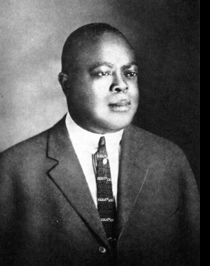
| Joe "King" Oliver (1885-1938) Cornetist and bandleader |
| King Oliver is said to have begun music as a trombonist, and from about 1907 he played in brass bands, dance bands and in various small groups in New Orleans bars and cabarets. In 1918 he moved to Chicago and in 1920 he began to lead his own band. After taking it to California in 1921, he returned to Chicago and, with some other muicians, started an engagement at Lincoln Gardens as King Oliver's Creole Jazz band. This group was joined a month later by the 22-year-old Louis Armstrong as second cornetist. With two cornets (Oliver and Armstrong), clarinet (Johnny Dodds), trombone (Honore Dutrey), piano (Lil Hardin), drums (Baby Dodds) and double bass and banjo (999Bill Johnson), Oliver began recording in April 1923. Many young white jazz musicians had the opportunity to hear him then, either on recordings or live at Lincoln Gardens. |
| By late 1924, the completely reorganized band included two or three saxophones, and played in Chicago as the Dixie Syncopators. Soon the members began to dispere and by autumn the group had disbanded, but Oliver stayed in New York, recording frequently with ad hoc orchestras. From 1930 to 1936 he toured widely, with various bands; he himself seldom performed during this period and he made no fyrther recordings after April 1931. He spent the final months of his life in Savannah retired from music. Oliver is generally considered one of the most important musicians in the New Orleans style. He played in a relatively four square rhythm and clipped melodic style and had a repertory of expressive deviations of rhythm and pitch, some verging on theatrical novelty effects and others derived from blues vocal style. He was especially renowed for his wa-wa effects, as in his famous three-chorus solo on Dipper Mouth Blues (1923), which was learned by rote by many trumpeters of the 1920s and 1930s and which became a jazz standard. |
 |
| Joe "King" Oliver |
| Oliver integrated his playing suprbly with his ensemble and was an excellent leader; the Creole Jazz Band may have been successful largerly because of the discipline he imposed on his musicians. Indeed, of the earlier New Orleans cornetists, only Oliver was extensively recorded in the 1920s with an outstanding ensemble. After 1924 the quality of his recordings declined, partly because of recurrent tooth and gum ailments and partly because his style was at odds with that of his younger sidemen; but with a good orchestra he was capable of coherent and energetic playing even as late as 1930. Almost all of his recorded performances have been reissued. |
| Oliver's influence is difficult to assess: his playing during his New Orleans period was not recorded and by 1925 his style had largerly been superseded by Armstrong's. The extent of Oliver's |
| on Armstrong himself, though clearly audible and significant, has yet to be examined properly. Oliver is credited with many melodies on record labels and in copyright registrations; it is not known how many of these he actually composed. |
 |
 |
| The most Famous Jazz Artists |