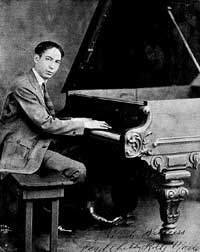
Retaining New orleans as his base, he later extended his travels to Memphis, St. Louis and Kansas City, frequently working for prolonged periods in minstrel shows. Eventually he travelled as far east as New York and as far west as Los Angeles, where he arrived in 1927. During these years of travel, Morton apparently fused a variety of black musical idioms with Hispanic music and white popular songs, creating a musical amalgam that bore a very close resemblance to the music then beginning to be called "jazz".
Morton remained in Los Angeles for five years. In 1922, however, he moved to Chicago, the new centre of jazz activity. His first recordings were made in 1923: two performances with a sextet and a series of solo piano renditions of his own works. By 1926-7, Morton was recording with his Red Hot Peppers, a seven -or eight- piece band organized for recording purposes and comprised of colleagues well-versed in the New Orleans style and familiar with Morton's music. The resultant recordings were a triumphant fusion of composition and improvisation. Noteworthy is the manner in which Morton provides opportunities for all the performers to contribute significant solos without losing sight of overall structural unity and balance between solo and ensemble.
As a pianist, Morton contributed not only some of his most inspired solos, but also sensitive countermelodies that were without precedent in 1920s jazz; similar ideas were taken up only by earl Hines and, some years later, Art Tatum.
In 1928, Morton moved to New York. There he continued to record such pieces as Kansas City Stomp, Low Gravy and Blue Blood Blues. He gradually made use of such "'modern" devices as homophonically harmonized ensembles and laid a greater emphasis on solo improvisation. However, he remained at heart true to the New Orleans spirit of collective improvisation. By 1930, Morton's style, both as arranger and pianist, came to be regarded as antiquated. Ironically, some of his compositions continued to be perforned regularly, remaining as influential pieces in the repertory throughout the 1930s. Indeed, it was benny Goodman's performance of the last-named title, which was largerly responsible for ushering in the swing era.
In the early 1930s, Morton drifted into obscurity. He settled in Washington, where he managed a jazz club and also played intermittently. In 1938, the folklorist Alan Lomax, later Morton's biographer, recorded him in an extensive series of interviews held at the Library of Congress. His accounts, both verbal and pianistic, have the ring of authenticity and revealed Morton as jazz's earliest musician-historian and a perceptive theorist and analyst of the music. The Library of Congress recordings rekindled public interest in Morton, eventually leading to further recording sessions in 1939-40 and in tandem with the New Orleans revival, a renewed career. This was cut short in 1940, however, owing to his ill health. |