An Abridged History of the Original Edenton Bell battery
The Edenton Bell Battery was initially organized as the Albemarle Artillery in March, 1862 by Edenton lawyer Captain William Badham, Jr. and his brother-in-law Lieutenant John M. Jones. Lieutenant Nelson McClees and his men from Tyrrell County joined the battery, as did men from Washington County. A few from Bertie and Perquimans Counties joined as well. The unit was officially incorporated into Confederate service as Company B, 3rd Battalion, North Carolina Light Artillery. After drilling in Edenton, Raleigh, and Richmond without cannon and after a threat to be disbanded and incorporated into the infantry, Captain Badham dispatched Lieutenant Jones back to Edenton in April, 1862, to solicit metal to cast cannon for the unit. Jones was successful in convincing the major institutions and residents of the town to donate their bells. Upon Jones' return to Richmond, Tredegar Foundry cast four bronze cannon on April 28, 1862, using the metal obtained from the melted bells of Edenton. The unit's name then became the Edenton Bell Battery.
The Men of the battery voted names for each cannon based on the bells from which the cannon was actually cast. A six-pounder was named the Edenton since the Chowan County Courthouse bell was used to cast it. Another six-pounder was named the Columbia in honor of McLees' men from Tyrrell County (Columbia being the county seat.) Using the bell from the Edenton Methodist Church, a twelve-pounder was cast and named the Fannie Roulac after a female leader of the church. Lastly, another twelve-pounder was named the St. Paul after the St. Paul's Episcopal Church bell that was used to cast it.
The battery saw action in Virginia with the ANV (Army of Northern Virginia) in battles at Winchester, Culpeper Courthouse, the  Seven Days Battle, and Fredericksburg. Subsequently transferred to the Department of North Carolina in 1863 to oppose Union advances towards the Wilminton and Weldon Railroad, the battery then saw action in the battles of Whitehall Bridge, Goldsboro, and Kinston. That same year, the unit was garrisoned at Fort Holmes on Smith Island (now Bald Head) and served as a "flying" battery for protection of Southern blockade-runners transiting Old Inlet at the mouth of the Cape Fear River. After the fall of Fort Fisher in January, 1865, the battery evacuated to Fort Anderson in Brunswick County, N.C. Subsequently engaged in a fighting retreat up the western bank of the Cape Fear River towards Wilmington, the St. Paul and its gun crew were captured on February 20, 1865 by Federal forces at the Battle of Town Creek near Orton Plantation. The remainder of the battery saw action around Wilmington and in the battles of Bentonville and Cox's Bridge. The six-pounder Edenton was surrendered with the surviving men of the battery and Army of Tennesse under General Joseph E. Johnson on April 26, 1865. The Fannie Roulac and the Columbia are rumored to have been dumped into the Eno River during the unit's retreat with Confederate forces west of Raleigh after the Battle of Bentonville. Seven Days Battle, and Fredericksburg. Subsequently transferred to the Department of North Carolina in 1863 to oppose Union advances towards the Wilminton and Weldon Railroad, the battery then saw action in the battles of Whitehall Bridge, Goldsboro, and Kinston. That same year, the unit was garrisoned at Fort Holmes on Smith Island (now Bald Head) and served as a "flying" battery for protection of Southern blockade-runners transiting Old Inlet at the mouth of the Cape Fear River. After the fall of Fort Fisher in January, 1865, the battery evacuated to Fort Anderson in Brunswick County, N.C. Subsequently engaged in a fighting retreat up the western bank of the Cape Fear River towards Wilmington, the St. Paul and its gun crew were captured on February 20, 1865 by Federal forces at the Battle of Town Creek near Orton Plantation. The remainder of the battery saw action around Wilmington and in the battles of Bentonville and Cox's Bridge. The six-pounder Edenton was surrendered with the surviving men of the battery and Army of Tennesse under General Joseph E. Johnson on April 26, 1865. The Fannie Roulac and the Columbia are rumored to have been dumped into the Eno River during the unit's retreat with Confederate forces west of Raleigh after the Battle of Bentonville.
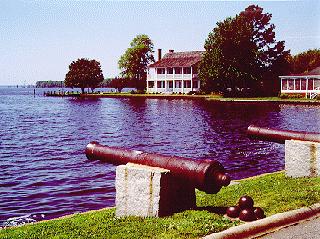
During the Years following the War and the return home of the surviving men of the Edenton Bell Battery, the whereabouts of the four cannon remained a mystery for generations. Not until 1990 did a Civil War reenactor from Edenton discover the six-pounder Edenton at Shiloh National Military Park in Shiloh, Tennesse. In 1999, the twelve-pounder St. Paul, with its distinct identifying markings, was discovered stored at Old Fort Niagara in Youngstown, New York. Prior to transfer to Old Fort Niagara in 1930, the St. Paul had been stored at the U.S. War Department's Watervliet Arsenal in New York State. Both Tubes (Edenton and St. Paul) are now home in Edenton, NC and are on display in Edenton's Waterfront Colonial Park.
|
