Bangkok Post, June 21 - July 5, 2000
The Rice Policy Committee yesterday agreed to spend a total of 11.69 billion baht for the Agriculture and Commerce ministries to build 66 paddy silos and a rice warehouse in the hope of improving grain prices. A total of 10.69 billion baht will be budgeted for the Agriculture Ministry to construct 66 silos in 24 provinces, with a combined storage capacity of more than two million tons of paddy. The remaining one billion baht will be allocated to the Commerce Ministry's Public Warehouse Organisation to build a new warehouse with a capacity of 400,000 tons of rice.
Supachai Panitchpakdi, a deputy prime minister and chairman of the committee, said after the meeting that the ministries have to discuss with the Finance Ministry the source of funds for the project and borrowing arrangements. It is believed that there are funds available under the World Bank's sector adjustment loan programme, and the two ministries have recommended borrowing from that.
"If there are SAL funds available, then the two ministries can propose the project for cabinet approval and go ahead," Dr Supachai said.
Deputy Agriculture Minister Newin Chidchob reportedly recommended that the project be screened by the National Economic and Social Development Board.
This would abide by the regulation that any state investment project worth more than 500 million baht must be screened initially by the NESDB. However, Dr Supachai said the regulations governing this project would be waived but he did not explain why this privilege would be extended. He said the Rice Policy Committee agreed to approve the project because it viewed the investment as fundamental for the development of the rice industry.The management of the silos would be handled by the Marketing Organisation for Farmers (MoF) as proposed by Mr Prapat Pothasuthon, the agriculture minister, although some members of the committee have expressed concern over the efficiency of the MoF.
Deputy Agriculture Minister Newin said the huge silos must be operated efficiently, otherwise the quality of paddy stored would be affected and rice prices depressed. He recommended that more facilities should be made available to support the project, otherwise it would be unable to raise paddy prices as expected. The project was initiated by Mr Prapat shortly after he took over the portfolio from Pongpol Adireksarn last month. At first, he planned to spend seven billion baht to build 20 giant silos in the central region. However, the project investment was expanded to 8.1 billion baht a week later to build a total of 13 silos, but with greater capacity.
The meeting of the Rice Policy Committee yesterday expanded the investment again, to 11.69 billion baht. Fearing the project may face opposition from the public, Mr Prapat has reportedly employed a private public relations firm to promote the project. The PR firm has reportedly planned to buy advertising space in various newspapers to win public support.
Kraisit Rojanakasetchai, a product manager in the Federation of Agriculture Co-operatives, cast doubts on the financial management and transparency of the project. He said that if the silos were not efficiently managed, instead of raising paddy prices the quality of the grains could be damaged, causing farmers to suffer financial loss. But Chatchawal Chompoodaeng, director of the MoF, said the MoF has operated silo businesses profitably before.
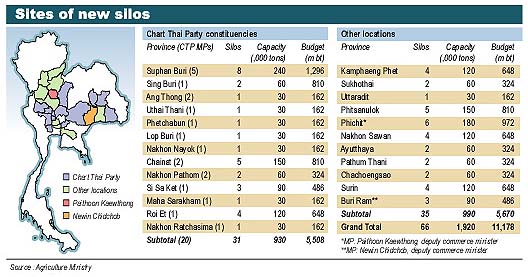
Questions are emerging over plans to spend 11.6 billion baht on paddy silos as more than half the proposed sites are in Chart Thai Party constituencies. A senior Finance Ministry source also questioned whether the huge silos, set to mushroom before the general election, would help lift rice prices as intended.
The Agriculture Ministry plans to build a total of 66 silos in 24 provinces. Of these, 31 costing 5.5 billion baht will be located in 20 provincial strongholds of the Chart Thai Party. Suphan Buri, in particular, will have eight silos, the most of any province, costing 1.3 billion baht. Agriculture Minister Prapat Pothasuthon is a Chart Thai MP for Suphan Buri. The party's leader, Banharn Silpa-archa, and many other cabinet members in Chart Thai's quota, are also from Suphan Buri. The project was initiated by Mr Prapat shortly after he replaced Pongpol Adireksan as farm minister. The silos are to help farmers store grain and bargain for higher prices.
However, the Finance Ministry source said the true reason that planters had to sell their rice for the best immediate price was because they were heavily indebted and needed money to survive.
"With or without silos, they will have to sell their paddy quickly for whatever they can get. As we know, some farmers have to sell paddy even before it's harvested."Therefore, the silo project could become a total waste of money, he said.
The Rice Policy Committee, chaired by Deputy Prime Minister Supachai Panitchpakdi, on Tuesday approved the new project and suggested borrowing from the SAL programme for the new investment. "The silo project is new and not included in the existing projects to borrow loans from SAL. If the government wants to borrow additional funds, then it will have to conduct a feasibility study for the venture, but we doubt the feasibility of the project," the source said.
Newin Chidchob, the deputy agriculture minister, recommended that the plan be screened by the National Economic and Social Development Board first, but the Rice Policy Committee agreed to waive the procedure for this project.
Goanpote Asvinvichitr, the deputy commerce minister, was quoted as saying that he did not think the huge project would be viable and he disagreed with spending any money on it. Petipong Pungbun Na Ayutthaya, the permanent secretary for Agriculture, said there were two options. The first is to have the state-owned Marketing Organisation for Farmers supervise the project and employ a professional firm to operate the silos. The second is to allow private operators to manage the whole venture.
He said the Agriculture Ministry might ask the government to issue bonds to fund the project. Suthiporn Chirapanda, a deputy permanent secretary who will supervise the project, said the venture would break even in 10 years. The silos would offer drying services at 180 baht a ton and monthly storage fees at 50 baht a ton. The ministry projects that the silos will earn a net profit of 1.2 billion baht to 1.5 billion baht a year.
Under the Chart Thai-initiated proposal, approved last month by the Rice Policy Committee, huge silos will be built at 66 sites in 24 provinces. Half of the planned silos, to cost 5.5 billion baht, are in Chart Thai party constituencies.
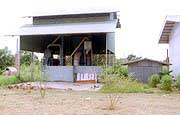 |
| One of the silos in Suphan Buri which has never been used. _ NIBHON KANANURAK |
Suphan Buri, the home-base of Chart Thai, will get eight new silos, the largest number of any provinces, at a cost of 1.3 billion baht.
In 1997, the Agriculture Ministry spent 15 million baht building silos with a storage capacity of 500 tonnes each for four farmers groups, in the hope they would help raise rice prices.
Today, paddy prices are still falling and three of the silos, intended to help farmers store grain and bargain for higher prices, have barely been used. The Krasiew farmers group in Sam Chuk district was forced to shut down the storage facility, equipped with a grain-drier, after drying only 5,000 tonnes of paddy rice. They could not afford the electricity and fuel bills: an hour's operation consumed 100 litres of oil and power, at a cost of 10,000 baht.
The Bang Kung farmers group in Muang district never had a chance to start up their grain-drying machine. They did not know where to find 300,000 baht to finance installation of power cables and other essential equipment. The Bang Plama farmers group in Bang Plama district was caught in a dispute over who should shoulder the operational costs. And even if they want to operate the grain-drier, they cannot-the motor has been stolen. The Yan Yao farmers group in Sam Chuk district suffered a similar fate. The drying machine was already defective when it was delivered. To date, no official transfer has been made.
Arb Thepsathit, of the Krasiew farmers group, said the Agriculture Ministry never asked if they needed the silo. "We accepted it simply because it was free. We were not aware of the high running costs," he said.
Problems arose as soon as the machine began operating. At first the group collected a 520-baht fee from each member to get things going
But after seeing the electricity and fuel bills, they decided to shut down the silo for good. "Had we continued using the silo we would have just accumulated more debt," he said. In principle, Mr Arb believes, silos are fine. In reality, they are ineffective and impractical.Rice planters are cold to the recent proposal because it does not fit their needs. "No farmer wants to store grain because it means additional expense. They all want to sell their produce for whatever they can get. They have to pay off debts," Mr Arb said.
Chamuay Amphet, of Bang Kung, said: "The longer the paddy is stored, the more expense farmers have to shoulder. Although the best immediate price is still low, at least they get cash. "Neither man could see any good eventuating from the latest silo project if it offers nothing more. The state must provide mills, transportation services and have a management team and adequate funding, they said."Silos should purchase rice from farmers and have their own mills. Without these it will make no difference. The price intervention scheme never works because it comes too late. By the time it is adopted the produce is already with the middlemen. The money ends up in their pockets," Mr Arb said.
Phayom Khanthong, of Sam Chuk district, scoffed at the silo project. "Are they joking? People who want to build silos don't know anything about farmers' lives. We are living on loans. Who can wait for prices to go up while the interest is piling up every day?" she said. If the state was sincere in helping farmers, it would help them cut production costs by lowering the price of fertiliser, insecticides and fuel. "Even though the paddy price is not so good, we can still survive. We should not be left to meet high production costs like this," she said.
Wan Lukfak, of Nong Ya Sai, said he demolished a 50-year-old barn and turned it into a stable instead. "I grow rice three times a year. I don't have time to dry the grain and store it. It is more convenient to sell it after harvesting. The whole process takes one day," he said.
Prayut Maprajan, of Ban Don in Uthong district, doubted the practicality of the project-and the state's understanding of rice farming as a business. "I wonder if the government knows how to sell paddy rice. It can't control the market and the prices at all," he said. Helping farmers reduce farm production costs would seem a better solution. Production costs for rice were currently 3,500-3,700 baht per tonne. The rice price should be at least 4,000 baht a tonne if farmers were to survive.
Decha Siripat, an NGO worker, said the project was of no use to farmers and was more likely to benefit middlemen and corrupt officials. "All measures so far have benefited these people, anyway. If this project fails, who will be responsible?" he said. He suggested that farmers change their way of farming rice and stick to the self-sufficiency principle. "It needs a big change. The government must first clear farmers' debts, so they can start all over again. In the end farmers might not get rich but at least they won't be heavily in debt," he said.
With four unused silos in this province already, the Agriculture Ministry seems headed for another mistake. The 15-million-baht spent on the four silos has proved to be a waste. And now the huge sum of 11.6 billion baht could evaporate, simply because of the government's ignorance.
Building huge paddy silos is the easiest part of the plan to support rice growers. Operating the silos effectively to make the most profit from fluctuations in paddy and rice prices is the real challenge. On that point industry experts agree, even if they differ on the merits of the government's plan to spend 11.69 billion baht to erect 67 silos nationwide. They are worried about the capability of state agencies to manage the project. As well, there are risks if co-operatives are not provided with training in storage techniques and financial planning.
For starters, silo operators need to know how best to store paddy to prevent decomposition and losses. Then there's the question of how much to buy each day and when to sell it. Chatchawal Chompoodaeng, director of the Marketing Organisation for Farmers, one of the two state agencies likely to oversee the project, is unsure if the government will finally allow his agency a management role. The other state agency slated for involvement is the Public Warehouse Organisation.
He notes that there are other business models to choose from, such as joint ventures with private companies or hiring professional managers. "If our agency gets the job, we'll have to recruit more staff and train them," he said. Mr Chatchawal said that no state agencies had experience in running paddy silos, adding that his agency had operated only five small maize silos. His comments cast doubt on whether the agency could match the capabilities of private rice trading companies such as Chia Meng Co in Nakhon Ratchasima. Since 1993, Chia Meng, one of the biggest rice millers and exporters, has managed 18 paddy silos, each of 2,500 tons, giving a total storage capacity of 45,000 tons.
Prapis Manathanya, the managing director, said that efficient operation required early planning. First, a silo operator would have to choose between silos made of steel or cement, each of which had its own advantages. Silos made of cement would have a longer life of about 20 years but would take longer to build. As well, in the first year, the high moisture content of cement would be absorbed by the grain, lowering quality and price.
Chia Meng opted for thick steel structures imported from the United States for 190 million baht. Construction was completed quickly and the silos were expected to have a life of 15 to 20 years, Ms Prapis said. However, steel silos required constant care because of Thailand's tropical climate. Wide variations in temperature between day and night caused condensation that could damage the crop. The company uses 12 thermometers to monitor fluctuations and climate control to regulate temperature and humidity.
The size of the silo is also important. Ms Prapis said this was determined by calculating future supply and demand. As Chia Meng needed about 15,000 tons paddy per month and enough stock for three months, it built total storage for 45,000 tons. Each silo requires a grain-dryer that ensures paddy retains an appropriate moisture content of 14-15%.
Silo operators must know how much paddy can be accepted and processed each day. Wet paddy must be dried within three days, otherwise it will spoil and be suitable only for making parboiled rice. Damrong Boonuthit, general manger of Chia Meng's plant, said the operation was highly efficient because there was no waste. As well, Chia Meng has its own power plant fueled by paddy husks. The electricity heats the boiler, producing steam for drying paddy. The ash from the husks is exported to Germany as insulating material. Ms Prapis said that steam-drying restored the aroma of fragrant rice. Chia Meng annual exports of high quality fragrant rice total about 200,000 tons, earning five billion baht.
An efficient rice mill is another prerequisite for success. Chia Meng's mill can process 600 tons of paddy per day and operates around the clock except for 15 days in the second half of September when it is closed for annual maintenance. The company is building another mill with the same capacity for completion in September.
Ms Prapis said that honest employees were crucial in the purchasing division because misreporting of rice strains and moisture content would damage the business. If rice strains were incorrectly classified, or wrongly blended, customers would reject shipments. Chia Meng used international standards and had separated its purchasing, loading, quality inspection and payment divisions to minimise risks. The company recorded where paddy from each supplier had been stored in order to trace rice in the event of rejection by customers.
Ms Prapis said private operators could regulate the flow of paddy by telling suppliers how much could be accepted on any given day. The situation facing state agencies could be different under the government's project, she warned, asking how they could refuse to accept supplies if farmers turned up and dumped paddy outside the silos. Ms Prapis said Chia Meng was willing to help train managers and staff for the state-sponsored project but would not operate any of the planned silos as it was already overloaded with business.
If the government wanted the project to be successful, it should hire private managers and act only as an internal auditor, she said.
Meanwhile, C.P. chairman Dhanin Chearavanont and Agriculture Minister Prapat Pothasuthon discussed solutions to falling commodity prices and the silo project was among the proposals, according to a minister official.
When the ministry decided to build 67 silos nationwide, CP supplies farm
machinery including rice milling machine and dryers.
Silo project is a loser, says board
National panel finds project is not feasible
Chatrudee Theparat and Phusadee Arunmat
Bangkok Post, August 8-9, 2000
In a unanimous decision, the National Economic and Social Development Board yesterday rejected the 10.8-billion-baht paddy silo project of Prapat Pothasuthon, the deputy agriculture minister. The board said the government lacked management skills and the project would end up loss-ridden. The board, chaired by Sippanondha Ketudat, considered the project yesterday, after the cabinet had sought comments from agencies concerned as to whether the country should commit itself to the huge spending proposed by the Agriculture and Co-operatives Ministry.
Board secretary-general Sansern Wongcha-um said the board was in total agreement it would tell the cabinet that it was against the project. The main aspect which led to doubts over the project was the proposal that the Marketing Organisation for Farmers (MOF), a state enterprise under the jurisdiction of the Agriculture Ministry, would manage the silos. The board also saw no reason why the government should have to intervene in the rice market, in which the private sector should be taking the leading role, he said.
"The board has a solution for this issue: the private sector should operate the business. If the state wants to take part, it should be the sponsor who supports farmers' organisations or co-operatives to operate [the silos] by themselves. The government may lend to them. This will help build up strong self-reliance among farmers," he said.
Social thinker Dr Prawes Wasi, who is also a member of the national development board, pointed out that the government would be taking a huge risk if it invested in the paddy silo project. Dr Prawes said it would be feasible to encourage agricultural co-operatives and farmers' groups to run silos. Farmers' co-operatives in the northeastern province of Surin had shown they can produce export-quality goods, he said.
A source at yesterday's meeting said the board was not convinced by the project to build 66 paddy silos in 26 provinces, because it did not believe the government could run the silos profitably. "Even representatives of the Agriculture Ministry admitted at the meeting that they doubted whether state personnel would be able to operate the silos efficiently. They said such staff would have to be trained first," the source said.
Chalongpop Susangkarn, president of the Thailand Development Research Institute and member of the board, warned the meeting that the project was unfeasible. "Other board members agreed with him that the MOF was not capable enough to ensure efficient operation of the silos," the source said.
Also, ministry representatives were unable to reply to a query from Chaiwat Wongwatanasart, secretary-general of the Council of State, as to how the new silos would raise the paddy price by 10% as proposed.
Meanwhile, Suthiporn Chiraphan, deputy permanent secretary of the Agriculture Ministry and head of the silo project, insisted after the meeting that his ministry needed to implement the project and that it was feasible. He warned that scaling down the project would make it risky because it would have to function with other projects such as the government's rice mortgage scheme.
The agriculture minister yesterday brushed off the National Economic and Social Development Board's veto of his 10.8-billion-baht silo project. Prapat Pothasuthorn said he doubted the board was familiar with a silo and offered to take its members on a field trip to give them an idea. The Chat Thai MP for Suphan Buri stood by his conviction that the project would be the best way to help farmers secure higher prices, and challenged the board to come up with a better alternative.
The cabinet had earlier considered the project but referred it to the board, with Prime Minister Chuan Leekpai remarking that it appeared unnecessary and was far too costly. The Project, initially approved by the Rice Policy Committee, involves building 67 silos in 25 provinces at 10.8 billion baht, plus another one billion baht for the Public Warehouse Organisation to build a godown. Supachai Panitchpakdi, the deputy premier, who chairs the rice committee, was in support of the board's view.
Go back to the Main Page