
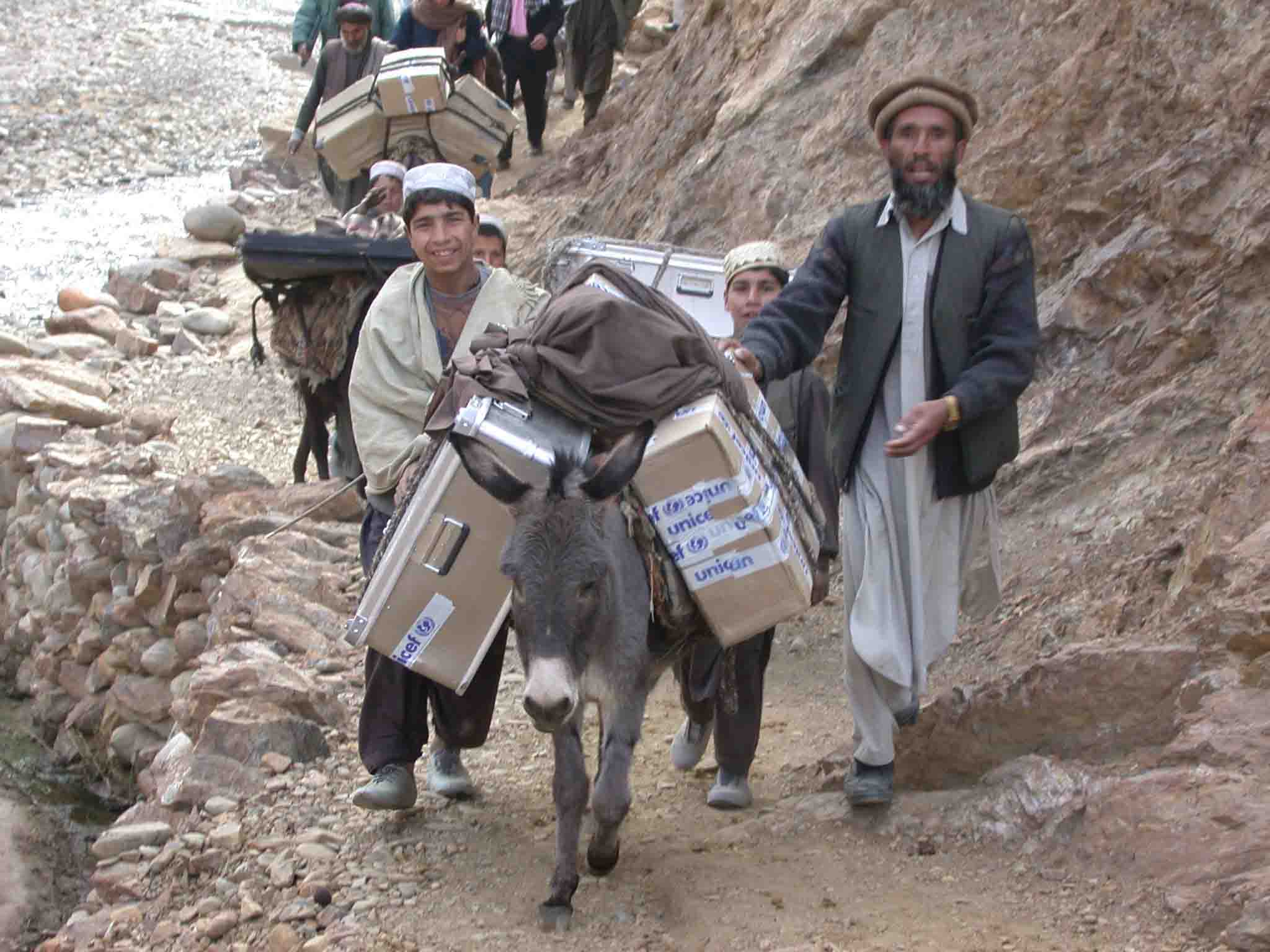
For the Kuchi communities, the chance of a better future for their children is clearly one of the driving forces behind their desire for decent schooling in their villages. At first they did not see how sending children to school could be of any benefit to an ethnic group rooted in its nomadic, pastoral history. But slowly community leaders began to come around to a new way of thinking; they saw the range of subjects that could be taught, saw that quality materials would be provided. In Namokab, the villagers voted with their bare hands � they built their school themselves.
Today�s donkey convoy is loaded with UNICEF Schools-in-a-Box, text books, chalkboards, school bags and recreational materials. The journey is a three hour trek along a path that at times narrows so much that the team has to fall into single file. In a few weeks� time, if the expected snowfalls materialise, this path may become impassable. This is perhaps the last chance to get the supplies into Namokab, to ensure that education takes place before the villagers prepare to move south again for the summer. For the March 2002 new term, UNICEF supported the distribution of supplies for some 1.8 million primary school children here in Afghanistan; for the winter term in southern and eastern provinces supplies were made ready for an additional 1.3 million children. In March 2003, this ongoing logistical exercise in partnership with the Afghan Ministry of Education will aim to meet the needs of a total 4 million pupils.
As the cluster of stone houses comes into view, a crowd of village elders gathers on the path, forming a welcoming committee that leads to the door of the school house. In the first of the five classrooms a group of twenty girls are seated, their bright dresses of red, pink and purple creating a splash of colour amongst the greyness of the mountain rock. This is the first year that Namokab has sent its girls to school, and this class will be the first to receive the new supplies. Each school bag is filled with pens, exercise books, pencils, erasers, rulers, slates and a set of text books � this class will be studying Pashtu language and Mathematics in its first year. The importance of the occasion is underlined by a solemn distribution of the bags to each pupil, each passing over of the materials accompanied by a short speech by Abul Rahimi, congratulating every girl on starting their education. But once the distribution is over, and the girls� initial shyness begins to diminish, chattering breaks out as the children begin to examine their new possessions. Educational materials are treated as prized possessions amongst Afghan children. In the classroom next door, where the older boys received items from UNICEF in March, textbooks have been covered with the cardboard from cartons of soap powder to protect them. Plastic bags, issued to children from the School-in-a-Box, look as good as new despite being carried with the children during their months on the road.
Fatima is seven years old, and is starting school for the first time today. She wanted to go last year with her brothers, but there were no books for her to study from.
�How could I go and learn ? There was nothing to learn. Now I hope to learn many things in the school.�
For her, interestingly, the future she dreams of is not one as a Kuchi. She has her sights set on other goals. �I want to be an engineer,� she exclaim proudly. This is something one hears a lot in Kabul and other major cities of Afghanistan, but to hear this from a young Kuchi girl is something of a surprise.
After two hours in Namokab, the convoy � its donkeys now loaded with firewood for the return journey � are set to leave the village and start the long trek back to Sherak. The village men come out once more to bid their farewells. But the children are nowhere to be seen. �They are in the classrooms of course, with their new books,� laughs one of the villagers, and as the group moves off up the path once more the sound of children reading aloud drifts through the chill December air. Education has come to the nomads of Afghanistan