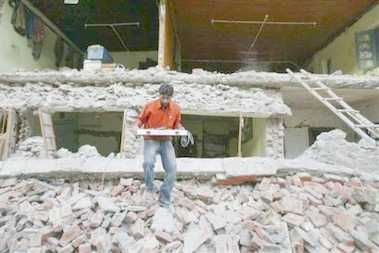
Officials in the Indian Kashmir reported at least 190 dead, including 20 soldiers who died in a landslide. At least 800 were injured and about 2,700 homes were destroyed or damaged across Jammu-Kashmir.
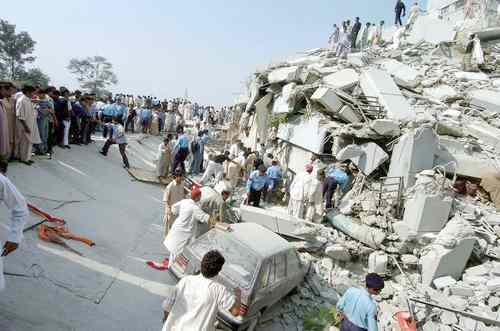
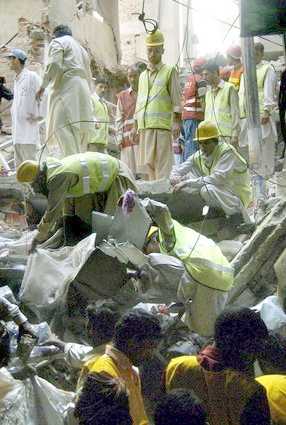
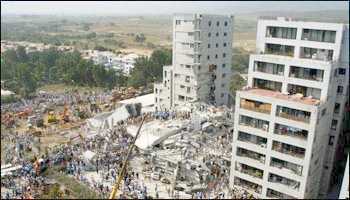
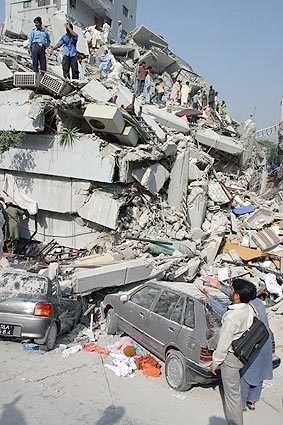
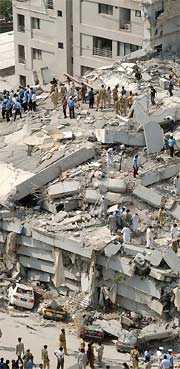
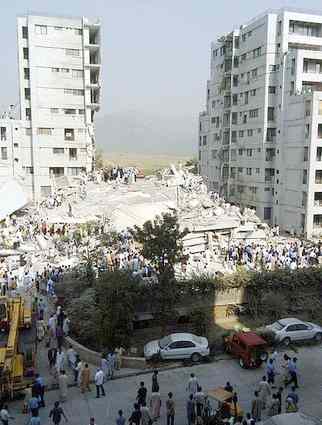
In Islamabad scores of people were feared killed or trapped when few buildings collapsed.
At least 500 are dead and more than 1,700 injured in one district of Pakistan's North West Frontier Province. A receptionist said,``After five seconds, I heard big sound, and then about 40 apartments collapsed,''.
Dozens of homes, schools, mosques and government offices were damaged in the Pakistan-controlled part of Kashmir. Pakistani President Gen. Pervez Musharraf and Prime Minister Shaukat Aziz directed federal and provincial officials to mobilize resources, ordered the military to extend all help to earthquake hit areas and appealed to the nation to stay calm. Landslides were hindering rescue efforts in some areas.
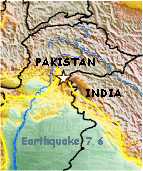
the worst hit areas were Muzaffarabad, the regional capital, and the towns of Bagh and Rawalakot. The districts of Batagram, Balakot, Mansehra, Abbottabad and Patan in northwestern Pakistan were also badly hit.
In the capitals of Pakistan, India and Afghanistan, buildings shook for about a minute. Panicked residents ran from their homes and offices. Aftershocks continued for hours afterward. Pakistan's army said the damage appeared to be extensive with a potential for massive casualties. Both countries reported scores of homes damaged, along with some schools, mosques and office buildings.
The tremor was felt in many places in northern India.
Residents in Kabul, the capital of neighbouring Afghanistan, felt the quake, fled their homes in fear of collapse.
The charity UNICEF, the world�s leading organisation working specifically for children, said it was ready to offer support as requested. We also have emergency supplies in place that can be immediately distributed. Up to 17 per cent of people in an area in Pakistan will be children under 5, and a quarter of the population is below the official poverty line.
Teams of doctors and Red Cross volunteers were traveling by road and on foot to remote areas in the mountains to provide emergency medical care.
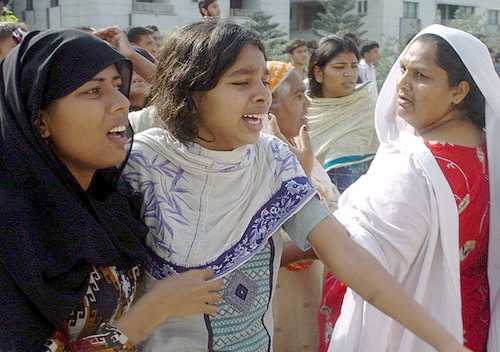
Residents sat in the open fields waiting for relief material to reach them. Most of the villagers had not eaten all day because they were observing a ritual fast during Ramadan, the Muslim month of fasting.
Large parts of Pakistan, India and Afghanistan are seismically active. The region's most severe earthquake in memory was on May 31, 1935, when a quake measuring 7.5 on the Richter scale destroyed Quetta in western Pakistan, killing between 30,000 and 60,000 people. |