Hend
My life in
Amazingly, I have been in
What better way to mark this one-month anniversary than to discuss such un-sexy topics as prices and exchange rates? I can feel your excitement through the screen!
Like my boss told me the first
time I met him, food and books in
Not all food is cheap here, though. When you go to the grocery store you see a pretty wide disparity. Vegetables are cheap. Cucumbers are like 8 rupees (20 cents) per kilogram. You can get yogurt for 15 rupees, (40 cents). Bread is cheap. So are things like rice and lentils, staples of the South Indian diet. Bananas are everywhere, about 2 rupees (5 cents) each.
But basically, everything that a Westerner
would eat is expensive, for obvious reasons. Breakfast cereal is as
expensive as or more expensive than in the
Transportation is cheap but can add up. You can go almost anywhere in the city for a dollar or less via an auto rickshaw, basically a three-wheel golf cart taxi. The bus is less than a quarter. If you want to hire a driver for the day, it’s about $10. Gas is about $4-$4.50 per gallon (so stop you’re complaining).
Like I said already, books are cheap, about ¼ to ½ what they might be in the States. I bought a big thick GRE/GMAT book for $10, and another littler book for about $2.50.
According to most people, rent has climbed dramatically
over the past few years, as people from all over the country move to
So in total, even though the exchange rate is about 40-45 Rupees/dollar, this doesn’t reflect the purchasing power of the currency here… especially if you’re hungry , in the mood for a banana, or about to take a standardized test. Adjust for that, and it seems more like 10 rupees/dollar.
……….
Today my host family’s father told me about something called vasdu, which is what he described to be the science of direction. Because of the magnetism of the poles, certain parts of the home should be pointing in certain directions… the main door, the head of the home’s bed, the kitchen, etc. There are a lot of these types of beliefs that mix religion, myth, and superstition. It’s not clear to me whether or not people really believe these things, or to what degree. It’s possible that some of them are just seen as colorful myths for entertainment (similar to Step on a crack, break your momma’s back for Americans). As one example, books are treated with great respect, which is pretty understandable. But one thing I heard recently is that you should never put a book on the floor because the earth sucks the knowledge downwards.
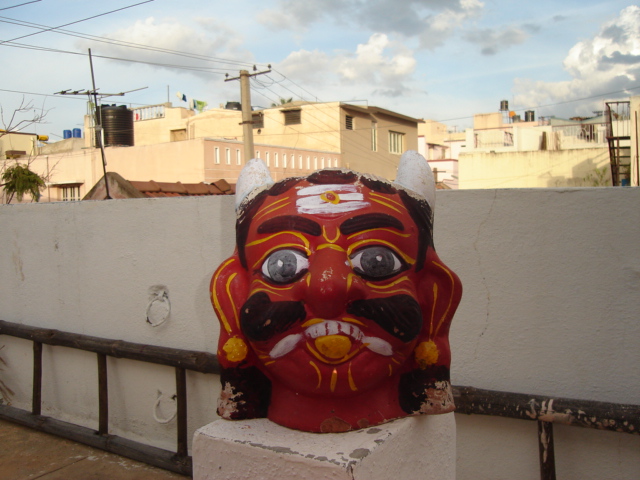
Also, a lot of houses in my neighborhood have these ugly statue heads, usually about a foot tall. According to my host family’s son, the belief is that this character reflects jealousy back on those passing by and looking enviously at the house.
Similarly, some families have a small statue of a smiling Buddha facing the entrance to the house. This is to attract wealth to the home.